
Japan Airlines began testing humanoid robots for ground operations at Tokyo’s Haneda Airport in May 2026, partnering with GMO AI & Robotics to trial machines for baggage loading and cabin cleaning in a two-year program running through 2028. The robots are produced by China’s Unitree — the same company whose humanoid machines have been demonstrated across manufacturing and logistics contexts globally. Haneda alone handles over 60 million passengers annually, and the pressure on ground operations has reached a point where automation is less a strategic preference than a structural necessity. JAL frames the project around reducing the physical burden on employees. The longer view is harder to frame that charitably.
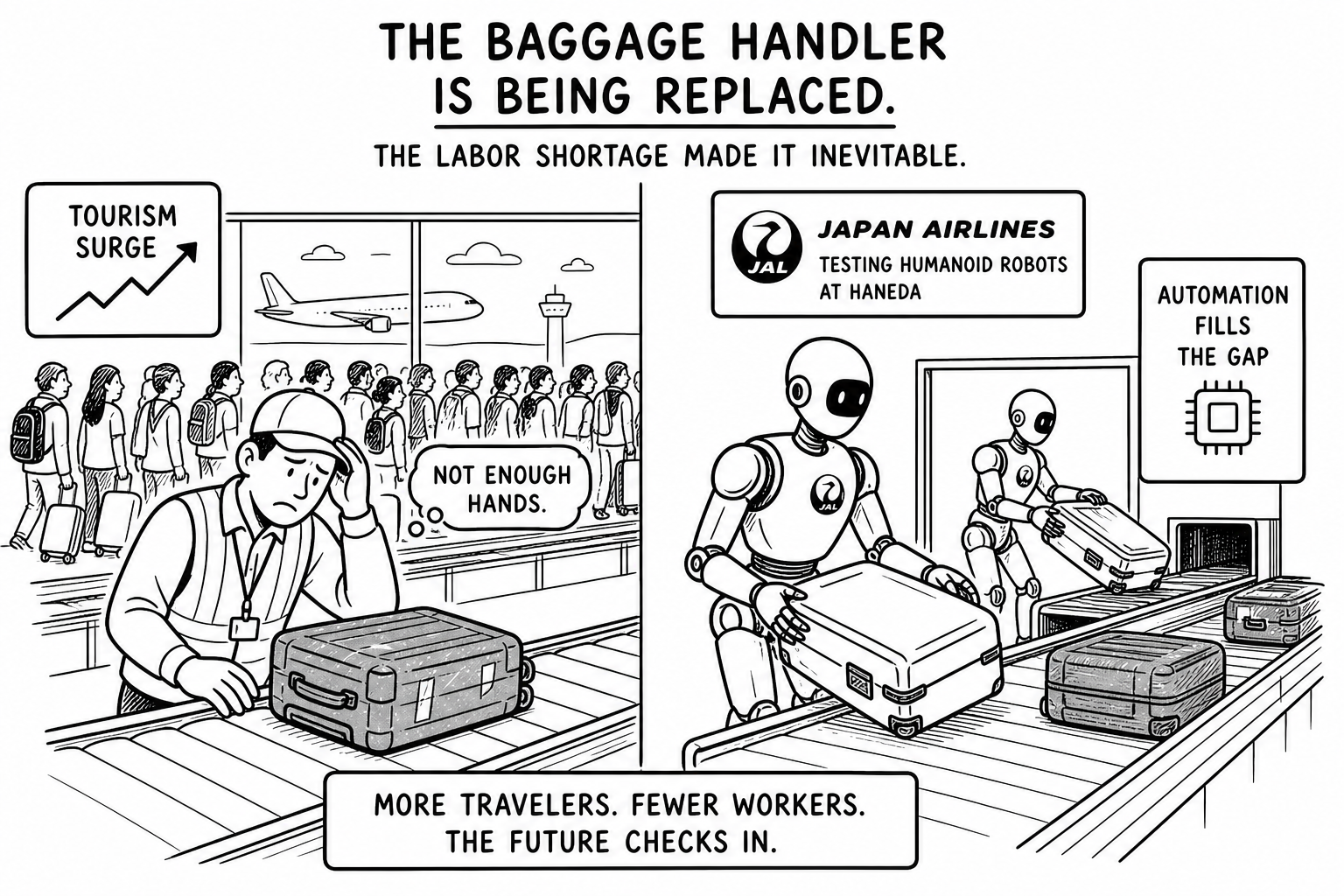
The labor context is specific. Japan may need more than 6.5 million foreign workers by 2040 to sustain economic growth, but immigration constraints and political debates limit how quickly that gap can be filled. More than 7 million international visitors arrived in Japan in the first two months of 2026 alone, following a record 42.7 million in 2025 — tourism demand expanding at a pace the domestic workforce cannot match. JAL has already moved to redistribute that demand through its free domestic flight program for international travelers, designed to redirect tourists away from overcrowded major hubs toward regional airports — an intervention that manages where people go. The robot trial manages what happens when they arrive. Both moves are answers to the same structural equation, and neither resolves it alone.
The market behind this trial is significant. Barclays estimates the physical AI industry — currently valued at $2 billion to $3 billion — could grow to as much as $1.4 trillion by 2035. The global airport robots sector is forecast to grow at 16.6% compounded annually through 2035. Singapore Changi is already integrating autonomous baggage tractors end to end. Schiphol is testing autonomous baggage tractor integration. Frankfurt’s AI-enabled security scanners shortened checkpoint wait times while holding staffing flat. Japan’s trial is not an outlier. It is the latest entry in a sector-wide recalibration of what airport ground operations require and who — or what — delivers it.
The labor question is the one the industry is not asking loudly enough. Ground handling is physically demanding, shift-based, and chronically understaffed — conditions that make it an obvious early target for automation. The workers doing this work are not knowledge workers whose roles require years of institutional context to replace. They are people performing repeatable physical tasks in constrained environments, which is precisely the category of work that physical AI is designed to absorb first. JAL says the robots are there to reduce burden. They are also there to answer what happens when the workforce needed to carry that burden is no longer available — and to establish whether machines can carry it instead before the question becomes unavoidable.