
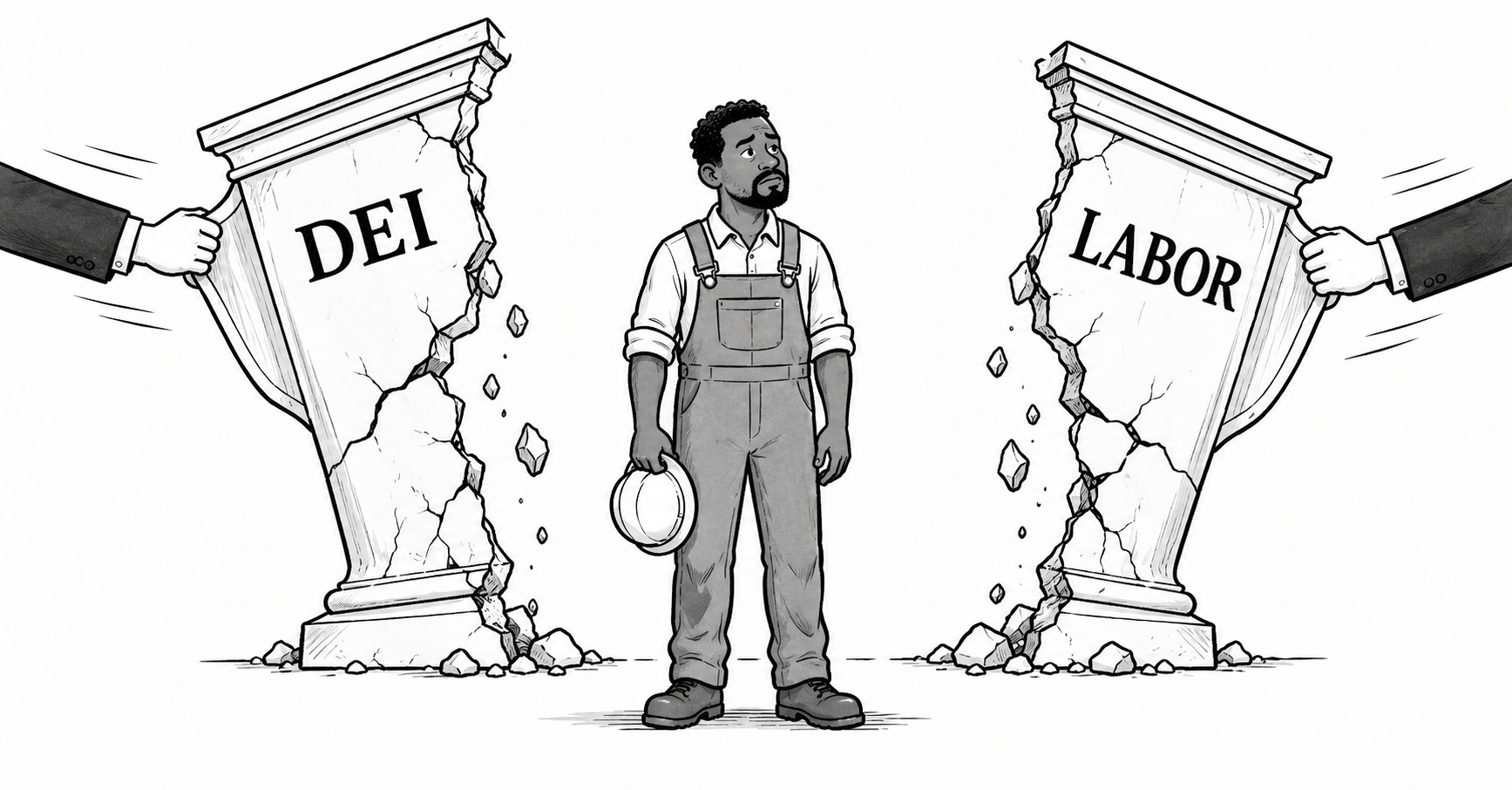
The Attack on DEI Could Leave Black Workers With Less Protection and Less Power

The national debate over diversity, equity and inclusion is usually framed around hiring goals, training programs, corporate language and public commitments. The discussion often centers on whether particular programs treat individuals fairly or whether they constitute preferential treatment. A more structural analysis reveals a different and more consequential concern: anti-DEI policies are advancing simultaneously with efforts that could weaken organized labor and collective worker power, potentially leaving Black workers with fewer institutional protections on both fronts.
Texas A&M University law professor Michael Z. Green examines that intersection in recent legal scholarship titled “Black Labor Matters.” Green argues that federal actions and corporate responses to anti-DEI pressure create particular vulnerabilities for Black employees—especially when paired with policies that weaken unions and collective-worker power. The analysis challenges the assumption that reducing or eliminating diversity initiatives affects all workers equally. It does not.
DEI programs and labor unions do not perform identical functions. Inclusion initiatives typically focus on recruitment, promotion, mentorship, workplace culture and demographic accountability. They operate primarily through individual advancement and organizational culture change. Unions negotiate wages, benefits, discipline procedures and working conditions. They operate primarily through collective bargaining and institutional power-sharing with management. But both can create institutional mechanisms through which employees—particularly those with less individual power—challenge unequal treatment.
The distinction matters when institutions weaken. When one structure weakens, the other becomes more important as a check on employer discretion. A Black employee who loses access to an internal equity office might still have a union representative, a grievance procedure or a collective-bargaining agreement that protects against arbitrary termination or wage discrimination. A nonunion employee might depend more heavily on HR systems, demographic reporting, federal enforcement and the personal courage required to file an individual discrimination complaint. Weakening both simultaneously leaves more disputes to individual workers who often have less information, fewer resources and less organizational power than their employers.
The economic stakes are not abstract. Black workers have historically experienced higher unemployment rates, lower average wages and less accumulated wealth than white workers. Educational credentials matter, but they do not fully eliminate wage gaps or employment disparities. Black workers are also disproportionately represented in some public-sector and unionized occupations. Changes to federal employment policy, federal contracting requirements and labor policy can therefore produce uneven effects even when written in race-neutral language.
Green’s analysis challenges the idea that anti-DEI measures merely remove preferential treatment or “restore merit-based hiring.” The practical issue is which institutions remain capable of identifying discrimination, protecting complainants and correcting unequal outcomes. If demographic data disappears, equity offices close, collective-bargaining rights weaken and federal enforcement resources decline, formal legal rights may remain while the mechanisms used to enforce them deteriorate. A worker still has the right not to be discriminated against, but fewer mechanisms exist to prove discrimination occurred or to compel remedies.
The parallel weakening of DEI and labor power is not accidental. Critics of both initiatives have mobilized similar arguments about economic efficiency and individual merit. Opponents of union power argue that collective bargaining reduces business flexibility and economic growth. Opponents of DEI argue that diversity initiatives reduce meritocratic hiring. Both arguments frame collective protections as economically inefficient. Both suggest that individuals should succeed or fail based on unmediated market competition rather than institutional support.
That framing obscures distributional questions. Markets do not operate from neutral starting points. They inherit historical patterns, family wealth, social networks and institutional bias. In a market without any institutional protections—neither union power nor diversity initiatives nor regulatory oversight—outcomes reflect existing inequalities amplified rather than interrupted. Black workers entering such a market inherit disadvantages that markets themselves do not eliminate.
Green’s scholarship also examines how different forms of worker protection interact. When federal enforcement of civil-rights law was the primary protection available to Black workers, individual complaints and class actions provided important remedies. When collective-bargaining agreements existed but federal anti-discrimination law was weaker, union grievance procedures provided protection. When both existed—which was broadly true for unionized Black workers in the latter twentieth century—they provided complementary protections. Weakening both leaves fewer alternatives.
The current moment presents a particular risk. Unionization rates among Black workers have declined along with overall unionization. Federal enforcement resources have fluctuated. Demographic reporting is under attack. Corporate equity initiatives are being scaled back or renamed. Taken individually, each change might be manageable. Taken together, they create a governance structure with fewer mechanisms for identifying discrimination or protecting workers who face it.
The argument is not that DEI initiatives should be preserved because labor protections are weakening. That would reverse the direction of inquiry. The argument is that policymakers and corporate leaders should recognize what they are disassembling and consider the consequences. If society decides that diversity initiatives should be eliminated, scaled back or restructured, that decision has concrete effects on specific workers—particularly those who have historically faced employment discrimination and have fewer individual resources to challenge it.
The analysis also raises questions about the alternatives corporations claim to be adopting. Some organizations assert that eliminating diversity initiatives will improve meritocratic hiring. Others suggest that they will replace diversity work with individual performance management and opportunity for anyone to advance based on qualifications. Those alternatives might work if they are implemented with genuine commitment to identifying and preventing bias. They are less effective if they simply remove institutional oversight while leaving unconscious bias, network advantage and historical inequalities to operate uninterrupted.
Green’s scholarship does not argue against scrutinizing particular diversity programs or reforming those that do not work well. It does argue for recognizing what is being traded away when institutions weaken their capacity to identify and correct inequality. The next phase of the DEI debate will not be defined only by which programs are renamed or eliminated. It will be measured by whether workers—particularly Black workers and others facing historical employment discrimination—still possess enough information, representation and institutional power to defend the employment rights that remain.