
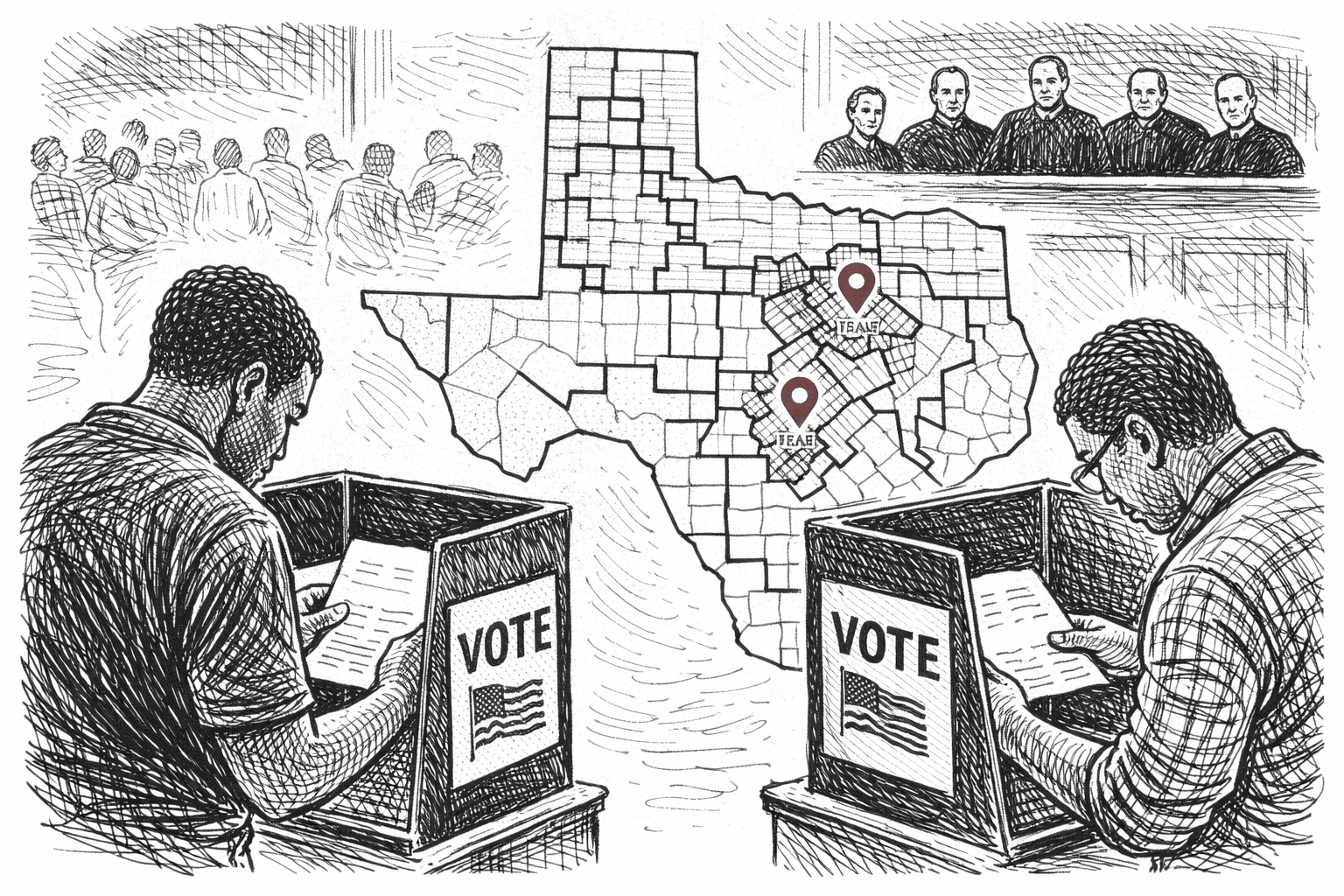
Texas Republicans redrew the state’s congressional map in August 2025 — not after a census, not because population shifts required it, but because Donald Trump wanted more Republican seats heading into the 2026 midterms. A federal three-judge panel reviewed the maps and found what civil rights groups had argued from the start: the redraw was a racial gerrymander, designed to dismantle districts where Black and Latino voters had successfully elected their candidates for decades.
The court struck the maps down. Then the Supreme Court stepped in.
Using its shadow docket — an emergency procedural mechanism increasingly deployed to bypass full review — the Court allowed the discriminatory maps to remain in place for 2026. The result is that Black and Latino communities in Texas are on track to experience the first legislatively enacted reduction in their electoral power since the Voting Rights Act passed in 1965. In a state that is only 40% white, white voters currently control over 73% of congressional seats. The new maps make that imbalance worse.
The NAACP and the Lawyers’ Committee for Civil Rights Under Law have called the maps unconstitutional, arguing Texas engaged in racial gerrymandering to prevent Black voters from electing candidates of their choice. The Trump administration’s Justice Department had pressured Texas to redraw the maps in the first place, threatening legal action if the state did not eliminate coalition districts where Black and Hispanic voters combined to form a majority.
As SSC reported yesterday in Texas Drew New Electoral Maps Five Years Early. Now a Dozen States Are Following., what began in Texas has since triggered redistricting efforts across more than a dozen states ahead of November — compounding the threat when layered against potential restrictions on mail-in voting and new voter ID requirements moving through state legislatures. The redistricting is not isolated. It is the leading edge of a coordinated restructuring of who gets to vote, where, and with what standing.
Why This Matters Redistricting is infrastructure. It determines which communities have political leverage and which ones don’t — and that leverage shapes everything from school funding to healthcare access to how federal dollars flow. When maps are drawn to dilute Black and Brown voting power, the downstream effects reach far beyond Election Day. Texas is the front line of a national effort to reshape political representation before the 2026 midterms. The Access Shift is not only economic. It is electoral.