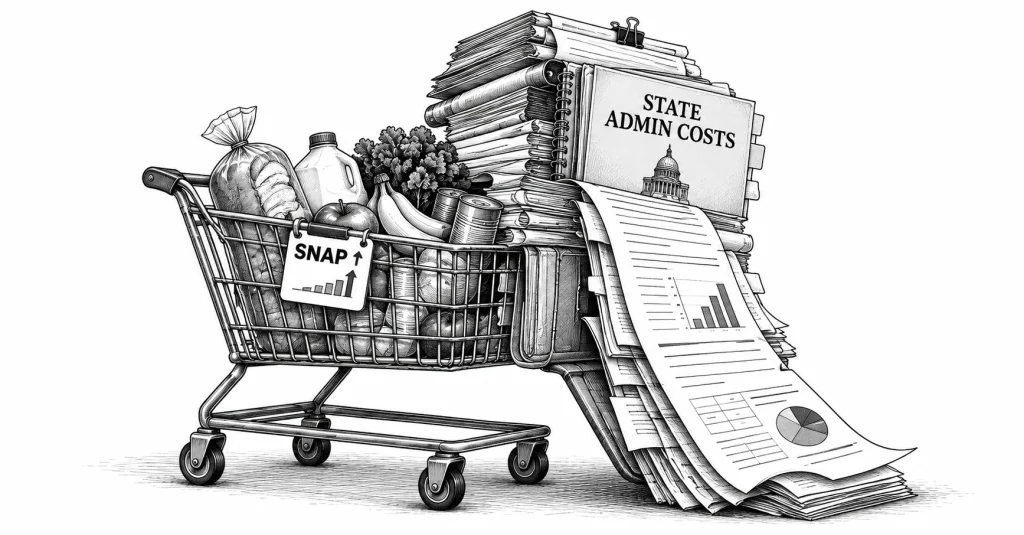
October brought a modest inflation adjustment for households and a larger administrative funding obligation for states. Those changes operate on different sides of the food-assistance system.
Maximum monthly SNAP benefits for a four-person household in the 48 contiguous states and Washington, D.C., increased from $994 to $1,023 on October 1, while the maximum for one person rose from $298 to $306, ABC News reported. These are maximum allotments, rather than amounts every participating household receives. Actual assistance depends on the household’s circumstances. The annual adjustment helps account for inflation, offering some additional purchasing power to eligible recipients. It arrives alongside a separate change that places more of the cost of administering food assistance on state governments.
The increase reaches one side of the system
For a family receiving the maximum four-person allotment, the increase is $29 a month. That can help with a grocery purchase, but it does not resolve every pressure on a food budget or guarantee continued eligibility. A benefit amount answers how much assistance a qualifying household can receive. Eligibility rules answer who qualifies, while administrative procedures determine how an application or renewal gets processed. Looking at only the new maximum leaves out the steps a household must navigate before assistance reaches its account. Those steps become particularly consequential when the agency managing them faces a changed budget.
States are now responsible for 75% of ordinary SNAP administrative costs, up from 50%, with the federal share falling to 25%, according to Ballotpedia’s October 1 accounting of state preparations. Its review found that 40 states had partially or fully appropriated funding for the increased obligation. This concerns the expense of running the program, rather than a requirement that states immediately pay 75% of recipients’ benefits. The funding change therefore belongs in a discussion of staffing, processing and administrative capacity. It should not be described as an automatic reduction in every household’s October payment.
A funding decision becomes an access question
Consider a hypothetical agency with $100 million in covered administrative expenses. Under a 50–50 split, the state contribution would be $50 million. Under the new split, it would be $75 million, assuming the same expenses and no applicable exception. The service has not become 50% larger; the state’s share of the bill has increased by that proportion. Legislators and administrators must decide how to finance the additional responsibility. They could provide more funding or seek lower operating costs, but the effect on recipients depends on the decisions made and how those decisions perform in practice.
The practical reporting questions are straightforward. Does an agency have enough staff to process applications and renewals on time? Can a recipient reach someone to correct a problem? Are notices clear enough for a household to understand what information is missing? A funding change alone does not establish that delays or errors will increase. It does make administrative performance an essential part of evaluating the policy. A family can qualify under the rules and still experience a disruption if a case is not resolved promptly. Those experiences need to be documented rather than assumed.
More changes are on a separate timetable
A further benefit-cost obligation is scheduled to begin in October 2027 for some states, linked to their payment error rates, The Associated Press reported. Payment errors concern inaccurate benefit amounts; the measure should not be casually presented as a fraud rate. That future obligation is separate from the administrative cost change that began this October. Combining them into one immediate event would obscure both the timing and the responsibility involved. Households need accurate information about their own benefits, while readers evaluating state budgets need to know which costs are already changing and which remain ahead.
The next useful measure of SNAP’s October changes will be how well states maintain access while absorbing a larger administrative bill. The benefit adjustment can be assessed through household allotments and grocery costs. The funding change should be assessed through appropriations, agency capacity and the experience of people applying or renewing. Both belong in the same story because assistance depends on an amount and a functioning delivery system. A higher maximum helps only after a household qualifies, completes the process and receives the support it is entitled to use.