The argument over immigration in Texas has always been framed as a political debate. It is becoming an economic emergency — and the people saying so most loudly are restaurant owners, farmers, and industry groups who have historically voted for the party now driving the enforcement that is draining their workforce.
Restaurant owners across Texas are breaking across traditional political lines to warn publicly that immigration crackdowns are driving away workers, raising costs, and threatening whether some businesses can continue operating at all. A recent New York Times investigation found owners in Houston, Dallas, and San Antonio describing kitchens running at reduced capacity, farms unable to bring in harvests, and supply chains straining under a labor shortage that is not cyclical — it is policy-driven and accelerating.
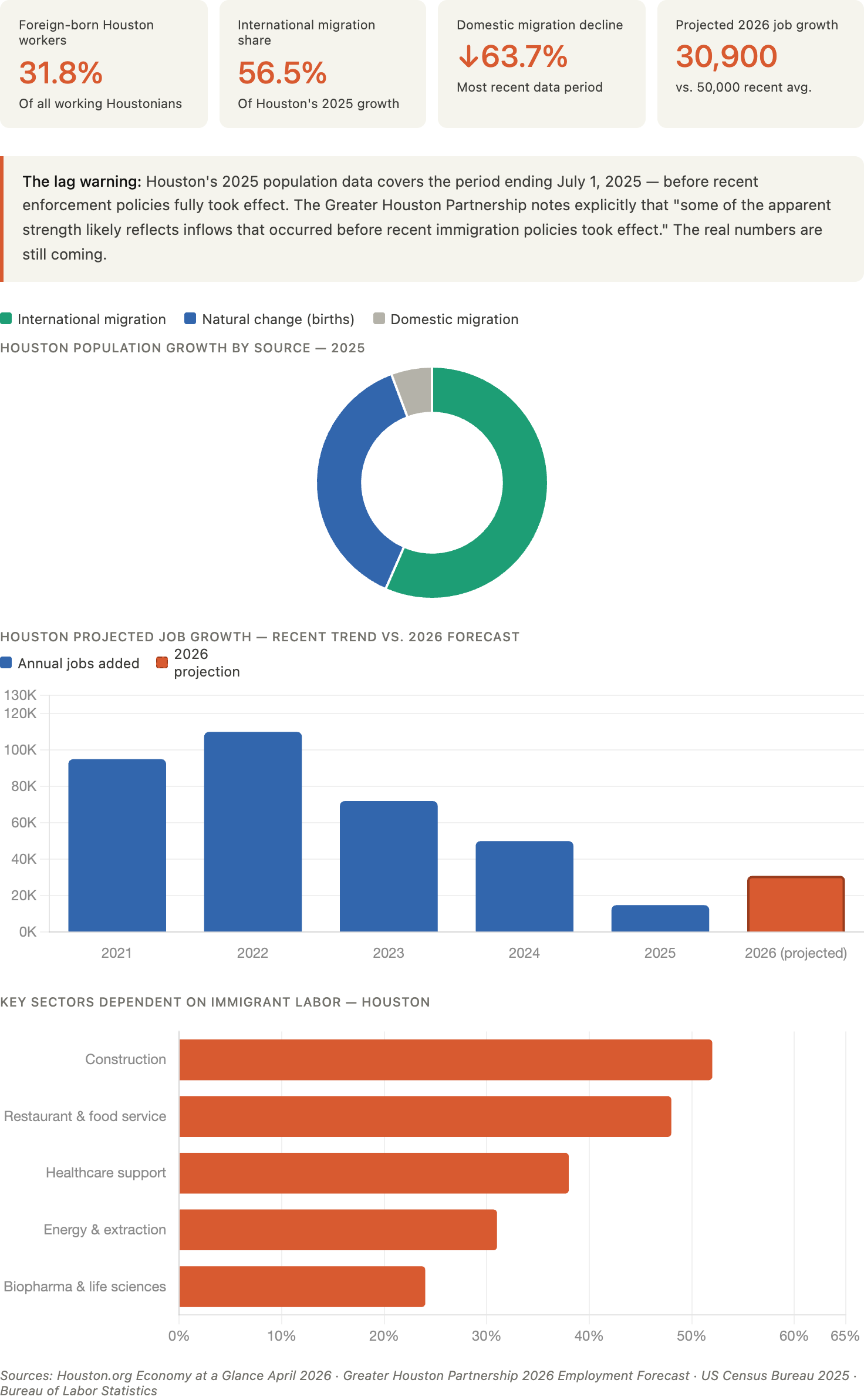
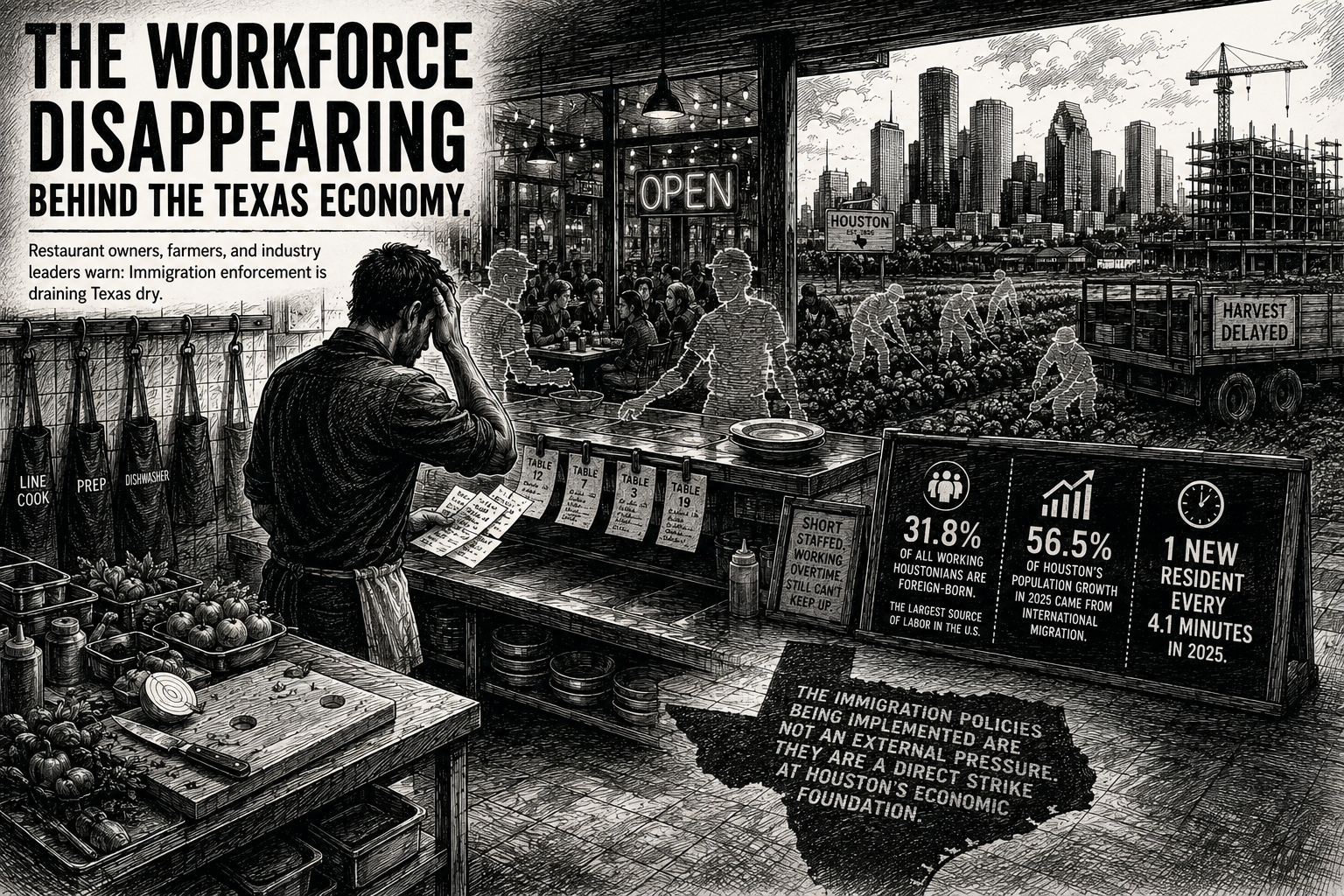
The math is not subtle. Foreign-born workers represent 31.8% of all working Houstonians — the single largest source of labor in America’s fourth-largest city. More than 56.5% of Houston’s population growth in 2025 came from international migration. The city added a new resident every 4.1 minutes last year. The immigration enforcement policies currently being implemented are not an external pressure on Houston’s economy. They are a direct strike at its foundation.
What the enforcement is actually producing
The effects are already visible in the numbers. Houston’s projected job growth for 2026 is 30,900 — significantly below the 50,000-job annual average of recent years. The Greater Houston Partnership attributes the slowdown to macroeconomic caution, but the labor force dimension is impossible to separate from that picture. Domestic migration to Houston fell 63.7% in the most recent data period. International migration — the engine that has powered Houston’s growth — fell 41.1%, with researchers noting that the true enforcement impact has not yet fully appeared in the numbers because the data covers a period before recent policies took full effect.
The restaurant industry is the most visible pressure point because it is the sector with the least ability to absorb labor shortages quietly. A kitchen that loses half its prep staff cannot maintain service levels through automation or software. The food either gets made or it doesn’t. Owners who spent years avoiding public statements on immigration politics are now speaking directly — not because their politics changed, but because the economic reality has become impossible to manage in silence.
Industry groups are pushing for work permit legislation that would create legal pathways for workers who are already in Texas and already employed. The argument is not ideological. It is operational: the workforce is here, the work needs doing, and the current policy framework is eliminating the legal mechanism that would allow both to coexist.
The broader Texas economy
Houston is not alone. The construction sector added 16,000 jobs in Houston over the last year alone — a sector that is heavily dependent on immigrant labor for everything from residential housing to the industrial and medical infrastructure that defines the Texas growth story. The Texas biopharma sector now employs over 116,000 people statewide, with job postings surging 68% year over year. The energy transition is generating massive investment in carbon capture, hydrogen, and battery storage — all of which require the same construction and technical labor force being depleted by enforcement.
Governor Abbott has threatened to pull $2.5 million in grants to Austin over the city’s ICE cooperation policies. The state is simultaneously driving enforcement that reduces the labor supply and penalizing cities that try to manage the human consequences of that enforcement. The internal contradiction is becoming visible in the quarterly numbers.
Texas built one of the most successful state economies in American history on a combination of business-friendly policy, low taxes, and an abundant, affordable workforce shaped significantly by immigration. Two of those three pillars are intact. The third is being systematically dismantled by the political coalition that built the other two.