
New polling documented by Brookings reveals a complete inversion of public approval for Donald Trump’s handling of immigration since March 2025. In March of last year, 51 percent approved of his approach while 44 percent disapproved — a net positive of seven points. By March 2026, those numbers had flipped: 43 percent approved and 52 percent disapproved, a net negative of nine points. The sixteen-point swing in the aggregate is significant. The Latino-specific shift is the structural story. Trump’s approval rating among Hispanic voters on immigration fell from 48 percent approve in March 2025 to 31 percent approve in March 2026 — a seventeen-point collapse in a single year, against a backdrop where his overall Latino approval had been one of the defining electoral narratives of the 2024 cycle.
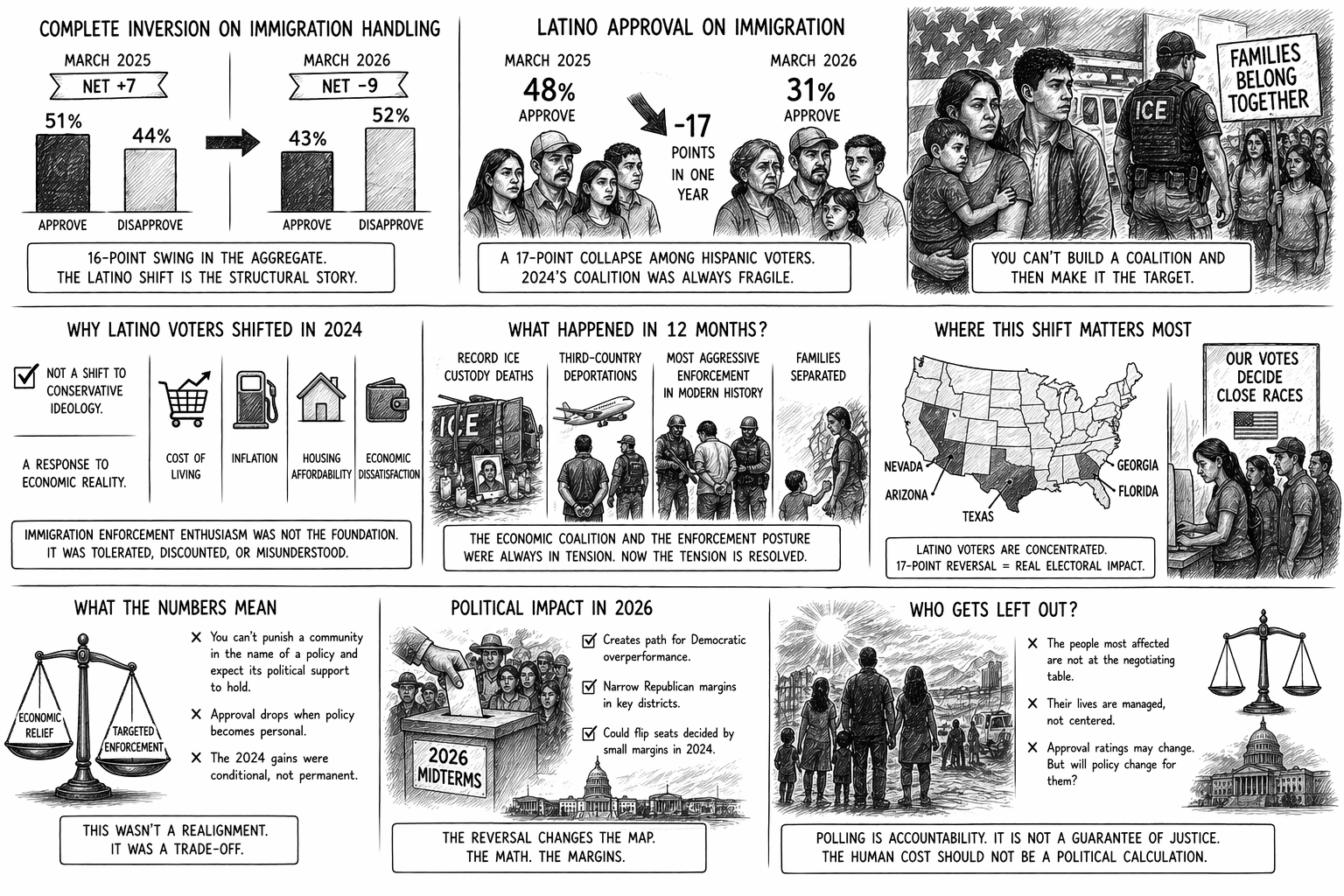
That narrative requires direct examination to understand why the collapse is not surprising. Trump’s 2024 gains among Latino voters were real — the exit polling and post-election analysis confirmed meaningful movement toward the Republican ticket in Latino-heavy precincts across multiple states. But the explanation for those gains that received the most attention — that Latino voters had shifted on cultural or ideological grounds, embracing a more conservative politics — obscured a more straightforward and more fragile explanation: Latino voters in 2024 were responding to economic conditions. Cost of living, inflation, housing affordability, and the sense that the previous administration had not delivered on economic promises were the primary drivers of the partisan shift. Immigration enforcement enthusiasm was not the coalition’s foundation. It was tolerated, or discounted, or not believed to be as aggressive as it turned out to be. The economic coalition and the enforcement posture were always in tension. Twelve months of record ICE custody deaths, third-country deportations, and the most aggressive immigration enforcement in modern American history have resolved that tension — and the polling reflects it.
The seventeen-point drop has specific geographic and political implications for the 2026 midterm cycle that the aggregate approval numbers do not capture. Latino voters are not uniformly distributed across competitive congressional districts — they are concentrated in specific markets, including Texas, Florida, Arizona, Nevada, and Georgia, where their share of the electorate is large enough to determine outcomes in close races. A seventeen-point reversal in Latino approval among a population that shifted meaningfully toward Republicans in 2024 does not simply reduce the margin of that shift — it creates the conditions for overperformance by Democratic candidates in districts where the 2024 Latino movement had narrowed their path to victory. Houston’s congressional districts, Arizona’s competitive seats, and Nevada’s Senate race are all environments where this reversal has direct electoral consequence that will become visible in November.
The Brookings analysis frames this as a potential opening for compromise — the argument that both parties have now absorbed enough political damage on immigration to consider a long-term legislative solution. That framing is optimistic in ways that the structural reality does not fully support. The communities whose lives have been most directly affected by the current enforcement posture — the families separated, the workers deported, the residents navigating daily life in environments where ICE administrative warrants create constant uncertainty — are not positioned as stakeholders in a bipartisan compromise negotiation. They are the variable being managed by a political system that is now recalculating its approach based on approval ratings rather than on the human cost of the policies producing those ratings. The polling is a political accountability mechanism. It is not a guarantee that what follows will be designed around the interests of the people the enforcement was applied to.