
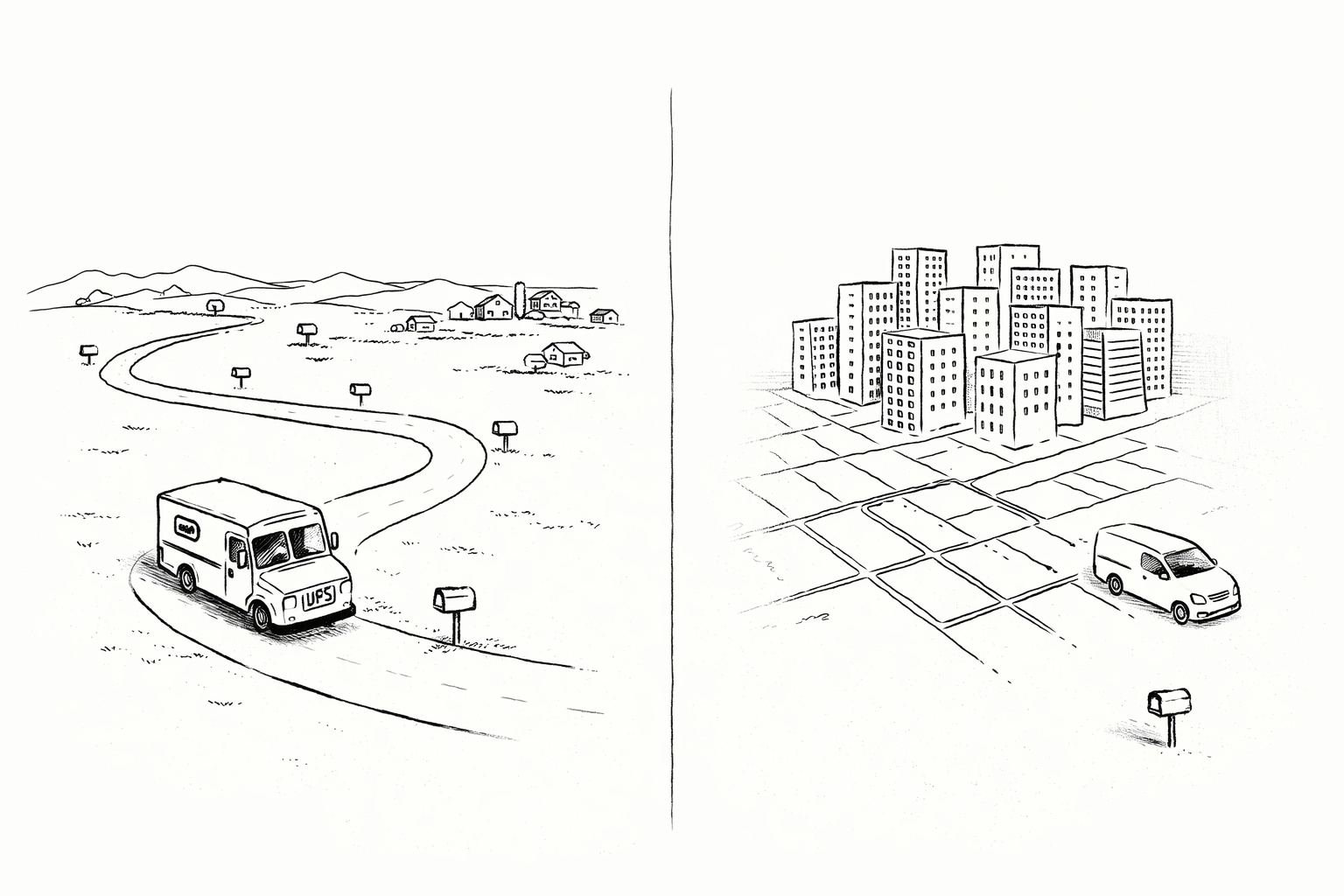
There are systems that were never supposed to turn a profit. They existed because they were necessary — because access matters more than margin, and because some things only work if they work for everyone.
The United States Postal Service was built on that logic. Not for efficiency, but for reach. It connected rural towns to cities, delivered prescriptions and ballots, and ensured that geography and income were not the deciding factors in whether you received what was sent to you. Its unofficial creed — neither snow nor rain nor heat nor gloom of night — was never really about weather. It was about a commitment to showing up regardless of conditions. That commitment is now under pressure in ways that feel different from anything before.
For many people, the mailbox carried a particular kind of meaning. Waiting on SAT scores, college acceptance letters, scholarship notices — the mailbox was a connection point between where you were and what might come next. It was infrastructure, but it was also something more personal than that. Something that showed up for you.
Today the agency is being evaluated increasingly like a business. Losses have reached roughly $9 billion in fiscal year 2024. Mail volume continues to decline. Private carriers have expanded their networks, and companies like Amazon — which once relied heavily on USPS, delivering more than a billion packages annually through the system — have spent years building their own logistics infrastructure, gradually reducing that dependence. What was a partnership is becoming competition. And private delivery, as it expands, optimizes for the same places it always has: dense, high-volume, profitable corridors. The gaps it leaves are not accidents. They are the natural result of a system designed around margin rather than reach.
This is the tension at the center of the postal service conversation. A business optimizes for efficiency. A public service optimizes for access. When one begins to operate like the other, the trade-offs become inevitable — and they fall hardest on the people who were most dependent on the original design. Routes that are less profitable become liabilities. Services that are essential but inefficient come under scrutiny. The question stops being how to deliver mail and becomes who still receives it.
The concern is not that the postal service disappears overnight. It is that it becomes something different so gradually that the change is hard to name until it’s already happened. Reduced routes. Longer delivery windows. Quiet adjustments that accumulate into a system that still technically exists but no longer functions the way the people who depend on it most were counting on.
This pattern has a history. Third spaces, public transit, local institutions — systems built for collective use, gradually reshaped by the logic of cost and efficiency until what began as optimization ended as exclusion. Once that shift happens, rebuilding access is significantly harder than maintaining it.
The conversation about the postal service is ultimately about something larger than mail. It is about whether certain parts of daily life are still treated as shared infrastructure — as things that belong to everyone by design — or whether everything, eventually, is expected to justify its existence on a balance sheet.
That is not a question about logistics. It is a question about what we still believe we owe each other.
The Access Shift
The gradual redefinition of who systems are designed to serve.
Across sectors—from public infrastructure to healthcare to everyday spaces—access is no longer assumed. As costs rise and systems face increasing pressure, services once built for broad reach are becoming more selective, more conditional, and less universal. The Access Shift explores how these changes are unfolding in real time—and what they reveal about who is included, who is left out, and how the structure of everyday life is quietly being reshaped.