
By Will Davison
A six-figure salary was once a marker of financial success. In some American housing markets, it is now the price of entry for a modest apartment.
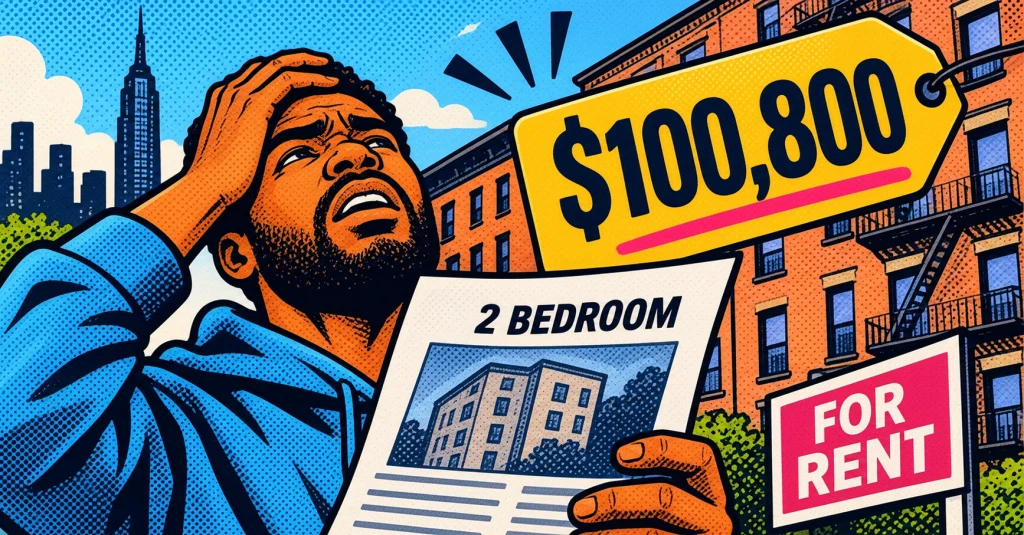
According to the National Low Income Housing Coalition’s 2026 Out of Reach report, a full-time worker in New York needs to earn $48.46 an hour, or about $100,800 a year, to afford a two-bedroom rental without spending more than 30% of gross income on housing. In the New York City area, the bar rises to $55.96 an hour, or about $116,400 a year. That is the same market where 268 affordable apartments in the Bronx will go to whoever wins a housing lottery.
The price of getting by
New York ranks fourth nationally for the hourly wage needed to afford a two-bedroom rental, behind California ($52.79), Hawaii ($49.38) and Massachusetts ($48.59). The national two-bedroom housing wage is $34.73 an hour, or about $72,240 a year, while a modest one-bedroom requires $29.19 an hour.
The typical renter is nowhere close. NLIHC found that the average renter earns $24.84 an hour, nearly $10 short of the two-bedroom benchmark, and 18 of the 25 most common occupations in the country pay median wages below it. More than 60% of all workers earn less than the two-bedroom housing wage.
The gap is widest for Black and Latino workers. NLIHC’s analysis shows their median full-time wages fall short of even the one-bedroom housing wage, by $6.97 and $6.90 an hour respectively, while the median white worker’s wage clears it.
Rethinking the middle class
The affordability squeeze no longer stops at low-income households. Workers with college degrees, established careers and salaries once associated with stability are making hard trade-offs between rent, transportation, childcare and savings.
Cities are experimenting at the margins, from Boston’s vote to stop making renters pay for parking to a New Jersey city’s $20 cap on rent increases. Those fixes move the math by dollars a month, while the gap between wages and rent is measured in tens of thousands a year.
The report’s benchmark also sets a low bar for what “affordable” means. It measures what a household must earn to keep housing at 30% of income, not what it needs to save, build wealth or absorb an emergency. For renters already behind, the margin is thinner still, as evictions set records just as the help runs out.
For generations, earning $100,000 meant you had made it. In a growing number of American communities, it now means you can cover the basics and little else.