
Boston doesn’t present as a city in decline. The numbers don’t support that narrative, and neither does the surface-level experience of moving through it. The economy remains anchored by high-wage industries, a steady pipeline of students and young professionals, and sectors — healthcare, education, life sciences — that continue to generate demand regardless of broader economic headwinds. But the signal emerging underneath that stability is more specific than the headline suggests: Boston is not struggling to grow. It is becoming more selective about who that growth still works for.
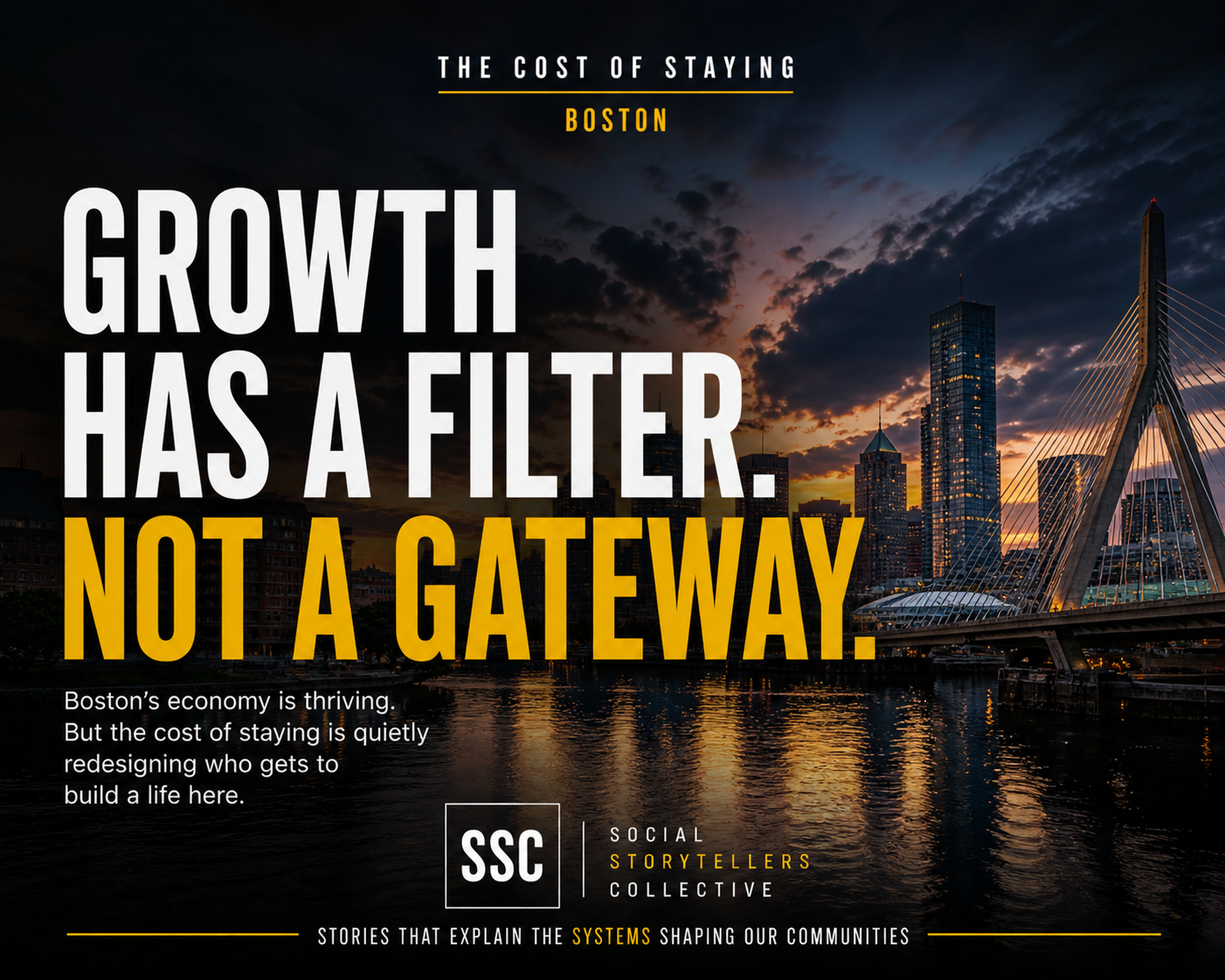
The housing market makes that shift visible first. Median home prices in Boston are approaching $800,000 — among the highest in the country — and have continued trending upward even as slight inventory increases would suggest some relief. That relief hasn’t materialized at the access level. What’s rising is not affordability. It’s the price ceiling. Rental availability has increased in parts of the metro, but availability and accessibility are not the same thing. A market with more units listed at $3,000 a month has not lowered its barrier to entry — it has simply adjusted to the upper range of what renters under pressure will absorb before leaving. The distinction matters because it shapes who stays and who doesn’t, and that calculation is already showing up in the data.
Population growth is still happening — the Boston metro added roughly 12,000 residents over the past year — but that figure tells a compressed story. The pace is notably slower than previous cycles, and the composition of who is arriving and who is leaving reflects the cost structure underneath it. The city continues to attract high earners, graduate students, and workers in its anchor industries. It is less effectively retaining the people who support those industries — the service workers, healthcare support staff, educators, and mid-income professionals for whom the math of staying in Boston has stopped working. That asymmetry doesn’t show up in a single data point. It accumulates in longer commutes, higher turnover in essential roles, and neighborhoods where the population turns over faster than community infrastructure can absorb.
What’s emerging is not contraction — it is recalibration. Boston’s economy is still producing value. The distribution of that value is becoming more concentrated. High-income sectors continue to expand while the cost structure surrounding them raises the threshold for participation at every level below the top. The city remains a center of innovation and upward mobility in the aggregate. The path into that mobility, for those who don’t arrive already positioned for it, is narrowing in ways that don’t make the headlines but reshape the city’s character over time.
That narrowing changes how Boston functions as a place. When access becomes conditional, behavior adapts accordingly. People stay for shorter periods. They commute longer distances from more affordable surrounding communities. They engage with the city in more temporary, transactional ways — extracting opportunity without being able to embed within it. Boston doesn’t lose relevance in that process. It becomes more concentrated, more specialized, and less broadly livable. The innovation economy continues. The city it sits inside becomes harder to inhabit for the people who make it run.
The signal is not that Boston is slowing down. It is that the terms of entry are being rewritten in real time — and the rewrite is not happening through policy announcement or dramatic disruption. It is happening through the accumulated weight of ordinary decisions: who can afford to renew a lease, who takes the job offer and who turns it down, who stays five years and who leaves after two. Growth continues. But the city it is producing is becoming legible only to a narrowing slice of the people who arrive looking for a place inside it.
Boston is part of City Signals, SSC’s ongoing series on what cities reveal about who they’re built for. Read the New York City, Miami and Houston installments now at socialstorytellers.substack.com. Future cities in the series include Washington D.C., Los Angeles, Dallas, Austin, and San Francisco.