THE COST OF WORK
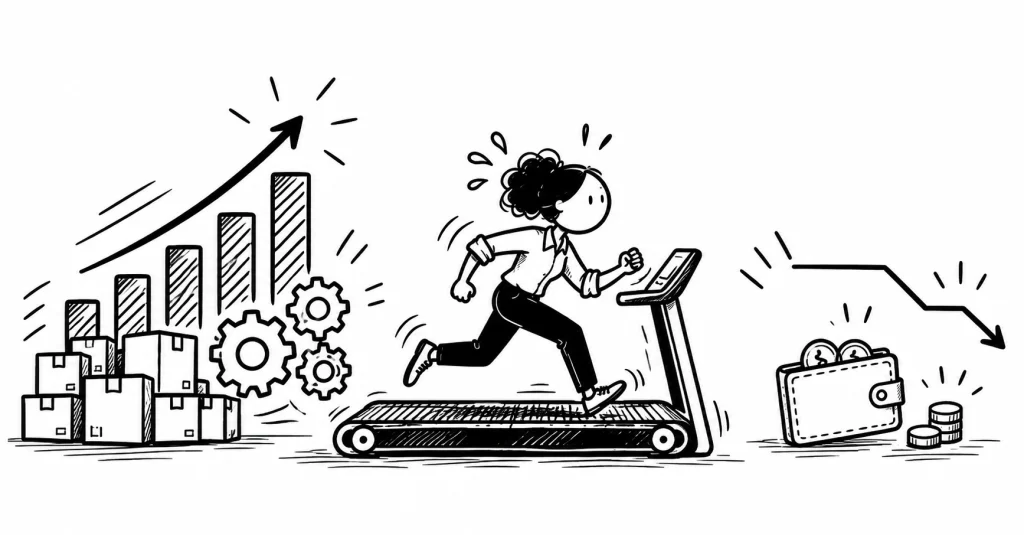
The latest federal figures show more output per hour alongside weaker inflation-adjusted compensation. Efficiency and household progress are separate measures.
Analysis | Social Storytellers Collective
Part of SSC’s reporting series examining labor pressure, workplace rules and who absorbs the cost.
U.S. nonfarm business productivity rose 2.2% year over year in the second quarter of 2026, while real hourly compensation declined 0.1%, according to the Bureau of Labor Statistics’ September 3 revised release. The figures measure different parts of the economy’s performance: productivity tracks real output per hour, while real compensation adjusts pay and benefits for consumer prices. Read together, they show that producing more per hour did not translate into an equivalent improvement in inflation-adjusted compensation over that period. For workers navigating higher expectations and the expenses surrounding employment, economic efficiency is an incomplete account of whether their position has improved.
Output and Purchasing Power Can Move Apart.
The quarterly figures reinforce the need to keep the measures separate. Productivity increased at a 1.4% annualized rate, while real hourly compensation fell at a 3.3% annualized rate. Those rates express the quarter’s movement on an annualized basis; they do not mean compensation fell 3.3% during the quarter itself. Nor do sector-wide averages describe every worker or employer. The release cannot identify who received a raise, whose duties expanded or which workplace adopted a particular technology. Its value is broader: it provides evidence that growth in output per hour and growth in workers’ purchasing power need to be examined independently rather than treated as interchangeable signs of progress.
Productivity gains can arise through better equipment, improved processes, different combinations of labor and capital, or other changes in production. They do not automatically establish that employees are working harder. They also do not prove that artificial intelligence caused the improvement. That requires evidence connecting particular changes to particular results. For SSC’s readers, the useful follow-up is closer to the workplace: what became easier, which tasks disappeared, what new responsibilities arrived and how compensation changed? A company claiming an efficiency gain should be able to describe the process behind it and the benefit workers received from participating in it.
A Faster Task Can Become a Larger Assignment.
Consider an illustrative team that uses software to reduce the time required for a recurring report. Managers could use the saved time to reduce overtime, improve quality, expand training or increase the number of reports expected. Each choice distributes the gain differently. The technology supplies an opportunity; the organization determines how that opportunity changes the job. Workers may experience meaningful relief if a bottleneck disappears. They may experience continued pressure if the old workload is immediately replaced by additional expectations. Measuring task speed alone misses the decision about what happens to the time that has been freed.
Gallup’s research on wellbeing and productivity supplies another part of the assessment. Its account of a 2018 study of nearly 7,500 U.S. full-time employees found that people experiencing frequent burnout were 63% more likely to take a sick day and 2.6 times as likely to be actively seeking another job. Those are associations from that study, not forecasts for a particular employer in 2026. They suggest why an organization should examine the sustainability of its output alongside the amount produced. A short-term gain may be difficult to retain if the conditions supporting it lead workers to withdraw or leave.
Make the Worker Benefit Visible.
Employers can put concrete measures beside productivity targets: compensation, overtime, staffing, completed training and the share of assignments finished within scheduled hours. They can also explain whether new tools change expected output and how workers will be supported through that change. Employees deserve clarity about the bargain before a faster process becomes a permanent increase in workload. The benefit does not have to take one form in every organization, but it should be identifiable. Better pay, reduced administrative burden, more development time and a manageable workweek are different ways an efficiency improvement might reach the people doing the work.
Productivity growth creates room for a better economic outcome; it does not determine who receives it. That distribution is shaped by compensation decisions, staffing choices, bargaining and the design of the job itself. Workers should be able to ask what changed for them when an employer announces that more can be produced with less time. Employers should be prepared to answer with something more concrete than another target. The next phase of the productivity debate should follow the gain into the working day and the household budget, where its value can be assessed in lived conditions rather than output alone.