
World Press Freedom Day arrives every May 3rd with the language of celebration — tributes to fallen journalists, declarations about the indispensable role of a free press, institutional statements from governments that are simultaneously making that freedom harder to exercise. The ritual is real. So is the gap between what gets said and what the data shows.
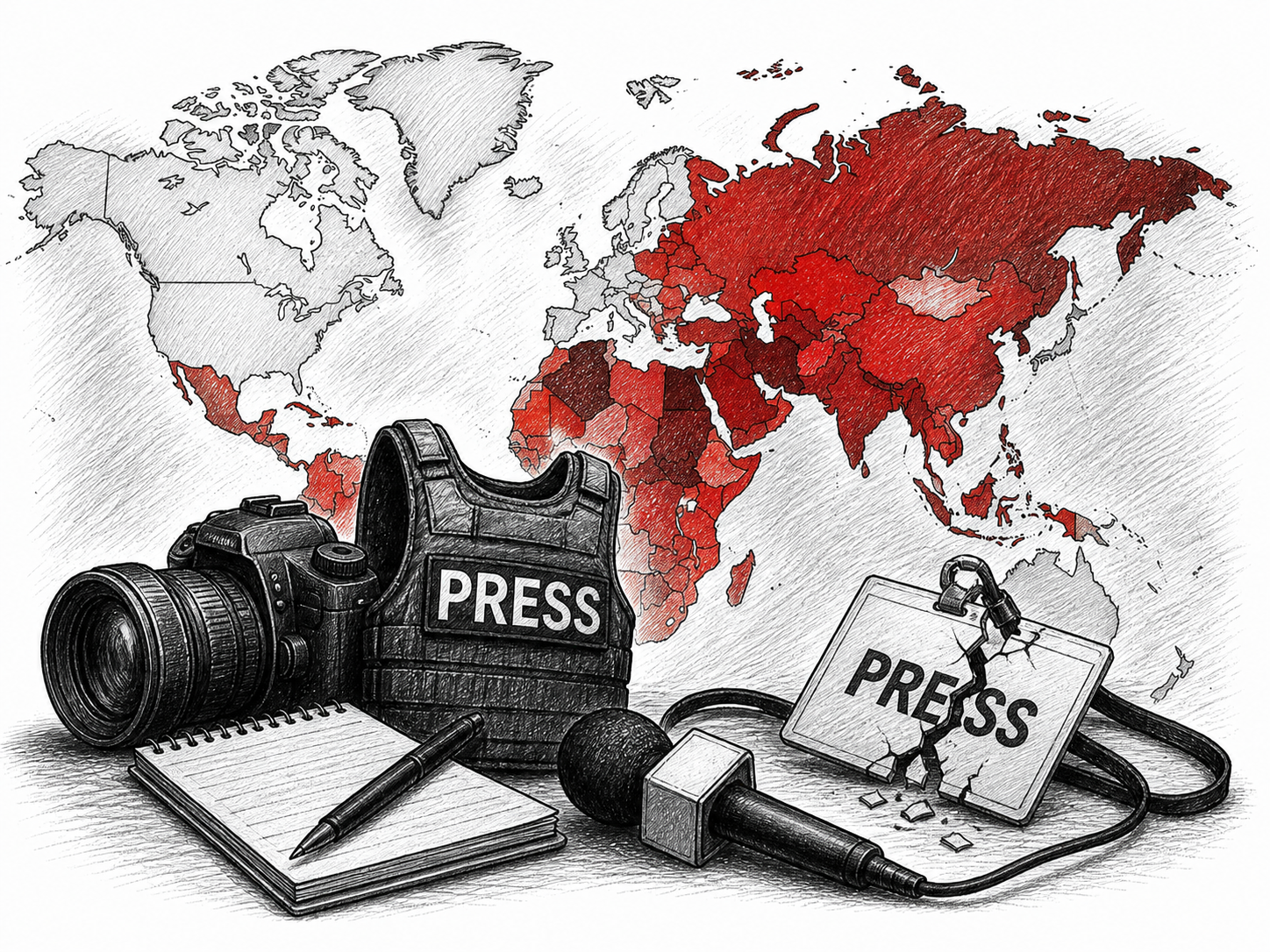
Reporters Without Borders released its 2026 World Press Freedom Index this week. The number is not ambiguous: press freedom has reached its lowest point in 25 years. For the first time in the history of the Index, more than half of the 180 countries surveyed fall into the “difficult” or “very serious” categories. Less than one percent of the world’s population lives under conditions rated “good” for press freedom. The map turns redder every year. This year it is the reddest it has ever been.
The United States dropped seven places to 64th. That number deserves more attention than it is getting. The country that has historically positioned itself as the global standard-bearer for press freedom now ranks below Timor-Leste, Namibia, and Trinidad and Tobago. RSF’s North America director said the administration has carried out a coordinated effort against press freedom since taking office — through funding cuts to public broadcasters, political interference in media ownership, and the systematic weaponization of state institutions against disfavored journalists and outlets. Voice of America shuttered. Radio Free Europe scaled back. NPR and PBS defunded. The infrastructure of independent information is not just under pressure. It is being actively disassembled.
That domestic contraction has global consequences. The cuts to the U.S. Agency for Global Media led to the closure and downsizing of international broadcasters in countries where they were some of the last reliable sources of information. The restructuring happening inside American media isn’t limited to public broadcasters — editorial headcount is being traded for entertainment investment across the ideological spectrum, and the communities with the least alternative access to credible information absorb the most cost when that trade is made.
More than 220 Palestinian journalists have been killed since October 2023 — more than in both world wars, Vietnam, Yugoslavia, and Afghanistan combined. Pope Leo marked the day at St. Peter’s Square by noting this right is violated “sometimes in blatant ways, sometimes in more hidden forms.” Both are present in the 2026 Index. The blatant is Gaza. The hidden is the chilling effect — the stories that were reported, confirmed, and ready to publish that never ran because the legal and political cost became too high.
Self-censorship has grown by more than 60 percent globally, driven by fear of reprisals, judicial intimidation, and economic pressure. That figure captures what the killed-journalist data cannot: the stories never told, the accountability never established, the communities never covered. The silence is invisible. The consequences are not.
SSC exists in that landscape — an independent publication covering race, access, and the systems that shape who participates in public life and on what terms. The stories that matter most are exactly the ones that become harder to tell as independent journalism contracts. Press freedom is not an abstract principle for publications like this one. It is the operating condition.
The map is getting redder. The celebration continues. The distance between them is the story World Press Freedom Day exists to name.