
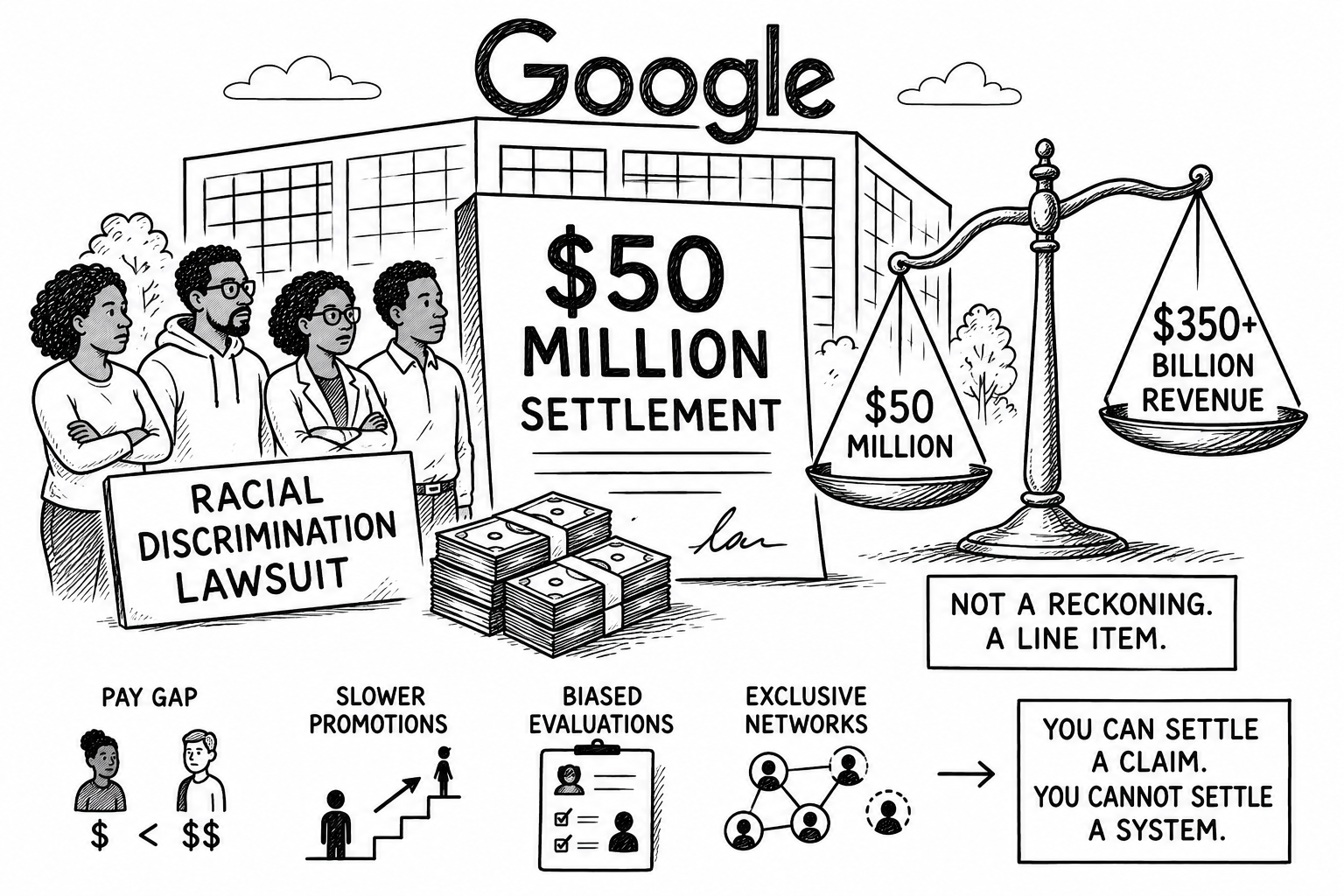
In 2022, Black employees at Google filed a lawsuit alleging systemic racial disparities in how the company hires, compensates, and promotes its workforce. This week, Google agreed to a $50 million settlement. The company has not admitted wrongdoing. It rarely does.
Settlements of this kind are often framed as closure. They are not. A $50 million figure at a company that generated more than $350 billion in revenue last year is not a reckoning — it is a line item. What the settlement does do is add another entry to a growing archive of workplace discrimination claims confronting major tech firms at the exact moment those firms are retreating from the diversity commitments they spent years publicizing.
The allegations in this case were structural, not incidental. The lawsuit did not center on a single manager or a specific incident. It centered on patterns — compensation structures that paid Black employees less, promotion pathways that advanced them more slowly, evaluation systems that produced racially skewed outcomes, and recruiting networks that reproduced existing gaps rather than closing them. That framing matters because it is harder to resolve with a check. You can settle a claim. You cannot settle a system.
The timing compounds the significance. Since 2023, corporate America has been in active retreat on diversity, equity, and inclusion. DEI staffing has been quietly reduced. Recruiting language has been adjusted. Public commitments have been softened or abandoned. Some of that retreat has been driven by political pressure. Some by shareholder scrutiny. Some by legal challenges targeting race-conscious workplace policies. Google, like many of its peers, has participated in that rollback while simultaneously presenting itself as a progressive employer.
The gap between those two postures is what this lawsuit documents.
For the tech sector specifically, that gap carries weight beyond employment. Google is not simply a company that hires people. It shapes the infrastructure of modern economic life — artificial intelligence systems, information access, digital advertising markets, cloud infrastructure, and workplace technology used by organizations globally. Who gets hired, retained, promoted, and funded inside that infrastructure is not a human resources question. It is a question about who has power over systems that everyone else depends on.
The $50 million settlement will be distributed. The structural patterns the lawsuit described will require something the settlement does not compel — accountability that outlasts the litigation.