
The research did not set out to study masculinity. It set out to study suicide. But when Stanford psychiatry professor Leslie Adams and her team sat down with Black men who had histories of suicidal ideation and behavior, masculinity kept entering the room uninvited. Participants were asked about mental health, social support, and experiences with racial discrimination. Nobody asked about gender norms. The topic surfaced anyway, again and again, in the language men used to describe why they hadn’t sought help, why they hadn’t told anyone, and why strength had become the only identity they felt safe inhabiting. The study, published in the Journal of Men’s Health, names what it found: racialized masculinity — a specific, compounding form of gendered expectation that does not simply tell Black men to be tough, but tells them that toughness is their biological inheritance and that vulnerability is a betrayal of it.
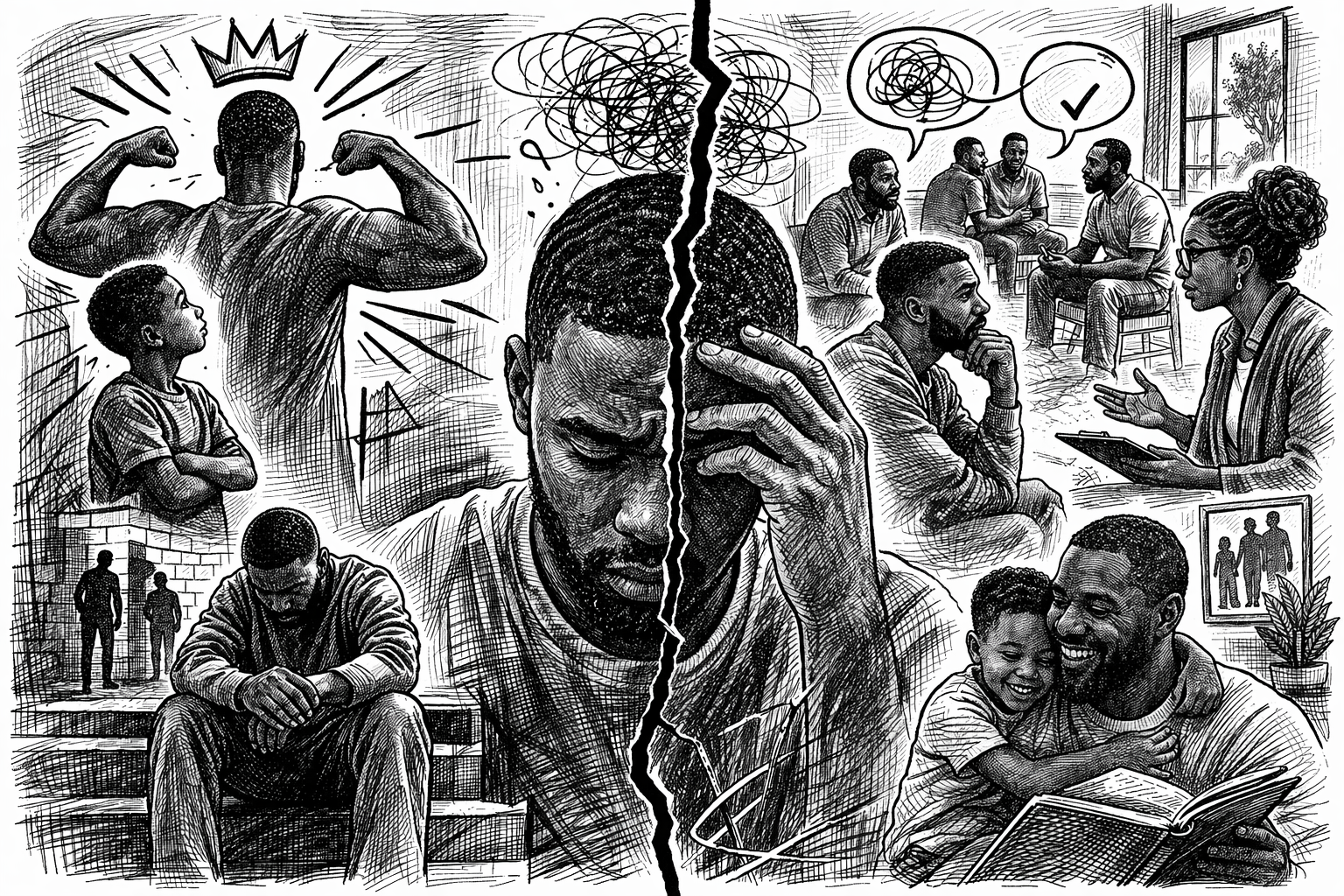
The distinction matters clinically and structurally. Traditional masculinity norms pressure men broadly toward stoicism and self-reliance. Racialized masculinity adds a second layer — the cultural script that positions Black men as inherently resilient, unbreakable, and beyond the need for care. That script does not emerge from nowhere. It is the product of centuries of racial ideology that denied Black humanity by denying Black suffering, and it has been absorbed so thoroughly into cultural expectation that it now operates from the inside rather than being imposed from without. When Black men internalize the message that they are supposed to be unbreakable, they do not simply avoid therapy. They avoid the recognition that something is wrong. They read their own pain as weakness. They perform strength in moments that call for honesty and pay for it in isolation, in escalation, and in outcomes that end lives.
What Adams’ research contributes is a framework for understanding this not as individual failure but as structural condition. The men in her study were not avoiding help because they lacked information about mental health resources. They were avoiding help because help-seeking had been coded — by culture, by media, by peers, and by a racial history that still shapes present-day expectation — as incompatible with being a Black man. That coding is not incidental. It is reinforced daily in the language used to celebrate Black male endurance, in the cultural narratives that treat suffering-without-complaint as strength, and in the institutional environments where Black men have historically had every reason to distrust the systems that were supposed to care for them. The result is a population for whom emotional suppression has been normalized to the point of invisibility — where silence is not a symptom but an expectation, and where the first crisis is often the last one anyone hears about.
The implications extend beyond individual men into the communities and families absorbing the downstream effects of that silence. Mental health crises that go unaddressed do not disappear. They reorganize. They appear as relationship instability, as economic disruption, as substance use, as physical health deterioration, and as the kind of accumulated, unspoken weight that shapes how boys are raised and what they are taught to believe about their own interior lives. The intergenerational transmission of racialized masculinity is not metaphorical. It is behavioral and environmental — passed through the modeling of fathers who never asked for help, the teasing of boys who showed emotion, and the cultural celebration of endurance over expression. Adams calls for culturally grounded interventions and the creation of community and digital spaces that affirm emotional expression. That is the right direction. But it requires first acknowledging that the problem is not individual men failing to seek help. It is a system that has made help-seeking structurally inaccessible by making it culturally illegible.
For SSC’s readership — men navigating professional pressure, economic precarity, family expectation, and the ongoing psychological weight of living Black in America — this research names something that has been felt far longer than it has been studied. The invitation is not to pathologize Black masculinity but to interrogate the specific conditions that have been imposed upon it, and to build something different in the space where silence used to live.