
Part of Society & Economy / The Access Shift — an ongoing series examining how access is being quietly reshaped across American life
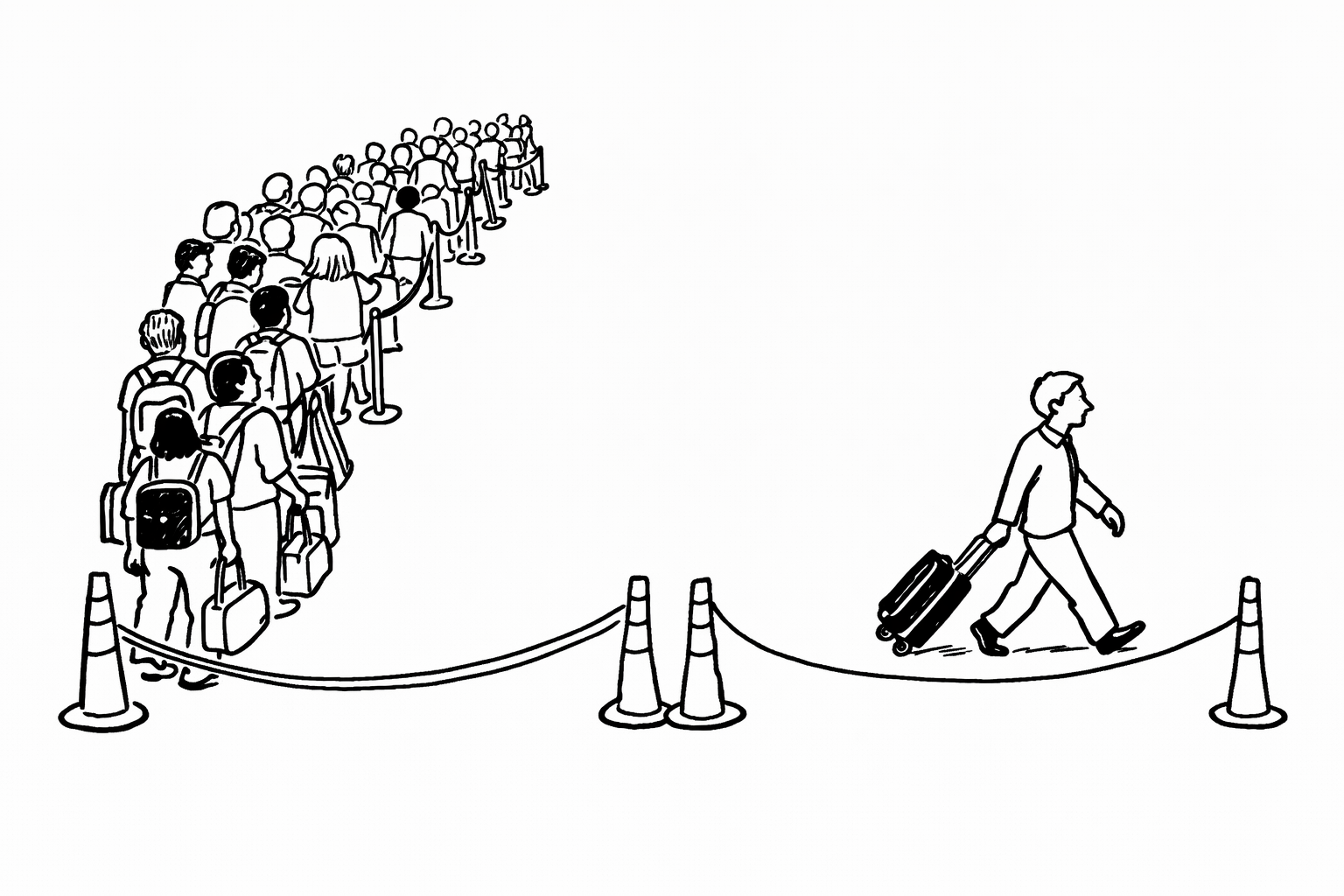
At Houston’s Bush Intercontinental Airport, the line is no longer just a line. It’s a dividing line.
This week, United Airlines confirmed that select passengers — including Premier 1K, Platinum, and Global Services members — are being routed through Terminal C security, effectively bypassing the longer TSA wait times impacting other terminals. At the same time, standard travelers in Terminal A were facing wait times as high as two hours, with Terminal E not far behind. The difference isn’t marginal. It’s structural.
And it’s not happening in isolation.
Just days earlier, a separate story surfaced out of the same airport: a man charging $65 an hour to stand in TSA lines on behalf of other travelers. What initially read as a clever hustle now looks more like an early signal. Because both developments point to the same underlying shift — access to time is becoming something you can buy, route around, or outsource.
Airports have always had tiers. First class, priority boarding, TSA PreCheck, CLEAR. But what’s emerging now is more fragmented and less visible. It’s not just about paying for speed. It’s about knowing where the system bends — and having the status, information, or resources to take advantage of it.
The Terminal C workaround illustrates that perfectly. This isn’t a new security system or a publicly announced program. It’s a routing decision that effectively creates two different airport experiences operating at the same time. One defined by congestion and delay. The other by access and flow.
What makes this moment different is how quickly those gaps are being filled by the market. When official systems create friction, informal ones step in to absorb it. A person waiting in line for you becomes a service. A shortcut becomes a strategy. And what starts as an exception begins to resemble infrastructure. The airport isn’t just where inequality shows up—it’s where it gets operationalized, priced, and folded back into the system itself.
Because time—especially in transit—has become one of the most valuable commodities there is. Missing a flight, sitting in a two-hour line, or navigating unpredictable delays isn’t just inconvenient; it carries real economic consequences. That pressure creates demand for anything that reduces uncertainty, and the market responds accordingly. What was once considered an edge case begins to look like a viable solution, and over time, those solutions reshape expectations around what movement should feel like.
The result is a layered system where access is no longer evenly distributed but segmented across different experiences of the same space. Some travelers move through optimized pathways built into the system, others navigate the default experience, and an emerging third group pays to bridge the gap themselves. That’s what a $65 TSA line-waiting service represents—not an outlier, but a prototype. Because once a behavior becomes normalized—once enough people see it, share it, and consider using it—it doesn’t stay on the margins for long. Airports aren’t failing; they’re revealing something deeper about how access now functions: not just where you’re going, but how you move through the system to get there.
⸻
Why This Matters
This isn’t really about airport lines. It’s about how access is being redefined in real time — and who the system is starting to work for.
Time is becoming a paid advantage. What used to be an inconvenience is now a differentiator. The ability to move faster through everyday systems — airports, healthcare, even customer service — is increasingly tied to status or money. If you can’t pay or don’t qualify, you wait.
The system isn’t breaking — it’s segmenting. Long TSA lines and quiet workarounds aren’t random. They’re creating two parallel experiences: one optimized for efficiency, the other absorbing the friction. The gap between those experiences is widening, not closing.
Informal services are filling structural gaps. A $65 line-waiting service sounds like a gimmick until you realize what it represents: demand that the system isn’t meeting. When people start outsourcing basic participation — like standing in line — it signals a deeper shift in how access is distributed.
Access is becoming less visible, but more powerful. This isn’t a clearly labeled premium tier. It’s routing decisions, insider knowledge, and quiet allowances that reshape outcomes without being obvious. The people who know how to navigate it move differently through the same space.
This is bigger than airports. What’s happening at IAH is showing up everywhere: faster lanes in healthcare, premium queues in digital platforms, priority access across industries. The pattern is consistent — systems are no longer designed for uniform experience, but for tiered movement.
The takeaway:
Access used to mean getting in. Now it means how smoothly — and how quickly — you move once you’re inside.
The Access Shift
The gradual redefinition of who systems are designed to serve.
Across sectors—from public infrastructure to healthcare to everyday spaces—access is no longer assumed. As costs rise and systems face increasing pressure, services once built for broad reach are becoming more selective, more conditional, and less universal. The Access Shift explores how these changes are unfolding in real time—and what they reveal about who is included, who is left out, and how the structure of everyday life is quietly being reshaped.