
On April 30, Hershey CEO Kirk Tanner credited the spread of GLP-1 medications directly for an 8% jump in Ice Breakers mint and gum sales in Q1 2026, telling analysts the company was seeing “strong demand” for breath-freshening products tied to what he called “GLP-1 adoption.” Ice Breakers is now Hershey’s third-largest confection brand. Hershey’s overall Q1 net sales climbed 10.6% to $3.1 billion — a strong quarter by any measure, made stranger by the fact that one of its growth drivers is a side effect that the companies making the drugs have not officially acknowledged exists.
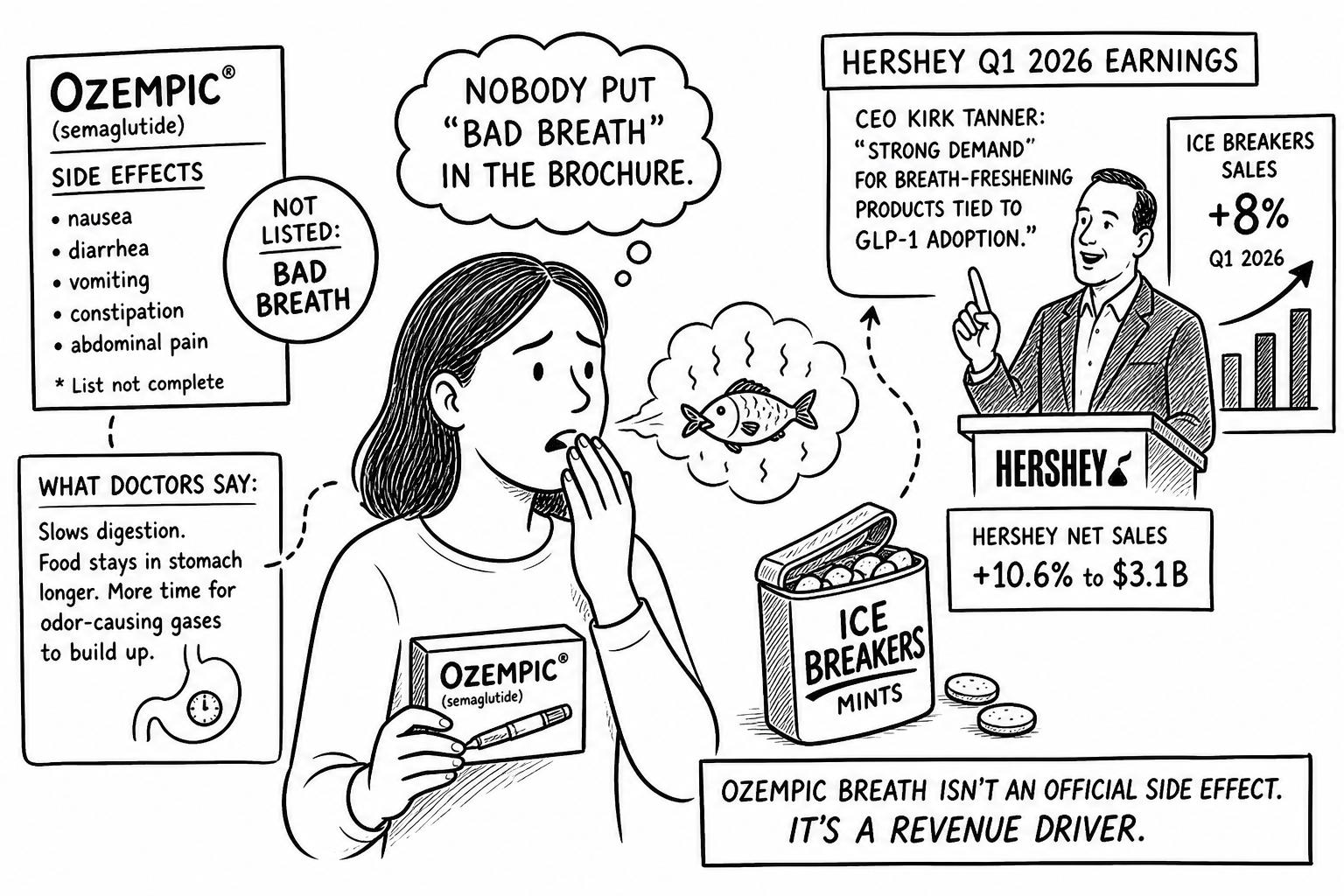
“Ozempic breath refers to a fishy smell in burps or bad breath,” according to Dr. Neha Lalani, speaking to Healthline. GLP-1 makers do not include bad breath as a listed side effect. Novo Nordisk’s clinical trials found that roughly 9% of people taking GLP-1 medications reported eructation — the clinical term for burping — but halitosis does not appear in the official side effect profile. The mechanism doctors point to is the same one that makes GLP-1 drugs effective for weight loss: they slow digestion. When food stays in the stomach longer, the byproducts of that delay — including the gases that produce bad breath — have more time to accumulate. The drug works by slowing the system. The breath is what happens when the system slows.
The gap between what patients are experiencing and what manufacturers are officially naming is worth examining on its own terms. GLP-1 medications are among the most prescribed drugs in the United States, with millions of people managing the side effects of a medication that is simultaneously being celebrated as a revolution in metabolic health. The side effect profile that reaches patients through official channels is incomplete — not because the experiences aren’t real, but because clinical acknowledgment moves more slowly than the market the drug has already created. Hershey’s earnings call is, in its way, a more honest accounting of what GLP-1 adoption actually produces in daily life than the prescribing information that accompanies the medication.
The broader implication is structural and connects to the GLP-1 economy SSC has been tracking — a market that is expanding faster than the clinical infrastructure designed to support it, producing experiences that patients are navigating largely on their own while the pharmaceutical industry manages the official narrative. Bad breath is a minor side effect relative to the documented risks of pancreatitis, thyroid changes, and the more dramatic body composition shifts that have generated their own cultural vocabulary. But it is visible in the market data in a way that reveals something true: the gap between what a drug officially does and what it actually does to the people taking it is being measured more accurately by a candy company’s quarterly earnings than by the label on the box.