
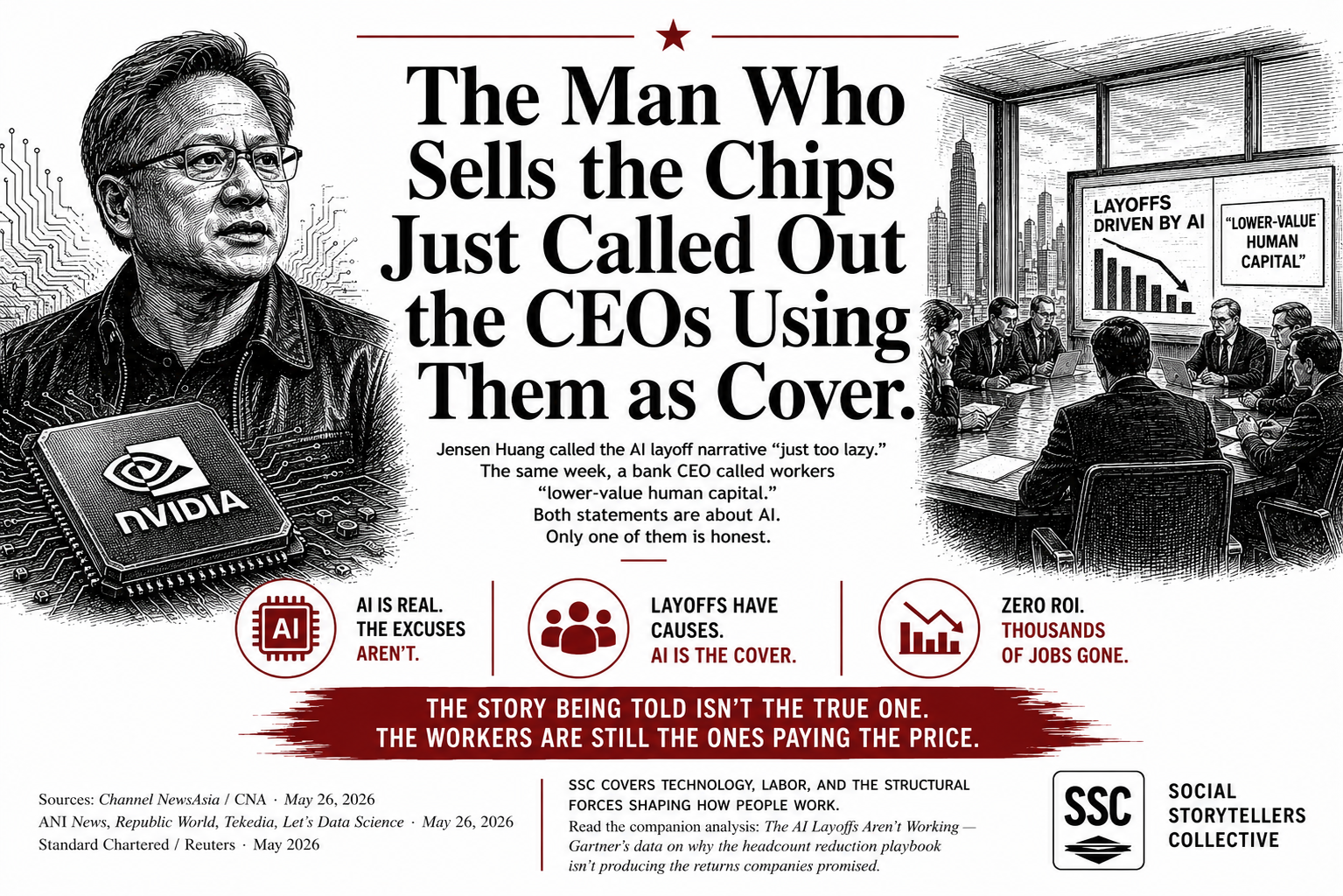
Both statements are about AI. Only one of them is honest.
Technology & Platform Design · Structural Reality
Jensen Huang, CEO of Nvidia, did not mince it. “The narrative that connects AI to job loss, for many of the CEOs that are doing it — it is just too lazy,” he told Singapore’s Channel NewsAsia on May 26. “AI has just arrived. How is it possible they’re already losing jobs? How is it possible that AI became productive and useful only six months ago, and they were somehow laying people off two years ago because of AI? It doesn’t make any sense.”
Then he said the part that matters most: “It was just a way for them to sound smart. And I really hate that. I think we’re scaring people and that’s irresponsible.”
Huang is not a neutral voice in this conversation. Nvidia makes the chips that power the AI systems companies are deploying. His company’s market cap has exceeded $3 trillion. He has more financial interest in AI adoption than almost anyone alive. When he says CEOs are misusing AI as a layoff explanation, he is not protecting workers. He is protecting the technology’s reputation — and his business’s long-term growth story. That context belongs in the analysis.
But the argument he is making is still correct. And it lands differently when you put it next to what happened the week before.
Standard Chartered CEO Bill Winters announced plans to cut more than 7,000 jobs over four years while describing the strategy as replacing “lower-value human capital” with technology. He later apologized for the phrase. The apology did not change the 7,000 jobs. The phrase, however, revealed something the polished language of “efficiency” and “transformation” usually conceals: some executives are not thinking about the workers being displaced. They are thinking about the balance sheet — and AI is the frame that makes the math sound inevitable rather than chosen.
Huang called this out directly without naming Winters specifically. His point — that companies were attributing layoffs to AI before the technology was even capable of replacing the roles being cut — is documented. SSC examined the Gartner data this week in The AI Layoffs Aren’t Working: 80% of companies piloting AI reported workforce reductions, with zero correlation to higher ROI. The companies cutting people in the name of AI are not the companies generating returns from AI. They are the companies using a powerful cultural narrative to do what cost pressures, post-pandemic overhiring corrections, and restructuring decisions were going to produce anyway.
Huang’s framing — “you’re not going to lose your job to AI, you’re going to lose your job to somebody who learned AI better than you” — is optimistic in the way that someone selling shovels during a gold rush tends to be optimistic. It places the responsibility on the individual worker to adapt rather than on the institution to invest in that adaptation. That framing has its own politics. The workers most likely to be displaced by AI are also the workers with the least access to the retraining, upskilling, and institutional support that would make adaptation possible.
But the underlying critique — that “AI did it” has become a board-level excuse that obscures real decision-making — is accurate. Google DeepMind’s CEO made the same point a week earlier, calling AI-driven developer layoffs a “lack of imagination” from some employers. Two of the most prominent voices in AI, in the same week, saying that the companies cutting jobs in AI’s name are not doing it because of AI. They are doing it because of the same pressures that have always driven layoffs — and AI is the headline that makes it easier to announce.
The workers who lost those jobs are still gone. The ROI still hasn’t arrived. And the people building the technology are now publicly saying the story being told about why those jobs disappeared is not the true one.
Sources: Channel NewsAsia / CNA · May 26, 2026. ANI News, Republic World, Tekedia, Let’s Data Science · May 26, 2026. Standard Chartered / Reuters · May 2026.
SSC covers technology, labor, and the structural forces shaping how people work. Read the companion analysis: The AI Layoffs Aren’t Working — Gartner’s data on why the headcount reduction playbook isn’t producing the returns companies promised.