
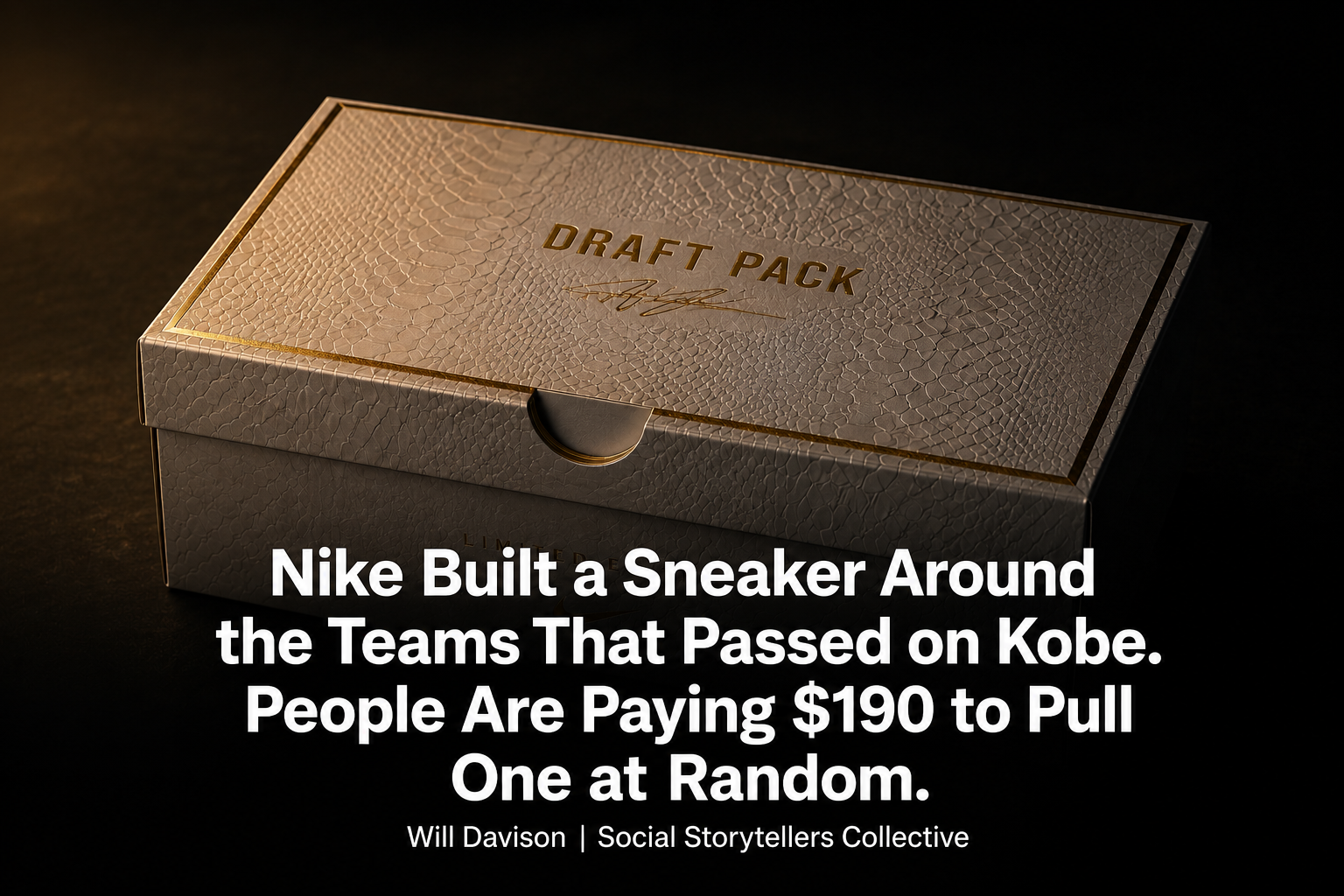
In 1996, twelve NBA franchises looked at a 17-year-old from Lower Merion, Pennsylvania and decided he wasn’t what they needed. The Charlotte Hornets took him at 13 and immediately traded him to the Lakers for Vlade Divac. The next twenty years settled the question of who was right. Now Nike is releasing a sneaker built around every team that got it wrong — and it is dropping as a blind box, meaning you don’t know which colorway you’re getting until you open it.
That is the premise of the Kobe 4 Protro “Draft Pack.” Fourteen colorways, one for each of the twelve franchises that passed, one for the Hornets who drafted him, and one in purple and gold for the team that figured out what they had. Each pair is marked with the colors of a specific franchise — visible on the Swoosh, Bryant’s signature on the heel counter, a lottery ball graphic on the insole representing each team’s draft position. The white upper features a wear-away design that fades over time to reveal the team colors underneath. You buy the box. You don’t choose. The mystery is the product.
The drop hits June 26 on the Nike SNKRS app. Retail is expected around $190 based on recent Kobe 4 Protro pricing. The resale market will do the rest.
What the Mechanic Is Actually Saying
Blind box drops are not new. Sneaker culture has been fluent in randomized releases for years — it’s the language of Supreme, of trading cards, of collectible toys, of any market where scarcity and mystery drive value above the object’s intrinsic worth. What makes this one different is the conceptual architecture. Nike isn’t randomizing colorways for the sake of it. The randomization is the argument. The blind box mechanic mirrors the uncertainty of the draft itself — the franchises that passed on Bryant were also pulling at random from what they thought they knew, and every single one of them got it wrong.
The shoe makes the scouts the product. Pulling a Charlotte Hornets colorway doesn’t mean you got the consolation prize — it means you’re holding the artifact of the team that technically had him first and let him go. That is a distinct piece of history. The team that picked him 13th is as much a part of the legend as the team that built dynasties around him. Nike is selling all fourteen positions in that draft story, and the randomness of the drop replicates the randomness of who gets to hold a piece of which chapter.
The Grief Economy and the Generation That Never Saw Him Play
Kobe Bryant died on January 26, 2020. He was 41. His daughter Gianna was 13. Eight others died in the helicopter crash in Calabasas. The mourning that followed was unlike almost anything the sports world had produced in the modern era — not because grief of that scale is unusual when a beloved figure dies, but because the generation most visibly devastated was one that had grown up watching him primarily through screens, through highlight compilations, through the mythology that accumulates around an athlete who retired in 2016 and spent his final years becoming something larger than a basketball player.
The buyers of the Kobe 4 Draft Pack are largely that generation. They experienced Bryant through YouTube and Reddit threads and the way older people talked about him — through cultural transmission rather than live games. The shoe gives them something physical to hold from a story they know intimately but never witnessed in real time. That is the grief economy operating at its most precise: turning a loss into an artifact, a mythology into an object, a draft night from 30 years ago into a $190 blind box that feels immediate and personal because the figure at the center of it feels immediate and personal to people who were children when he was retired and born when he was in his prime.
The SSC Angle
The Kobe 4 Draft Pack is a culture story about who controls the narrative of overlooked genius — and what happens when the market decides the answer. Every team that passed on Kobe Bryant made a judgment call with incomplete information. The scouts saw what they saw. The front offices made their picks. The draft is, structurally, a system for evaluating human potential under conditions of radical uncertainty, and history records every miss with perfect clarity.
Nike is selling the miss. Not as failure — as value. The colorways representing the teams that got it wrong aren’t discounted or marked as the lesser pulls. They are the point. In a cultural moment where overlooked talent is everywhere — where the Anthropic fellowship bypasses traditional credentials, where the Rolex watchmaking school builds its own pipeline because the system stopped producing what the market needed — there is something resonant about a sneaker that monetizes the judgment of the people who looked at something transformative and looked away.
The blind box says: you don’t get to choose which part of the story you hold. You pay your $190, you open the box, and history decides. That is either a very cool sneaker drop or a very precise metaphor for 2026, depending on what you pull.