
Part of The Inner Work — an ongoing series on intentional living, mental clarity, and the quiet practices that sustain us.
I didn’t discover nothingmaxxing. I was already doing it — I just didn’t have a word for it yet.
After months of insomnia driven by algorithm burnout, I started building small pockets of intentional stillness into my day. No phone. No music. No input of any kind. Just quiet. What I noticed wasn’t dramatic — it was subtle and cumulative. I simply felt better. Clearer. More like myself. For someone who is deeply introverted, reducing stimuli isn’t a luxury. It is maintenance. The world is loud by design, and without deliberate decompression, the noise doesn’t stop — it just gets louder inside your head.
That experience is what makes nothingmaxxing resonate beyond the trend cycle. As the language around it evolves, a new comparison is taking hold: modern meditation. Not in the traditional sense — no breathing techniques, no guided audio, no posture requirements — but in outcome. The goal is similar: reduce input, settle the nervous system, and create space between stimulus and response.
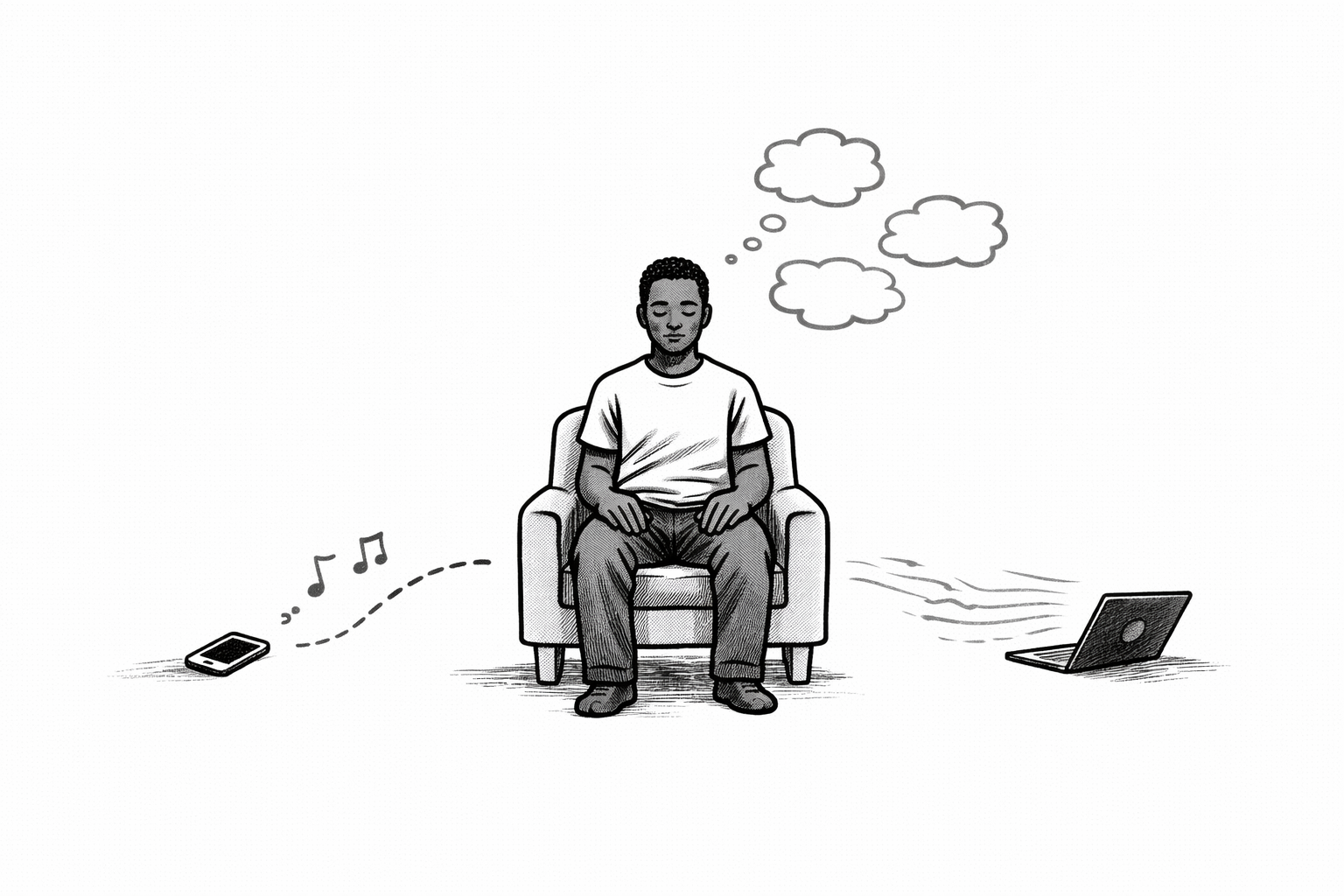
What differentiates nothingmaxxing is its lack of instruction. Traditional meditation often asks for focus — on breath, on thought, on awareness. Nothingmaxxing removes even that layer. No phone, no music, no talking, no external engagement. Just stillness for a defined period of time. It’s less about directing the mind and more about depriving it of constant interruption. For many, meditation has become another task to learn, optimize, and perform correctly. Nothingmaxxing feels more accessible because it requires nothing beyond stopping — no technique to master, no expectation to do it right. The barrier to entry is lower, even if the experience itself is uncomfortable at first.
Experts, including those featured on Good Morning America, are beginning to connect the dots: reduced stimulation allows the brain to downshift, which over time can help train lower reactivity, improve mood regulation, and create a buffer against stress. For introverts especially, that downshift isn’t optional — it’s how the system recovers. The world is built for constant output, constant engagement, constant response. Nothingmaxxing is the deliberate refusal of all of it, and the research suggests that refusal has real physiological benefits.
The comparison to meditation isn’t perfect. Meditation is often about awareness — observing thoughts, developing presence. Nothingmaxxing doesn’t necessarily guide that process. It creates the conditions for it without structuring what happens inside the silence. For some, that freedom is the appeal. For others, it can feel like emptiness rather than clarity. But as The Algorithm Followed Me to Bed explored, the system extracting your attention was never neutral — and neither is the decision to withdraw it. Stillness, when it’s intentional, is not passivity. It is one of the few acts that belongs entirely to you.
What’s emerging is less a replacement for meditation and more a translation of it — reframed for a generation that is less interested in ritual and more interested in immediate relief. The same underlying need for mental stillness, expressed in a different language. For those of us who have been quietly doing this for years, it’s less a discovery and more a recognition. The practice already existed. It just finally has a name.