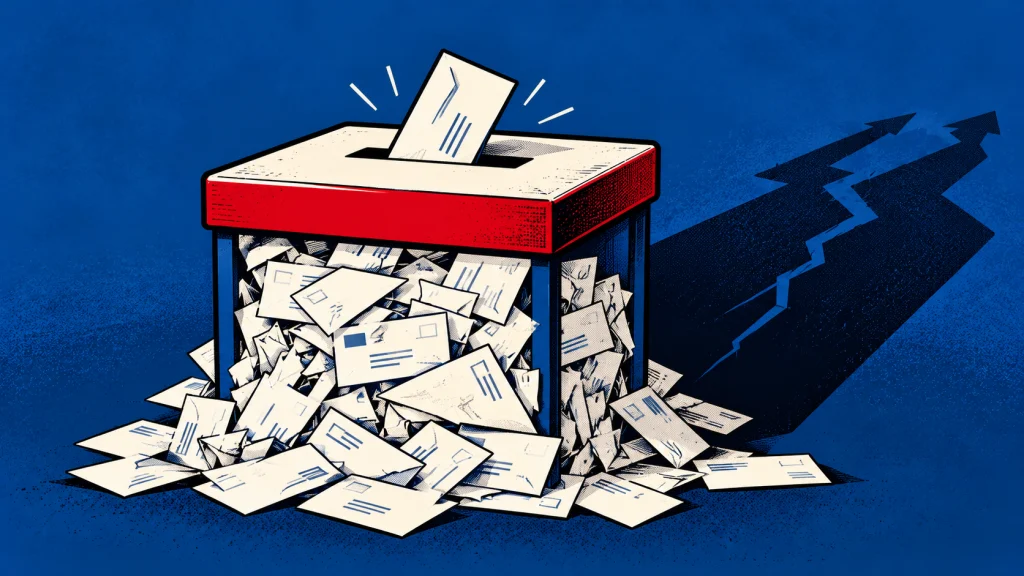
With Election Day approaching, Americans are voting amid economic frustration, political distrust and uncertainty about the country’s direction. The results will determine how much power Donald Trump and Congress have over the next two years.
Election Day is still four days away, but tens of millions of Americans have already made their decisions.
More than 44 million ballots have been cast ahead of the November 3 midterm elections, according to early-voting trackers. Participation is running ahead of the comparable period in 2022, with particularly strong increases in states where control of the Senate is being contested.
That kind of participation tells us Americans are paying attention. What it doesn’t tell us is what they’re about to do with that attention.
The national mood is hardly celebratory. A recent Pew Research Center survey found that 77% of Americans were dissatisfied with the country’s direction. Another AP-NORC survey found that eight in ten voters wanted substantial change or a complete overhaul of how the country is governed.
That’s a striking amount of dissatisfaction heading into an election that won’t change who occupies the White House.
But it could change how Washington works.
Americans Are Voting With Their Wallets, but Not Only Their Wallets
The economy remains the issue connecting voters across party lines. Pew found that 84% of registered voters considered it very important to their congressional vote, while 73% cited the future of democracy and 68% pointed to healthcare.
Those numbers capture the competing pressures shaping this election. Americans are frustrated by the cost of living, divided over immigration and federal policy, and concerned about the country’s political institutions.
We’ve been examining that tension at SSC. In our recent analysis of gas prices, groceries and voting, we explored why voters don’t always judge economic performance through national statistics. They judge it through what remains in their bank accounts after paying for everyday necessities.
But financial frustration doesn’t automatically translate into support for a different party. Voters also consider immigration, public safety, cultural issues, healthcare and whether they trust the alternatives.
That helps explain why the same economic conditions can produce different political choices.
The Polls Show a Democratic Advantage. The Ballots Haven’t Been Counted.
National polling provides one picture of where the electorate stands.
Pew’s October survey showed 44% of registered voters preferred Democratic congressional candidates, compared with 36% who preferred Republicans. The RealClearPolling average covering surveys through October 26 showed a similar eight-point Democratic advantage.
A Reuters/Ipsos survey released October 26 placed Trump’s approval rating at 32%, reflecting the political pressure facing Republicans as they defend their congressional majorities.
But national vote preference is not the same as congressional seat distribution.
All 435 House seats are on the ballot, along with 35 Senate seats and 36 governorships. The results depend on individual state and district contests, where candidate quality, local concerns, turnout and district boundaries can matter as much as national sentiment.
The early-voting numbers require similar caution. Some states report party registration, but being registered with a party doesn’t establish which candidate a person selected. Nor does a surge in early ballots necessarily mean more people will vote overall. Some voters may simply be casting ballots earlier than usual.
Still, the intensity is worth watching. Texas alone had recorded more than 6.3 million early votes by Wednesday, according to an Associated Press analysis, approximately 50% more than at the comparable point in 2022.
For a midterm election, that’s substantial participation before Election Day even begins.
What Happens If Washington Changes Hands?
Republicans currently control the House and Senate, allowing the party to pursue its legislative priorities alongside the Trump administration. The election could preserve that arrangement or divide power between the parties.
Three broad outcomes would produce different political conditions.
If Republicans retain both chambers, the administration would have a clearer path to advancing legislation on taxes, immigration, energy and federal spending. Republican lawmakers would still have their own disagreements, and Senate procedural rules would continue to constrain some legislation, but unified party control would reduce one major obstacle.
If Democrats gain the House while Republicans retain the Senate, major legislation would require more negotiation. House committees could increase scrutiny of federal agencies, demand documents and hold hearings on administration decisions. Budget deadlines and spending disputes could become major points of confrontation.
If Democrats gain control of both chambers, congressional oversight and opposition to administration proposals could expand substantially. But Trump would retain veto authority, and Senate rules would still limit how much either party could accomplish without broader agreement.
None of these outcomes automatically guarantees lower prices, changes to healthcare or a different immigration system. Congressional power influences those policies, but legislation, executive authority, courts and economic conditions all affect what ultimately changes.
And governors’ races deserve attention of their own. State leadership will continue shaping education, housing, election administration and public services regardless of which party controls Congress.
The Next Two Years Are About More Than Passing Laws
The 2026 election will establish the political environment leading into the 2028 presidential race.
A Congress aligned with the White House could concentrate on implementing remaining administration priorities. Divided government could shift more attention toward investigations, negotiations and executive actions. In either case, questions about affordability, immigration, federal spending and institutional accountability will remain.
That makes the next two years important even if Washington produces relatively little major legislation. Decisions about oversight, funding, judicial appointments and the operation of federal agencies can affect Americans without generating the kind of headline attached to a sweeping new law.
And voters will be measuring the consequences.
The remarkable thing about this election isn’t simply that more than 44 million people have already participated. It’s that so many Americans are engaging with a political system they also say they’re dissatisfied with.
Some are voting for continuity. Others want change. Many are making choices under financial pressure or amid concerns about where the country is headed.
By Tuesday night, the results will begin revealing which candidates and parties earned enough support to govern. Some close races may take longer to settle.
What those decisions mean for ordinary Americans will take considerably longer to understand.
The election determines who gets power. The next two years will show what they do with it.