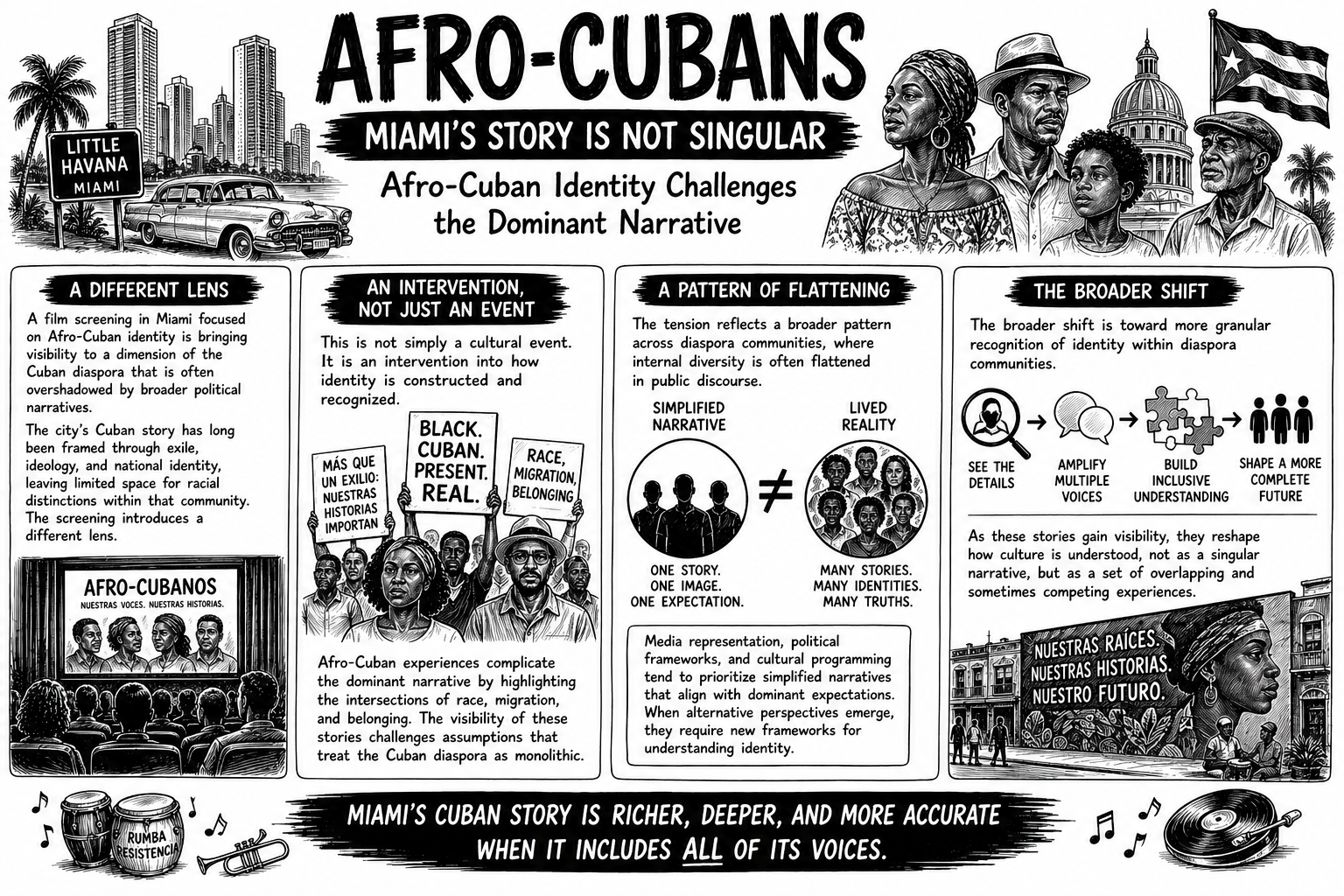
At the 2025 Miami Film Festival, a documentary called Two Islands made its debut — a film that began as a two-week residency between Afro-Cuban musicians from Miami and Aboriginal storytellers, dancers, and musicians from Australia, tracking a two-year international cultural exchange. The film is not, on its surface, a political document. But in the context of Miami, centering Afro-Cuban artists as the subjects and agents of a story — not the backdrop for someone else’s narrative — is itself a form of intervention.
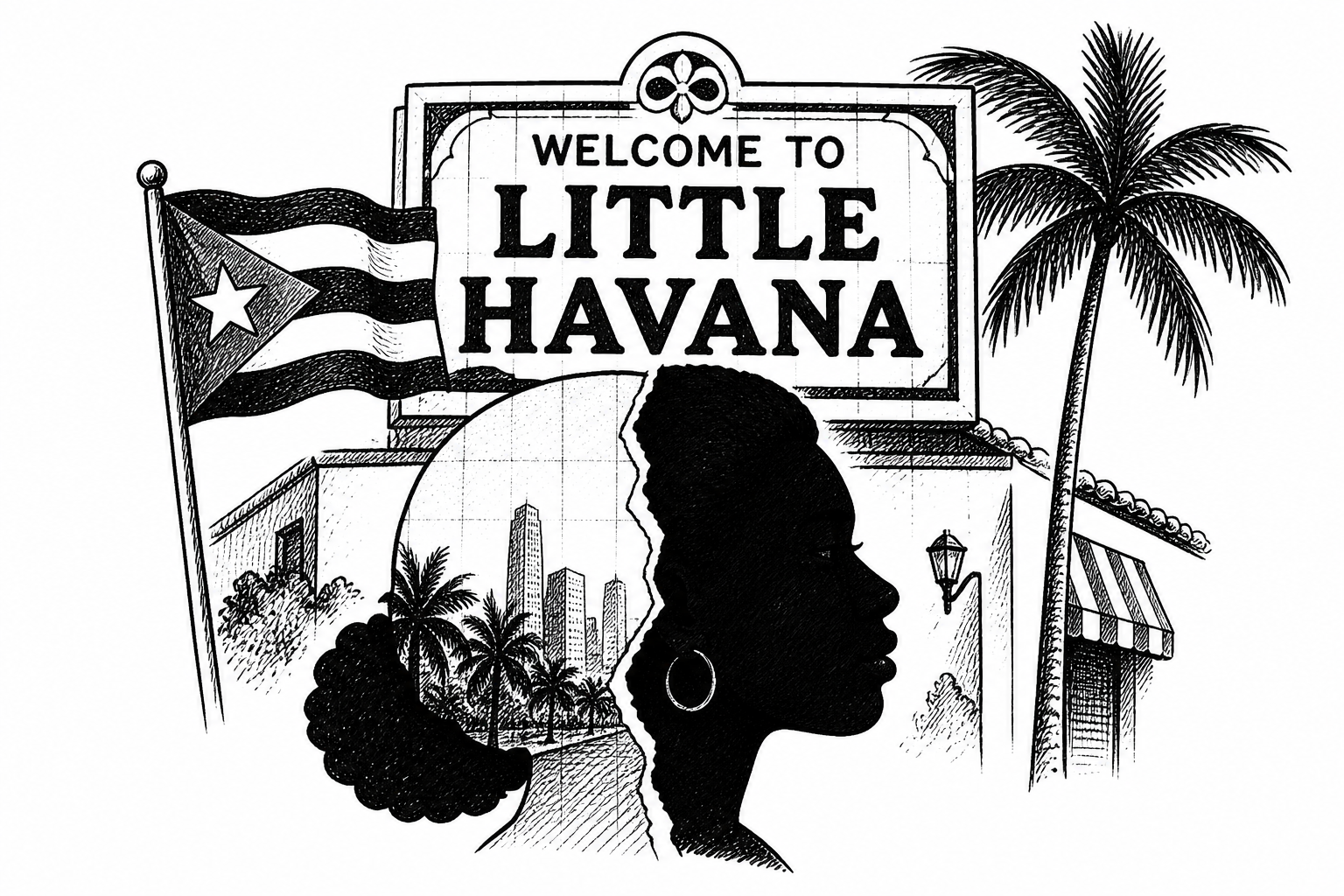
Miami’s Cuban story has long been organized around a specific set of reference points: exile, anti-communism, the Bay of Pigs, Little Havana, and the political consolidation that made South Florida’s Cuban diaspora one of the most influential ethnic voting blocs in the country. That framework is real, but it is also selective. Miami is home to approximately half of all Cuban immigrants in the United States — and it is a city where cubanidad, the cultural concept of Cuban identity, has become most closely associated with whiteness. The Afro-Cuban experience sits inside that city but outside that frame.
Research into Afro-Cuban reception in South Florida documents that Black Cubans arriving after 1958 confronted not only anti-Black Southern racism but also a racially exclusive “ethnic enclave” — a Cuban community that formed around a success myth that treated Cubans and other Latin Americans as hailing from “racial democracies,” flattening the role of race within the diaspora itself. White Cubans were permitted to attend White-only schools with government-subsidized English-language programs, while Afro-Cubans were relegated to Black American neighborhoods already shaped by redlining, mass incarceration, and anti-Black discrimination. The conditions of arrival were not shared equally.
What resulted is a dual erasure. In Cuba, the national preference has long been for the concept of a colorblind Cuban identity — cubanidad over race. In the United States, that erasure was compounded by American racial categories that absorbed Black Cubans into one racial designation while Cuban identity remained coded as something else. Afro-Cubans became members of two diasporas simultaneously — the Cuban diaspora and the African diaspora — without full belonging in either public narrative. Miami’s dominant Cuban story made room for exile and ideology. It made less room for race.
Filmmaker Sergio Giral, considered the father of Afro-Cuban cinema, addressed this gap directly in The Invisible Color, a documentary centered on the Black Cuban exile community in South Florida — their contributions to Miami’s civic culture documented through testimony because the mainstream record did not capture it. That film exists in a lineage that Two Islands now extends, part of a slow accumulation of cultural production that insists on visibility within a community whose public image has historically curated itself around a narrower story.
This is not simply a cultural event. It is an intervention into how identity is constructed and recognized. The tension it surfaces reflects a broader pattern across diaspora communities: internal diversity flattened by the political utility of a unified narrative. Even a documentary like Hijos de la Diáspora, which explores Cuban diaspora identity across nine countries, centers on the experience of living between two cultures — the Cuban home and the country of arrival — as a shared condition, without always naming how differently race shapes that experience depending on where in the diaspora you land.
The stakes here extend beyond representation. When Afro-Cuban artists occupy the center of a film, when their cultural exchanges with Aboriginal musicians in Australia become the subject of documentary attention, the story of what Miami is shifts. Afro-Cubans in South Florida have created diasporic alliances with other Afro-descendant communities — Afro-Caribbean immigrants, African Americans — as a strategy for navigating social isolation and building economic opportunity. Those alliances produce a different map of the city than the one that gets exported through dominant political and media coverage. The film is evidence of a community that has been building infrastructure and connection regardless of whose story gets told about them.
The broader shift is toward more granular recognition of identity within diaspora communities. As these stories gain visibility, they reshape how culture is understood — not as a singular narrative, but as a set of overlapping and sometimes competing experiences. Miami is a Cuban city. It is also a Black city, a Caribbean city, a Haitian city. The Afro-Cuban story doesn’t displace the dominant narrative. It complicates it in ways that are long overdue.