
Part of Social Storytellers Collective’s ongoing coverage of economy, behavior, and how markets shift.
Peloton is projecting its fifth consecutive year of revenue decline. That number is worth sitting with — not because it signals mismanagement, but because it signals something more fundamental about the kind of demand the company was built on.
The operational story is actually reasonable. Peloton has reduced debt, generated positive cash flow, and made meaningful adjustments to its product line. By execution metrics, the company is functioning better than its revenue numbers suggest. The problem isn’t how Peloton is being run. The problem is what it’s running toward.
At its peak, Peloton wasn’t just a fitness company — it was a behavior. It reflected how people were living during a specific, compressed moment: staying home, investing in convenience, reimagining routines around a space that had become everything at once. The product fit that moment almost perfectly. And then the moment ended.
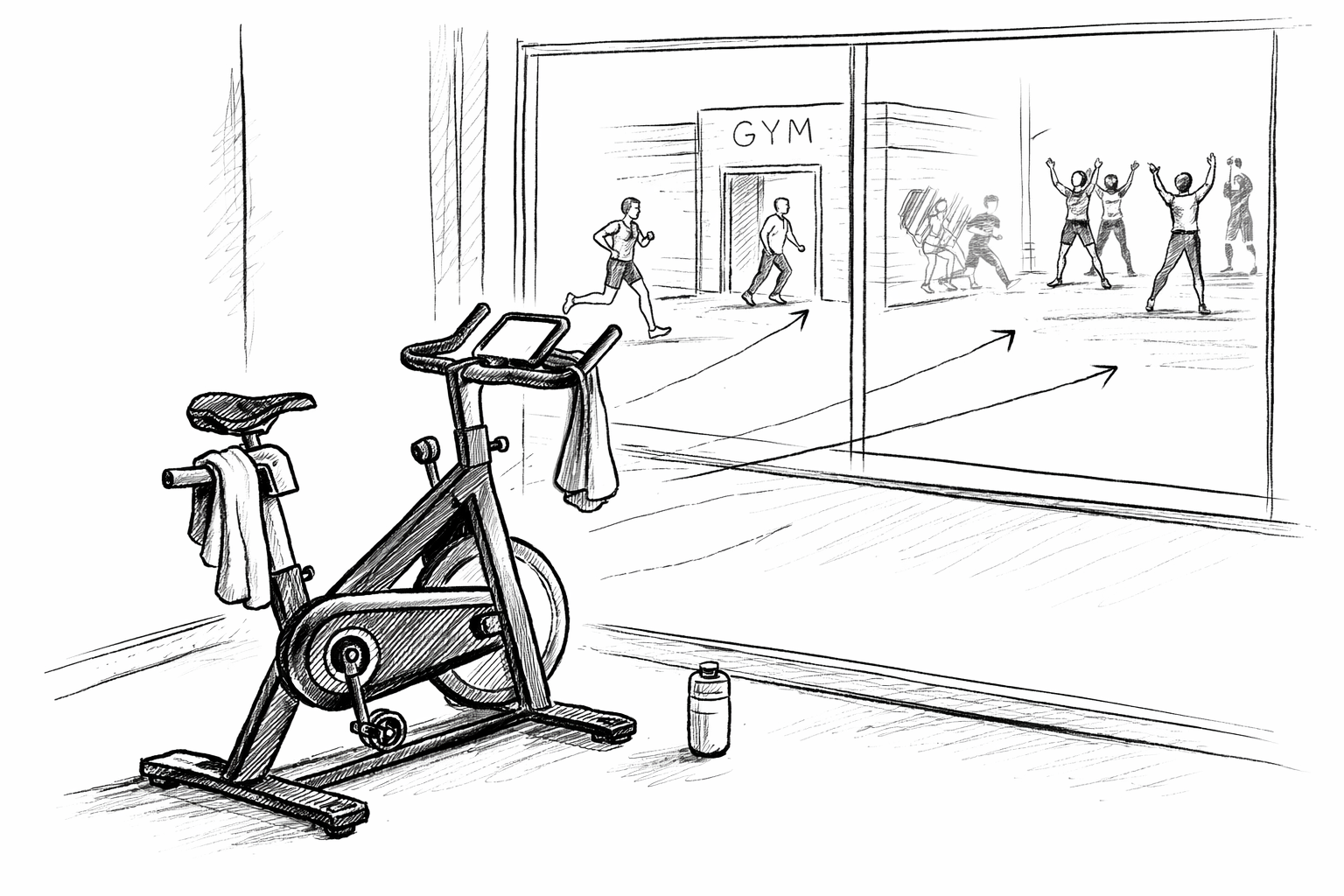
As behavior normalized, so did preferences. People didn’t simply leave their homes — they rediscovered what they had been missing. Gyms. Classes. The particular motivation that comes from being around other people working toward the same thing. U.S. gym membership has already returned to pre-pandemic levels, and that return isn’t temporary. It’s behavioral. Which means the challenge Peloton faces isn’t cyclical — it isn’t waiting for demand to bounce back. It’s structural. The demand that drove its growth was pulled forward by circumstance, not created by the product.
That distinction matters because it changes what a recovery actually looks like. You can’t market your way back to a moment that no longer exists.
What Peloton’s latest move suggests, though, is that the company may understand this. Its recently announced Commercial Series — a new line of connected bikes and treadmills designed for high-traffic gym environments, with distribution expected in late 2026 — is not an expansion play. It’s a repositioning. Rather than continuing to bet on at-home ownership as the primary model, Peloton is moving into the shared physical spaces where its former customers have already returned. It is meeting behavior where it actually is, rather than where the pandemic temporarily placed it.
That is a more honest strategy than chasing a recovery that isn’t coming. It won’t return Peloton to its 2020 valuation. But it may be the clearest signal yet that the company has stopped fighting the shift and started working with it.
The broader pattern here extends beyond one brand. Pandemic-era demand didn’t disappear — it redistributed. Products that once felt essential are being re-evaluated within a more balanced set of choices, and convenience alone is no longer a differentiator when community and experience have reemerged as genuine alternatives. Peloton is one of the more visible examples of that redistribution. It won’t be the last.