
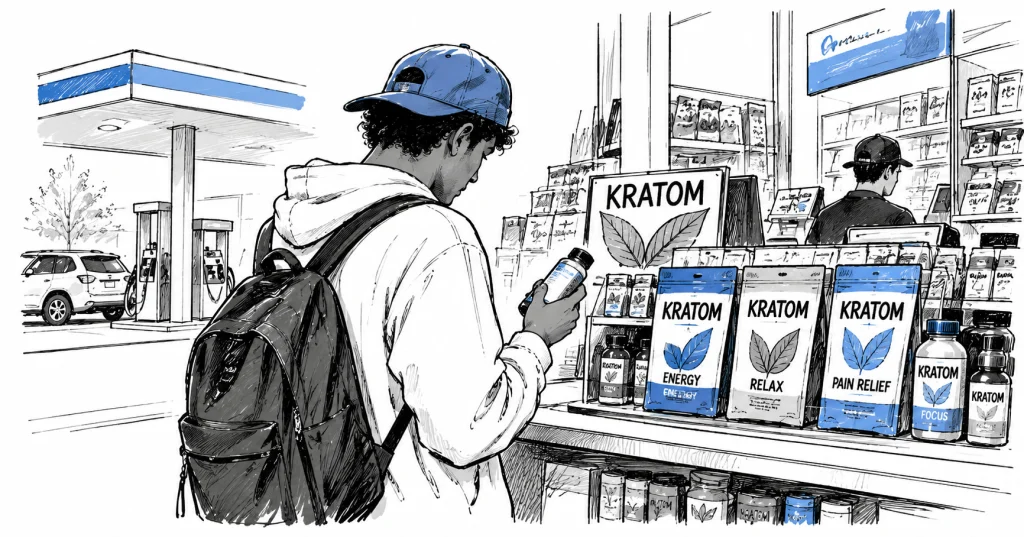
Marketed for energy, pain relief and relaxation, kratom products have become familiar convenience-store purchases. But a growing number of deaths involving concentrated derivatives is exposing a dangerous gap between what consumers see on the packaging and what they may actually be taking.
At a gas station, the difference between an energy supplement and a potentially dangerous opioid can be hard to see. Colorful packages promise relaxation, focus or relief from pain. Some products come as gummies, tablets or small liquid shots, displayed alongside merchandise people buy without a second thought. No prescription is required, and the person behind the counter may know little about what is inside. For consumers, the setting itself creates a sense of familiarity. If something is sold at the neighborhood convenience store, how dangerous could it be?
That assumption is becoming harder to defend. Kratom, a plant native to Southeast Asia, has built a substantial American market among people looking for alternatives for chronic pain, anxiety, fatigue and opioid withdrawal. But the market has expanded beyond traditional botanical products into concentrated derivatives that can produce powerful opioid-like effects. One compound, 7-hydroxymitragynine, commonly called 7-OH, has drawn particular concern from public health authorities. Kratom leaves contain only trace amounts of it naturally, while commercially enhanced 7-OH products can contain dramatically higher concentrations. The Food and Drug Administration says 7-OH has no approved medical use and cannot legally be sold as a dietary supplement, and its scientific review found the compound roughly two to nine times as potent as morphine in preclinical studies.
The Deaths Are No Longer Isolated Warnings
The numbers point to a growing public health problem. A Centers for Disease Control and Prevention study published this year found that poison centers logged 14,449 kratom exposure reports between 2015 and 2025, climbing from 258 in the first year to a record 3,434 in the last. The study counted 233 kratom-associated deaths over that period, and 184 of them, or 79%, involved other substances as well. Hospitalizations tied to kratom alone rose from 43 in 2015 to 538 in 2025, a surge the researchers connected to the arrival of high-potency, semisynthetic formulations such as 7-OH. These figures do not establish that kratom alone caused every death, but they document a pattern of increasingly serious incidents involving products that remain within easy reach.
Texas offers a particularly troubling picture. A 13 Investigates report from ABC13 Houston found that the Texas Department of State Health Services counted 111 kratom- and 7-OH-related deaths from January through August of this year, up from 14 in 2017, the first year the state tracked them. The investigation also introduced viewers to the family of Jonas Heath, a 19-year-old Oklahoma State University music student who died in April. His autopsy attributed his death to toxicity involving 7-OH, kratom and a related derivative, and his mother, Rae Heath, believes he progressed from kratom to 7-OH less than two months before he died. She has since launched a nonprofit, the 7-OH Truth Project, and plans to press Texas lawmakers to pass Jonas’s Law when bill filing opens in November, turning a personal loss into a campaign to warn other families.
The concern is spreading beyond Texas, and Utah’s version of the story may be the most unsettling yet. Earlier this month, state health officials linked four deaths to two semi-synthetic kratom compounds, mitragynine pseudoindoxyl (MGPI) and MGM-15, found in products labeled as “cat’s claw,” an herbal supplement that is harmless in its natural form. Laboratory testing found the compounds in products sold under brand names such as Buzzers, and none of it appeared on the labels. The people who bought those tablets were not making an uninformed choice about kratom. They were sold one product and given another. The products surfaced in gas stations, smoke shops and online stores even though Utah now bars the sale of any kratom product other than pure leaf, a reminder that a ban on paper means little when no one checks what is inside the package.
How Did Something This Powerful Become a Convenience-Store Product?
Part of kratom’s commercial appeal is its botanical identity. The plant has a history of traditional use in Southeast Asia, and some American consumers say traditional leaf products have helped them manage pain, improve energy or step away from other opioids. Many of those users warn that sweeping bans could push people back toward more dangerous drugs, and their concern deserves a hearing. But their experience is precisely why the distinction matters. Traditional kratom leaf and chemically concentrated 7-OH are not the same product, and an industry that sells both under the same broad label is putting the credibility of responsible users at risk along with the health of everyone else.
A Law Without Teeth
Texas did not ignore this problem. Its 2023 Kratom Consumer Health and Safety Protection Act caps 7-OH at 2% of a product’s total alkaloid content and bans synthetic kratom alkaloids. Yet products far exceeding those limits have kept reaching consumers. Texas Attorney General Ken Paxton has sued a Midlothian retailer operating as Smokey’s Paradise and two California-based online sellers, alleging that lab testing found products with 7-OH levels between 86% and 96% of total alkaloid content, nearly 50 times the legal limit. Consider what violating that law costs. Under the kratom act, penalties start at $250 for a first offense and top out at $1,000 for repeat violations. When a product can be sold at nearly 50 times the legal limit and the first fine costs less than a case of inventory, the law is not a deterrent. It is overhead. The fact that the attorney general is also leaning on the state’s deceptive trade practices law suggests that even Texas officials know the kratom statute alone cannot do the job.
There is evidence that real enforcement changes the outcome. Los Angeles County recorded 10 local 7-OH overdose deaths between 2025 and early 2026, and California authorities responded with an enforcement push that included arrests. According to ABC13’s reporting, a county official said Los Angeles has not recorded another 7-OH-related death since that effort began. One county is not a controlled study, but the contrast with Texas is hard to dismiss. A state with a law and weak penalties is still counting the dead, while a county that treated the sale of these products as a matter of accountability has, so far, stopped adding to its count.
Federal authorities are now moving to close part of the gap, though the pace deserves scrutiny. The Department of Health and Human Services first recommended placing 7-OH above a set threshold in Schedule I in July 2025, following an FDA scientific review. The Drug Enforcement Administration did not announce its intent to act on that recommendation until July 2026, a full year later. On October 9, HHS revised its recommendation to cover both 7-OH and MGPI, which would fall into Schedule I when a product contains more than 1 milligram per gram in solid form or 1 milligram per milliliter in liquid form, or when the ratio of mitragynine, kratom’s predominant alkaloid, to those compounds drops below 100 to 1. The Justice Department said the DEA would issue a new notice of intent reflecting that threshold, and no temporary scheduling order for 7-OH has taken effect yet. The threshold approach is sound, because it targets enhanced products without treating botanical kratom the same way. But more than a year passed between the federal government identifying the danger and moving to act on it, and Jonas Heath died inside that window.
The Consumer Often Carries the Risk
For someone dealing with chronic pain, exhaustion or opioid dependence, the appeal of an inexpensive product that promises relief is understandable. It is also an indictment. Medical care is expensive, addiction treatment can be difficult to reach, and pain management often comes with long waits and little follow-through. In that vacuum, the gas station shelf has become a kind of unofficial pharmacy for people the healthcare system has not served well, and the products filling that gap are the least regulated ones in the building. Texas health officials have warned that people using 7-OH have reported symptoms ranging from vomiting, confusion and a racing heart to trouble breathing, loss of consciousness and seizures, while Utah officials say the newer semi-synthetic compounds carry risks of dependence, severe withdrawal, overdose and death. Some people may not realize they are consuming a potent opioid-like substance until they experience dependence or a medical emergency.
The larger issue extends beyond kratom itself. Americans routinely encounter products marketed for wellness, relaxation and performance in retail settings where the line between supplements and pharmacologically active substances is difficult to read. Packaging can create an impression of legitimacy without offering any real assurance of safety. A gas station is not a pharmacy, and a product’s presence on a shelf does not mean regulators have evaluated it for medical use. For consumers unfamiliar with the chemistry, those differences may stay invisible until something goes wrong, which is why anyone with concerns about a kratom or 7-OH product should call the Poison Help Line at 1-800-222-1222.
The deaths now being documented across the country demand more than another warning about personal responsibility, because personal responsibility assumes people know what they are buying. In Utah, the labels hid the compounds that killed four people. In Texas, products tested at nearly 50 times the legal limit still found their way to the counter. No consumer can make an informed choice when the package itself is the lie. Accountability has to start upstream, with mandatory independent testing before these products reach shelves, labels that disclose what is actually inside, penalties large enough to outweigh the profits, and liability for the retailers who keep selling what they have been warned about. As regulators move to restrict the most dangerous formulations, families are already living with the consequences of a market that grew faster than its safeguards. The product may be sold as an ordinary purchase, but the consequences are anything but ordinary.
Sources: CDC Morbidity and Mortality Weekly Report; ABC13 Houston; Utah Department of Health and Human Services via Deseret News; Texas Office of the Attorney General; KXAN; U.S. Department of Health and Human Services; U.S. Department of Justice; Texas Department of State Health Services; FDA.