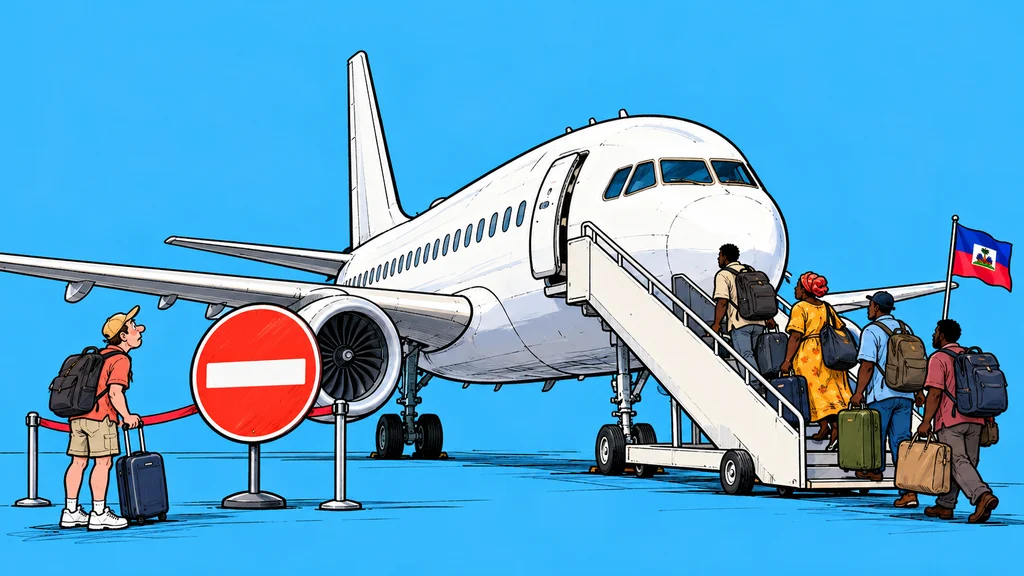
The United States government tells Americans not to travel to Haiti “for any reason.” It is deporting Haitians there anyway. The same State Department that warns of kidnapping, gang violence, terrorism, unrest and failing hospitals is part of a government putting people on planes to the country it considers too dangerous for its own citizens to visit, and I cannot reconcile those two positions.
Many of the people on those flights spent years building lives here. They worked in hotels, hospitals, factories and construction, paid taxes and raised children, some of them U.S. citizens. Some fled Haiti because they feared for their lives. Now that Temporary Protected Status for Haitians has ended, the question is not whether the government has the authority to deport them. The question is whether using that authority this way can be squared with the values America claims.
The Government’s Own Warning
Haiti sits under a Level 4 “Do Not Travel” advisory, the State Department’s highest warning. The conditions are severe enough that U.S. embassy employees may not leave the compound except on official business, cannot bring their families and are barred from using public transportation, taxis or ATMs. The government admits it has an “extremely limited” ability to help Americans who get into trouble there.
The Federal Aviation Administration bars U.S. commercial flights from flying below 10,000 feet over Port-au-Prince because of the threat from armed groups, and it recently extended that ban to March 2027, Human Rights Watch reported. Deportation flights land in Cap-Haïtien instead, because the capital’s main airport is considered too dangerous.
The numbers behind those warnings are staggering. At least 3,050 people were killed in Haiti in the first six months of this year, and nearly 1.5 million people have been driven from their homes inside the country. More than half the population needs humanitarian aid and faces crisis-level hunger or worse, according to Human Rights Watch, citing UN and migration agency figures. This is not a temporary flare-up. It is a prolonged collapse of security and basic services.
What Deportees Are Landing In
Protected status for an estimated 330,000 Haitians ended on July 27, after the Supreme Court cleared the way in June. The first deportation flight under the new policy landed Aug. 20 with 161 people aboard, and Haitian authorities counted 474 deportees on five weekly flights through mid-September. People arriving in Cap-Haïtien received a simple meal, a drink and about $77 in cash, The Associated Press reported, and then they were largely on their own.
Human Rights Watch interviewed 44 of the people deported on the August flights. One of them, a 38-year-old man identified as Pierre, had worked at a Florida hotel for nearly seven years. He was sent to Haiti on Aug. 20, while his wife and 5-year-old son, a U.S. citizen, stayed behind in Florida.
We talk about deportation as paperwork: detention, hearings, a manifest, a flight. But the paperwork ends when the plane lands, and the consequences do not. Someone still needs a place to sleep tonight, a father still needs a way to reach his son, and a person who once escaped violence now has to figure out how to survive it again, in a country where traveling to a relative’s home can mean risking extortion, kidnapping or worse.
The Case for Enforcement Has Limits
I believe in legal immigration and naturalization, and in the United States as a place where people can still chase the American dream. I also support Temporary Protected Status, and I believe it should last until it is actually safe for people to go home. Immigration law exists for a reason, and I accept that the United States has the right to set the rules for who can stay and to remove people who do not have legal permission to remain. The administration argues that a temporary humanitarian designation was never meant to become a permanent path to residency, and on that narrow point it is correct.
But the purpose of Temporary Protected Status is just as clear. It exists for countries where conditions make it unsafe to send people home. Haiti first received it after the 2010 earthquake, and it was extended through years of political turmoil, disasters and violence. Ending that protection while the danger is growing, not shrinking, turns the program’s own logic upside down.
The Department of Homeland Security has pointed to deportees with serious criminal records, saying 15 of the 161 people on the first flight had convictions. Those cases should be handled under the law. But that leaves 146 people on the same plane, and none of the 44 deportees Human Rights Watch interviewed appeared on DHS’s list. A few criminal records cannot justify sending everyone else into the same danger without individual review, due process and the legal protections against returning people to persecution or torture.
Danger Does Not Check Passports
The hardest part of this policy to accept is how differently it measures risk depending on who faces it. When the traveler is an American, Haiti is too dangerous to visit. When the person is a Haitian immigrant, the same danger is not enough to stop a deportation. If my employer asked me to travel to Haiti tomorrow, I would say no, and nobody would question that decision. The people on these flights don’t get to say no.
A travel advisory and a deportation order run on different legal standards, and I understand that. But the legal difference does not change what is waiting on the ground. A kidnapping is no less terrifying because the victim is Haitian, gang violence is no more survivable for someone without a green card, and hunger and the lack of medical care hit the same way regardless of nationality. It echoes a broader pattern in how immigrant communities are discussed in Washington, like the claims SSC examined about Somali families in Minnesota, where the people affected become talking points instead of neighbors.
Policies Do Not End at the Border
Sending someone back is an administrative outcome. Giving that person a real chance to survive and rebuild is something else entirely, and right now Haiti cannot offer it to the hundreds arriving each month with little more than a meal and $77. Human Rights Watch found little government or humanitarian support waiting for them once they leave the airport.
Congress can decide whether humanitarian protection is still warranted, and immigration courts can weigh individual cases against documented risks. We should expect those decisions to rest on credible evidence about what is happening in Haiti, not on a push to hit enforcement numbers. Asking for humanity in immigration policy does not mean abandoning the rule of law. It means admitting that laws operate in the real world, where their consequences can be devastating and sometimes cannot be undone.
None of this is abstract for the communities that have built lives here. In Miami, home to Little Haiti and one of the largest Haitian communities in the country, many families know someone who held protected status, and Pierre’s wife and son are still in Florida waiting to see what happens next. If you live there, or anywhere Haitian families have put down roots, ask your neighbors how they are doing, and ask your representatives whether they have looked at conditions in Haiti before supporting more flights.
America cannot credibly tell its own citizens that Haiti is too dangerous to enter while treating that same danger as an acceptable cost for the Haitians it sends there. If the violence is real enough to protect ourselves from, it is real enough to protect others from too.
The measure of a nation’s humanity is not how well it protects its own people from danger. It is whether it refuses to send other people into it.