
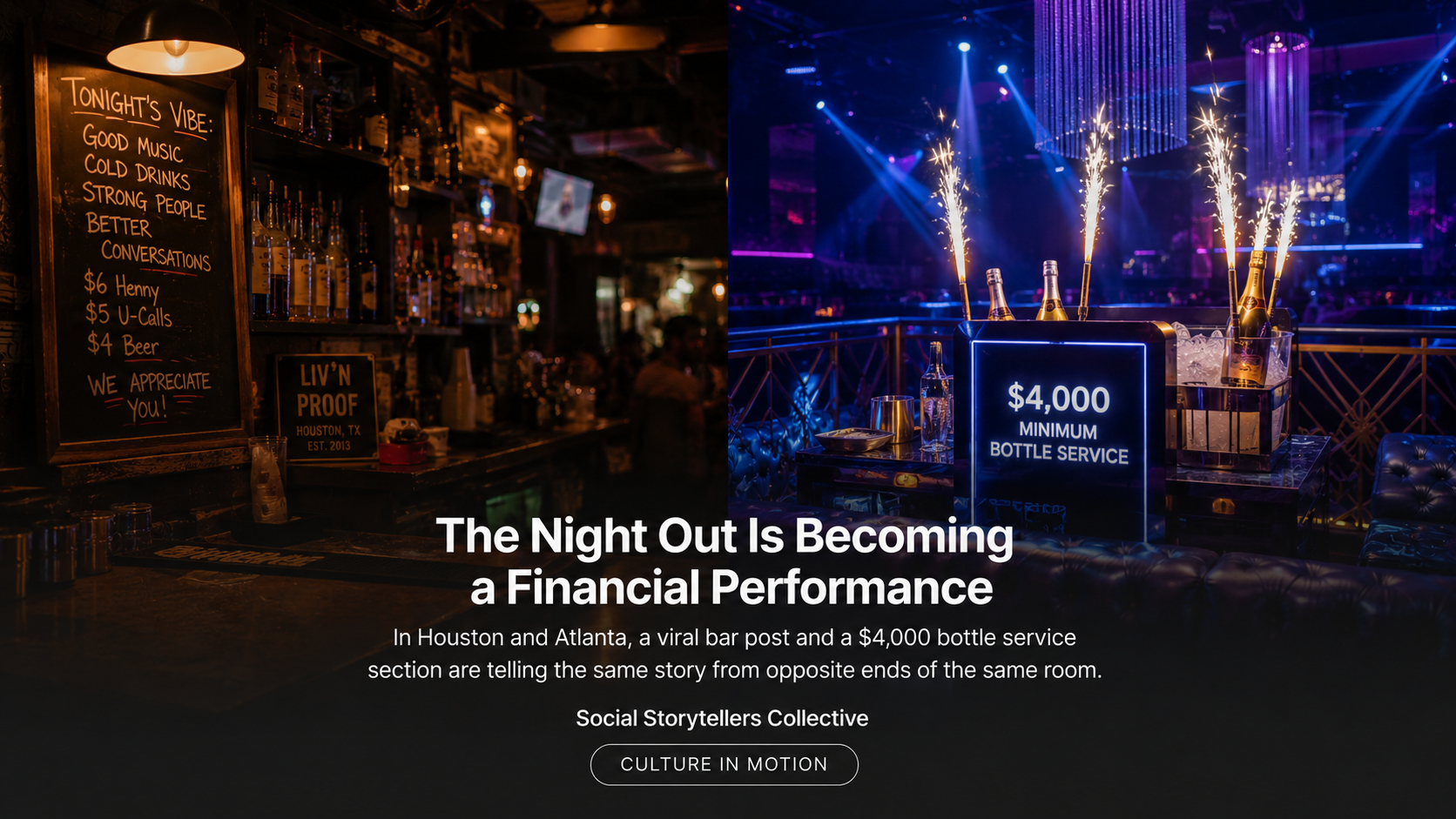
A Houston bar called The Liv’n Room posted something this week that stopped scrolls cold.
Bold red letters. A woman named Jhy center frame. The text: We regret to inform y’all but: JHY IS FIRED. The reveal, tucked in smaller type at the bottom: fired up and ready to serve you the best vibes and cocktails on Sunday. The Monica soundtrack running underneath it — “U Should’ve Known Better” — was not background music. It was a second layer of the joke, a choice that rewarded the people who caught it and told them something about the room they were already in.
591 hearts. 100 comments. The comment count is the tell. People didn’t just like the post. They came to participate in it.
The misdirect is the engine. Your brain reads termination before it reads punchline — and that half-second of genuine alarm is what makes the joke land. But the alarm only works if Jhy is someone you already have a relationship with. A stranger getting fake-fired generates nothing. A regular — someone the audience knows, has ordered drinks from, has a feeling about — generates exactly this.
That is the whole argument in miniature. The Liv’n Room is not marketing at its audience. It is marketing through a shared language — one that assumes Monica familiarity, assumes Jhy familiarity, assumes enough communal investment that a fake firing creates real stakes. Corporate hospitality brands hire agencies to approximate this. It does not approximate. It either lives in the community or it doesn’t. The Liv’n Room found its specific. That is rare. And it is worth naming — because it stands in direct contrast to what much of the nightlife economy has become.
In the same cities where moments like The Liv’n Room’s post go viral, a different kind of nightlife content is also spreading — and it tells a more complicated story about what a night out now costs and what it means.
Viral social media posts highlighting nightclub sections priced between $2,000 and $4,000 are circulating widely across Houston and Atlanta feeds. The immediate reaction in comment sections is usually sticker shock. The deeper story is not the price. It is what the price is for — and why people are paying it.
The economics of nightlife have changed dramatically over the last decade. Clubs increasingly rely on high-margin bottle service and premium table reservations to offset rising operating costs tied to real estate, security, insurance, staffing, and entertainment bookings. What used to be an occasional luxury has gradually become the business model itself. In many major cities, general admission customers subsidize the atmosphere while high-spending sections subsidize the profitability. The room is designed around the appearance of exclusivity because exclusivity has become the product being sold.
Social media accelerated this transformation. Instagram and TikTok changed nightlife from a localized experience into a broadcastable identity performance. A section is no longer simply a place to sit. It is content. Sparklers, bottle parades, branded signs, and elevated seating arrangements are engineered for visibility because visibility now carries cultural and sometimes economic value. The section operates as proof of access in an economy where access increasingly functions as currency.
That pressure lands differently in Houston and Atlanta because both cities occupy specific positions in Black cultural and professional life. They are major centers of Black entrepreneurship, entertainment, sports, and upward mobility narratives. In those environments, nightlife spending becomes tied to broader ideas around success, aspiration, networking, and image maintenance. The issue is not that people are enjoying luxury experiences. It is that the surrounding culture increasingly normalizes high-cost participation even as broader economic pressures continue intensifying outside the club walls.
The contradiction becomes sharper when placed against the wider affordability crisis affecting younger professionals. Rent costs remain elevated. Student loan payments have resumed for millions of borrowers. Credit card debt continues climbing. White-collar layoffs are spreading through the professional class that drives much of this spending. Yet highly visible luxury spending persists — because the modern economy rewards the appearance of success almost as aggressively as success itself.
In some cases, the social value of seeming financially comfortable outweighs the financial logic behind the spending decision. That is not a moral failure. It is a rational response to a culture that has made visibility a form of economic participation. When homeownership feels delayed, retirement feels uncertain, and traditional milestones feel less attainable, experiential luxury becomes easier to justify — because it produces immediate visibility and temporary escape. The VIP economy thrives in periods when long-term stability feels out of reach. People may not believe they can buy permanence anymore. But they can still purchase proximity to the appearance of it for one night.
The Liv’n Room and the $4,000 bottle section are not opposites. They are two expressions of the same underlying need — to belong to something, to be seen inside a room that feels worth being in, to participate in a shared experience that carries meaning beyond the transaction.
The difference is in the architecture. The Liv’n Room built belonging through community — through Jhy, through Monica, through the joke that only works if you’re already family. The VIP section builds belonging through spending — through the sparklers, the sash, the section that proves you made it.
One is free to participate in. The other has a cover charge that could cover two months of rent.
Both are selling the same thing. Only one of them knows its audience well enough to give it away.