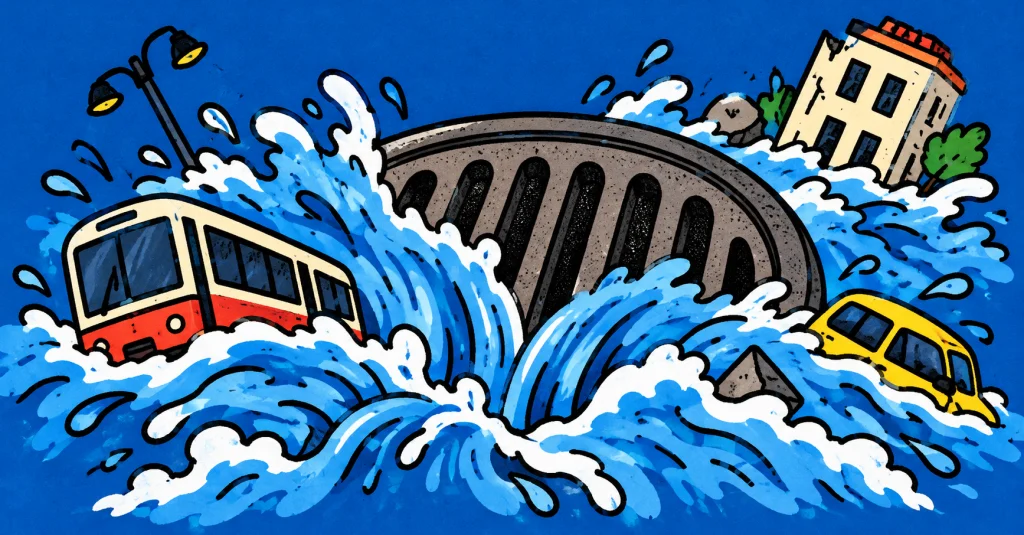
Heavy rainfall flooded homes, businesses and major transportation routes across Turkey’s largest city. The disruption illustrates how quickly extreme weather can overwhelm the systems that keep urban life functioning.
More than 2,700 people were evacuated after severe rainfall flooded Istanbul’s roads, homes and businesses, leaving at least three people dead and four reported missing as of Thursday morning, October 15. The downpour inundated underpasses, stranded vehicles and disrupted public transportation across Turkey’s largest city. Authorities closed schools, restricted motorcycle traffic and urged residents to avoid unnecessary travel as emergency crews worked to clear damaged streets and rescue stranded residents. Some areas experienced their heaviest rainfall since 1985, according to municipal officials cited by the Associated Press. The immediate emergency was a weather disaster, but the scale of the disruption also raises questions about urban drainage, transportation resilience and the ability of rapidly developing cities to withstand increasingly severe rainfall.
A city brought to a standstill
The flooding began after heavy rainfall intensified Wednesday evening, overwhelming roads and underpasses during a period when many residents were traveling home. Emergency crews responded to widespread flooding, stranded motorists and damage to residential and commercial properties. According to figures from Istanbul’s governor’s office reported by Anadolu Agency through Reuters Connect, authorities recorded 1,277 flooding incidents and 15 landslides. Emergency services received 2,518 weather-related reports, while the flooding affected 808 homes, 280 businesses and 76 vehicles. Those figures demonstrate that the damage extended far beyond a handful of submerged streets. It affected the spaces where people live, work and depend on public infrastructure.
The vulnerability of transportation networks
Urban transportation systems are particularly exposed when intense rainfall overwhelms drainage infrastructure. Roads and underpasses can become dangerous as water accumulates, while transit stations and pedestrian routes may become difficult or impossible to access. Istanbul experienced widespread congestion as commuters sought shelter and vehicles became stranded. Anadolu reported that traffic density reached approximately 90% during Wednesday’s evening rush hour, with disruptions affecting bus, metro, tram and Metrobus services. These systems are essential to a city of Istanbul’s size, where residents rely on transportation to reach jobs, schools and medical appointments. When a major network stops functioning, the consequences extend into economic activity and access to essential services. The flood therefore created both a public-safety emergency and a disruption to everyday urban mobility.
The costs extend into homes and businesses
Flood damage can create financial consequences long after streets reopen. Homeowners and renters may face repairs, replacement costs and temporary displacement. Businesses can lose inventory, equipment and operating revenue when floodwaters enter commercial properties or prevent employees and customers from reaching them. The reported damage to hundreds of homes and businesses in Istanbul suggests that recovery will involve more than clearing debris from roads. Local authorities will need to assess building safety, restore utilities where affected and determine which public infrastructure requires repair. The financial burden may fall unevenly depending on insurance coverage, household savings and access to government assistance. The available reporting does not yet establish the total economic losses or how those costs will be distributed.
Extreme rainfall tests urban planning
In Istanbul’s Omerli area of Beykoz, rainfall reached approximately 193.84 millimeters, according to the governor’s office figures carried by Anadolu. That volume of precipitation can overwhelm drainage systems, especially where water must pass through constrained channels or built-up areas. However, rainfall intensity alone does not explain every instance of flooding. Land use, drainage maintenance, road design, construction patterns and the location of buildings can influence how water moves through a city. Investigators will need to determine which of those factors contributed to the most severe damage in Istanbul. It would be premature to attribute the entire disaster to a single infrastructure failure or to climate change without supporting analysis. The event nevertheless illustrates why cities must evaluate infrastructure against severe-weather scenarios rather than relying exclusively on historical operating conditions.
Emergency response and public accountability
Authorities mobilized a substantial response as the flooding intensified. Anadolu reported that approximately 8,000 personnel and 2,000 vehicles and construction machines were deployed, while officials established a crisis coordination center. Schools remained closed through Friday, and residents were advised to stay indoors where possible. These measures reduced exposure to dangerous conditions, but the emergency also raises questions about advance warnings, evacuation procedures and coordination across transportation and municipal agencies. The effectiveness of the response should ultimately be evaluated through documented timelines, emergency-service performance and the experiences of affected residents. Reporting on the number of responders deployed is important, but it does not independently establish whether every neighborhood received timely assistance.
The infrastructure questions that remain
Istanbul’s recovery will provide an opportunity to examine which roads, drainage channels, neighborhoods and public facilities experienced repeated or disproportionate damage. Officials will also need to determine whether existing flood-risk maps and emergency procedures adequately reflected the conditions that developed Wednesday night. Future investment decisions could include drainage improvements, infrastructure maintenance, development restrictions in high-risk areas and more accessible public warning systems. Each option carries costs, but so does rebuilding after repeated disruptions. For residents, the central concern is whether they can depend on essential systems during severe weather. Istanbul’s flooding shows how quickly that access can disappear and why recovery should include a serious examination of the infrastructure intended to protect it.