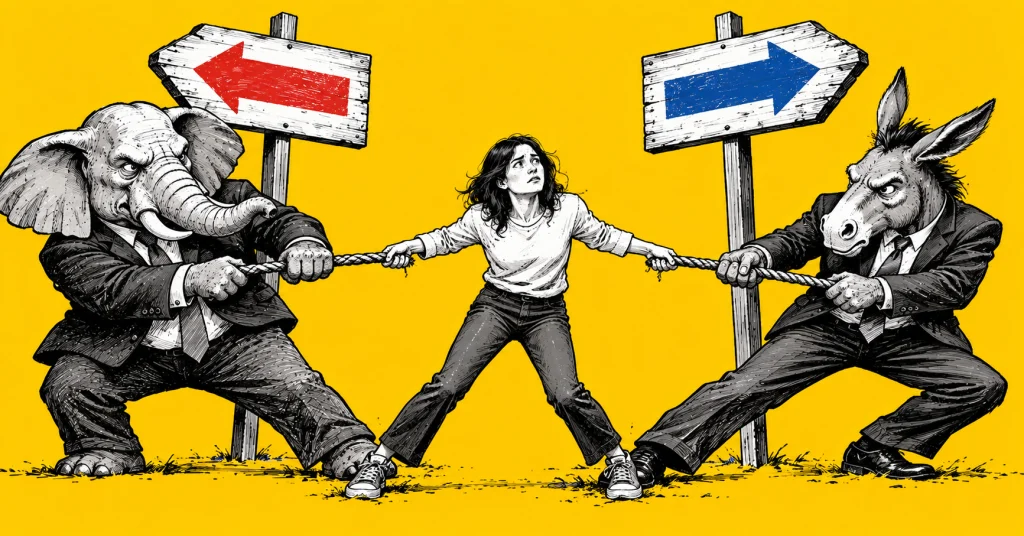
As the midterms approach, new Pew Research Center data helps explain why partisan enthusiasm may not tell the whole story. Many independents who lean Republican or Democratic are being motivated more by opposition to the other party than by confidence in the one they favor.
The 2026 midterm environment is increasingly being shaped by voters who may support one party without feeling much attachment to it.
A Pew Research Center survey found that majorities of Republican- and Democratic-leaning independents say a major reason they lean toward one party is that they believe the other party’s policies are harmful to the country. By contrast, relatively few say they lean toward their preferred party because they believe its own policies are good for the country.
Among Republican-leaning independents, 56% said opposition to Democratic policies was a major reason for their political lean, compared with 34% who pointed to the benefits of Republican policies. Among Democratic leaners, 64% said Republican policies were harmful, while just 27% said Democratic policies were good for the country. Pew surveyed 9,750 U.S. adults from May 26 to June 1.
That helps explain the midterm mood
The findings add useful context to SSC’s earlier reporting on the 2026 congressional elections. In Democrats Have an Eight-Point Midterm Lead. The Bigger Warning for Republicans Is Who Wants to Vote., we examined polling showing Democrats with an advantage in the congressional vote while also finding stronger engagement among Democratic voters.
The new Pew data suggests that some of that energy may be driven less by enthusiasm for Democrats than by opposition to Republicans.
That pattern exists on both sides. Self-identified Republicans and Democrats are much more likely than independents to say their own party’s policies are good for the country. But even among committed partisans, opposition remains powerful: 73% of Republicans said Democratic policies are harmful, while 75% of Democrats said the same about Republican policies.
The midterms may therefore be shaped as much by negative partisanship as by positive attachment.
Many leaners still do not want the party label
Pew also found that a significant share of independents who consistently lean toward one party still resist formally identifying with it.
About four-in-ten Republican and Democratic leaners said disagreement with their preferred party on important issues was a major reason they do not fully affiliate. Similar shares pointed to frustration with party leadership.
Among Democratic leaners, 44% said frustration with party leaders was a major reason they remain outside the party, up from 28% in 2016. Forty percent of Republican leaners said the same about GOP leadership.
That creates a more complicated electorate than topline Democratic-versus-Republican polling can show. Some voters may reliably support one party in November without believing that party represents them particularly well.
The midterms may be more about rejection than loyalty
That distinction could become increasingly important as Election Day approaches.
A voter does not need to be enthusiastic about a party to be highly motivated to vote against the alternative. That helps explain how a party can struggle with its own image or leadership while still benefiting from strong turnout among voters alarmed by the opposition.
The midterm question, then, may not simply be which party Americans like more.
For a significant number of voters, the more consequential question may be which party they are more determined to stop.