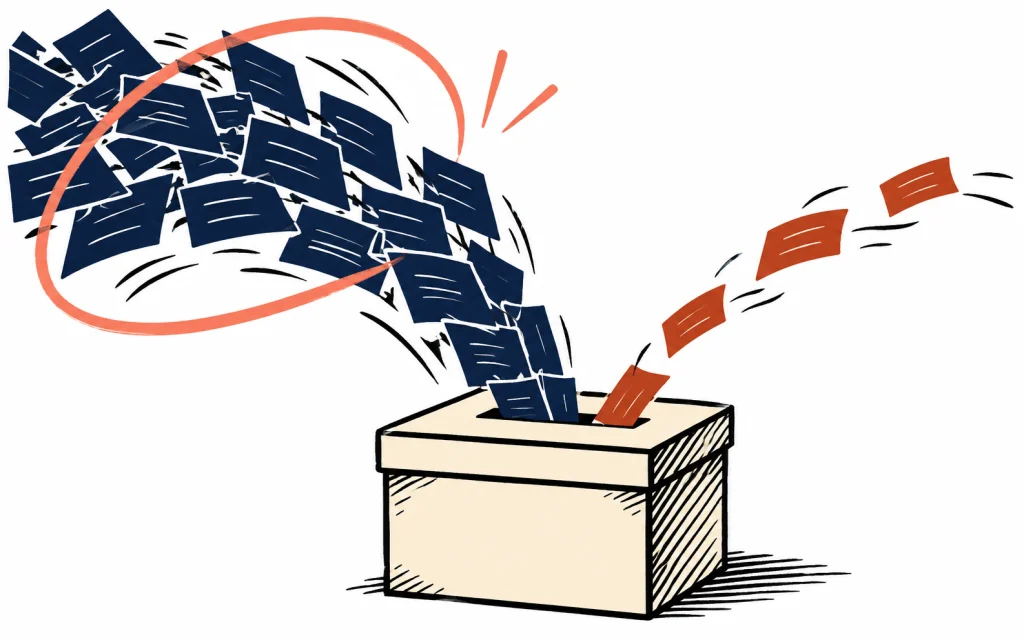
New Pew data shows Democratic voters entering the final weeks of the midterms more motivated and more engaged than Republicans, while Trump’s approval has fallen to 30% and economic frustration remains the dominant issue.
The most important number in the latest Pew Research Center midterm survey may not be the eight-point Democratic advantage in the national House vote. It may be the enthusiasm gap underneath it. Among registered voters, 44% currently say they would support the Democratic candidate for the House in their district, compared with 36% who favor the Republican, according to a survey of 5,062 U.S. adults conducted from September 28 through October 4. But Democratic supporters are also more likely to say the election matters, more likely to have thought seriously about it and substantially more likely to describe themselves as extremely motivated to vote. With Election Day on November 3, that combination gives Democrats something potentially more valuable than a polling lead: voters who appear more prepared to act on it.
The engagement differences are considerable. Seventy-eight percent of Democratic House supporters say it “really matters” which party controls Congress, nine percentage points above Republican supporters. Democrats are also 14 points more likely than Republicans to say they have given the election a lot of thought and 17 points more likely to say they are extremely motivated to vote. That represents a reversal from the environment heading into the 2022 midterms, when Republican supporters held a small advantage on at least one of Pew’s engagement measures. National preference polling does not determine individual congressional districts, and a registered voter is not necessarily a voter who ultimately casts a ballot. But enthusiasm matters precisely because midterms are participation contests. The side that converts more of its supporters into actual voters can outperform what topline national polling initially suggests.
Trump is increasingly part of that motivation. His approval rating has fallen to 30%, with 68% of Americans disapproving, his lowest rating of his second term and roughly comparable to the lowest point Pew recorded near the end of his first. More consequentially for November, 63% of registered voters say Trump is a factor in their congressional vote. But the motivation is heavily negative: 44% describe their vote as a vote against him, compared with 19% who describe it as a vote for him. Among Democratic House supporters, 84% say their vote is against Trump. That gives Democrats a recognizable mobilizing figure even though Trump himself is not on the ballot. Midterm elections frequently become referendums on the governing party, but Pew finds the anti-president component is stronger now than it was against Joe Biden at a similar point in 2022.
There is another warning inside Trump’s own coalition. Among people whose 2024 vote has been validated, 67% of Trump voters currently approve of his job performance while 31% disapprove. At the beginning of his second term, Pew measured approval among those voters at 95%. That does not mean one-third of Trump’s former voters have become Democrats. In fact, the data shows something more complicated. Among 2024 Trump voters who now hold an unfavorable view of the Republican Party, only 49% currently support a Republican House candidate, while 25% are unsure and 14% prefer another candidate. By contrast, 73% of Harris voters who now view the Democratic Party negatively still say they would support a Democratic House candidate. Republican vulnerability may therefore be less about mass partisan conversion than about former supporters becoming disengaged, undecided or unwilling to automatically return to the party.
The Economy Is Still the Center of the Election
The political dissatisfaction is being reinforced by economics. Eighty-four percent of registered voters say the economy is very important to their vote, making it the leading issue among both parties. That includes 88% of Democratic supporters and 82% of Republican supporters, an unusually broad agreement in an election otherwise characterized by partisan division. Pew separately found growing concern about the costs of gasoline, energy and other household necessities as Americans’ assessments of economic conditions become more negative. Only 22% of Americans say they are satisfied with the direction of the country, while 77% are dissatisfied. Even among Republicans and Republican-leaning independents, national satisfaction has fallen to 39%, down from 65% shortly after Trump returned to office. The governing party therefore enters the final stretch carrying both the normal burden of incumbency and an electorate increasingly unhappy with conditions around it.
The rest of the issue agenda helps explain why dissatisfaction is difficult to isolate to one policy fight. After the economy, 73% of voters say the future of democracy is very important, followed by healthcare at 68%, education at 62%, immigration at 59% and foreign policy at 57%. The ongoing U.S. military action in Iran also remains unpopular: Pew found only about a third of Americans approve of Trump’s handling of the conflict, while 77% expect it to continue for at least another six months. Immigration remains more important to Republican voters than Democrats, but Pew found Democratic voters assigning greater importance to the issue than they did four years ago. The 2026 electorate therefore does not appear to be organizing around one clean partisan dividing line. Voters are carrying economic anxiety, institutional concerns, war fatigue and immigration into the booth simultaneously.
The data does not mean Democrats have secured control of Congress. An eight-point national advantage can narrow, congressional elections are decided district by district, and 15% of registered voters remain unsure about which House candidate they would support. What Pew does show is an unfavorable combination for Republicans entering the final three weeks: a deeply dissatisfied public, a president at 30% approval, slippage among portions of his 2024 coalition and an opposition electorate that currently appears more motivated to participate. Republicans still have an energized core, and the economy remains an issue both parties can compete over. But midterms are often decided not only by what voters believe. They are decided by which dissatisfied voters decide showing up is worth the effort. Right now, Pew’s numbers suggest Democrats have the advantage there too.