Immigration enforcement actions are beginning to disrupt Chicago’s construction sector, particularly in trades like roofing, framing, and concrete work, as reported by the Chicago Sun-Times. Contractors are reporting delays tied to labor shortages following recent raids, with some crews unable to maintain staffing levels needed to keep projects on schedule. The disruption is unfolding at a moment when housing demand remains elevated and development timelines are already under strain, turning enforcement into an immediate constraint on production.
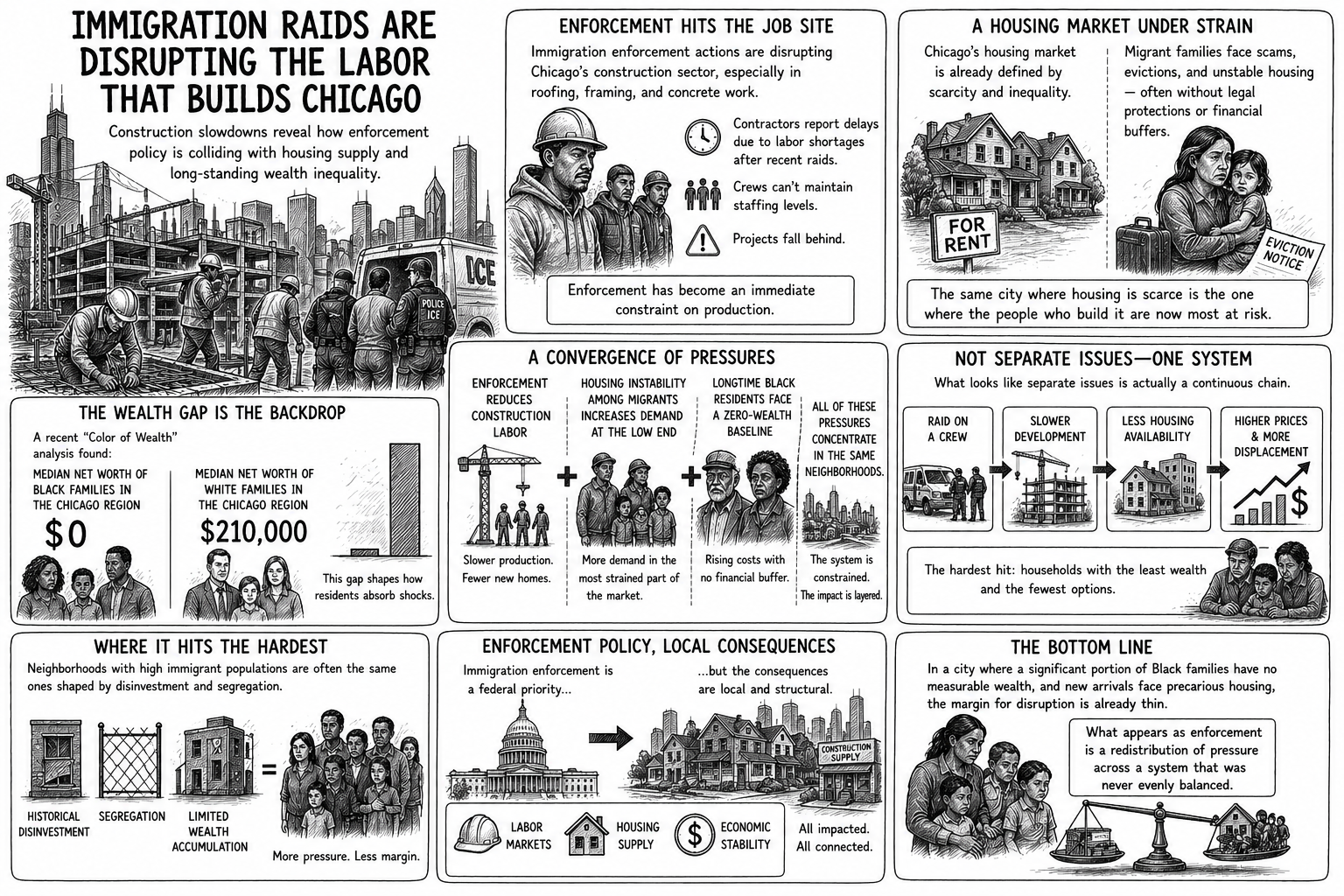
The labor disruption is not occurring in isolation. Chicago’s housing market is already shaped by scarcity and inequality, with both longtime residents and newer arrivals competing for limited supply. Migrant families have reported scams, evictions, and unstable housing conditions as they attempt to navigate the city’s rental market, often without legal protections or financial buffers. At the same time, the workforce that builds and maintains that housing is increasingly exposed to enforcement actions, creating a system where both the supply and the people trying to access it are under pressure.
What makes this moment distinct is how it intersects with Chicago’s deeper economic structure. A recent “Color of Wealth” analysis found that the median net worth of Black families in the Chicago region is effectively $0, compared to roughly $210,000 for white families. That gap is not just a statistic. It shapes how residents absorb shocks. When housing becomes unstable or more expensive, households without accumulated wealth have fewer options, fewer buffers, and less ability to relocate or wait out market shifts.
The result is a convergence of pressures that are usually discussed separately. Immigration enforcement reduces the availability of construction labor, slowing the production of new housing. At the same time, housing instability among migrants increases demand at the lower end of the market, where affordability is already strained. Longtime Black residents, many of whom are navigating a zero-wealth baseline, are positioned within that same constrained system, where rising costs and limited supply compound existing inequality.
This dynamic reframes the story beyond labor disruption. It is not simply that raids are slowing construction. It is that enforcement is interacting with a housing system that is already structurally imbalanced. The same neighborhoods absorbing new arrivals are often the ones historically shaped by disinvestment, segregation, and limited wealth accumulation. The pressure is layered, not sequential, and it concentrates in the same places.
What mainstream coverage often isolates as separate issues — immigration, housing shortages, racial wealth gaps — is operating here as a single system. A raid on a construction crew affects the pace of development. That delay affects housing availability. That scarcity affects pricing. And those price pressures fall hardest on households with the least financial resilience. The chain is continuous, even if the policies are not framed that way.
The broader shift is about how urban systems absorb policy decisions that are not designed with them in mind. Immigration enforcement is being executed as a federal priority, but its consequences are local and structural, shaping labor markets, housing supply, and economic stability simultaneously. In a city where a significant portion of Black families have no measurable wealth, and where new arrivals are navigating precarious housing conditions, the margin for disruption is already thin. What appears as enforcement is, in practice, a redistribution of pressure across a system that was never evenly balanced to begin with.