In 2015, I argued that the former ESPN reporter could rebuild her reputation through accountability and meaningful action. After a confrontation at an NBA game and reports of her departure from the State Department, I’m revisiting what professional redemption actually requires.
Eleven years ago, I wrote about ESPN reporter Britt McHenry after a video surfaced showing her berating an employee at a towing company. She had been suspended for a week, the footage was everywhere, and the public was debating whether one bad moment should define her career. My April 21, 2015, commentary on Medium, Demonstrating Altruism Can Save Britt McHenry’s Television Career, made a straightforward argument: people make mistakes, but restoring a damaged reputation takes more than an apology. It takes consistent action that shows something has changed.
I never imagined I would be revisiting that argument more than a decade later. McHenry moved from sports journalism into political commentary and recently joined the Trump administration as a State Department press adviser. Now she has reportedly resigned after another confrontation captured on video, this time at an NBA game in Washington, D.C., instead of a towing company office. The professional consequences may also have arrived faster.
Page Six reported that McHenry resigned Thursday, October 22, after an altercation at the Washington Wizards’ home opener against the Milwaukee Bucks. According to the outlet, she had been promoted the day before to lead external affairs and press for Under Secretary of State Jacob Helberg’s team, which would put a promotion and a departure roughly 24 hours apart. The State Department declined to comment on personnel matters and has not confirmed the circumstances of her exit.
Another Confrontation, Another Viral Video
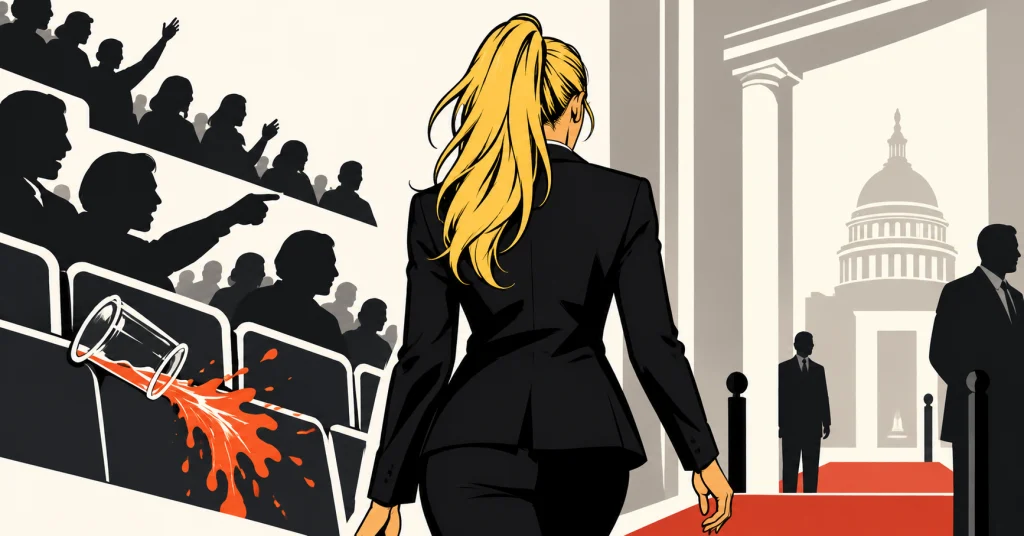
The incident unfolded Wednesday evening at Capital One Arena. Video obtained by TMZ shows her arguing with a spectator seated behind her before throwing a drink in his direction. As she left her seat, members of the crowd booed, and she waved and blew kisses toward them before being filmed exchanging words with arena staff.
The footage leaves out part of the story. Sources close to McHenry told TMZ and Page Six that the confrontation began when male spectators made offensive comments about Bucks forward Kyle Kuzma and his fiancée, model Winnie Harlow. McHenry reportedly stepped in, and the men then turned misogynistic insults on her. Other reporting and additional footage suggest a drink may have been thrown toward McHenry before she responded, and accounts differ on whether she was removed from the arena or left on her own.
Those details matter. If McHenry was being harassed or had a drink thrown at her, that context belongs in the reporting, and acknowledging it doesn’t require excusing her own conduct. It means refusing to reduce a complicated confrontation to whichever few seconds travel furthest online. Even with that context, the episode raises a familiar problem for someone whose job depends on public communication, judgment and composure under pressure.
What I Said in 2015
When I first wrote about McHenry, I was interested in where personal conduct, reputation management and the internet’s growing memory for our worst moments collide. Social media had turned what might once have been an isolated incident into a national conversation, and I argued that public figures needed to understand an apology was only the first step toward repairing trust.
McHenry apologized, ESPN suspended her for a week, and she kept broadcasting. She left ESPN in 2017 during broader layoffs and went on to work in political commentary and television. In September 2026, she announced her appointment as a State Department press adviser.
From the outside, that appointment looked like proof that a widely publicized controversy doesn’t have to close every door. Whether her later opportunities reflected personal growth, professional qualifications, institutional politics or some mix of all three is much harder to know. That is where my original argument still applies, because professional survival and personal accountability can run on separate tracks. Someone can keep advancing, land more influential jobs and collect achievements without the public ever learning what, if anything, they took from the moment that nearly derailed them.
The Difference Between Moving On and Changing
I don’t believe one recorded confrontation should become the complete story of anyone’s character. I didn’t believe it in 2015, and I don’t believe it now. People get provoked, react badly, apologize and grow, and the conflicting accounts of what happened at Capital One Arena are one more reason not to rush to conclusions.
It is still reasonable to look closely at recurring public conduct, especially when the person involved has taken a government communications role. Public affairs professionals speak for institutions, respond under pressure and are trusted to use sound judgment when a situation turns uncomfortable. In September, McHenry was celebrating a new role at the agency responsible for American diplomacy. A few weeks later, her name was circulating again because of footage from the stands, with a career milestone and a reputational crisis landing in the same news cycle.
What I can’t determine from either video is whether McHenry has changed over the past 11 years, because no viral clip offers access to someone’s private growth. What the public can weigh is the conduct it has seen, the circumstances reported by credible outlets and the professional consequences that follow.
Eleven Years Later, the Same Principle Applies
Looking back at my 2015 piece, I still stand by its central premise. McHenry deserved a chance to show growth, and people in her position still deserve that chance. Accountability shouldn’t mean permanent public punishment, and a new mistake shouldn’t erase everything a person has accomplished.
Redemption can’t be measured only by how smoothly someone resumes a career, though. New titles and high-profile appointments show resilience and access, and they say little about whether the behavior underneath has changed. Meaningful accountability shows up in what people do over time, particularly when a situation tests their patience in public.
The public may never know everything that happened in those stands or what was said before McHenry’s reported resignation. I didn’t write about her in 2015 because I wanted her career to end. I wrote because I believed careers can recover when people take responsibility and show real change, and I still believe that. What she does with this next stretch, out of the spotlight of a government title, will say more about the last 11 years than either video can.
Sources: Medium (2015 commentary) · Page Six · TMZ · Front Office Sports