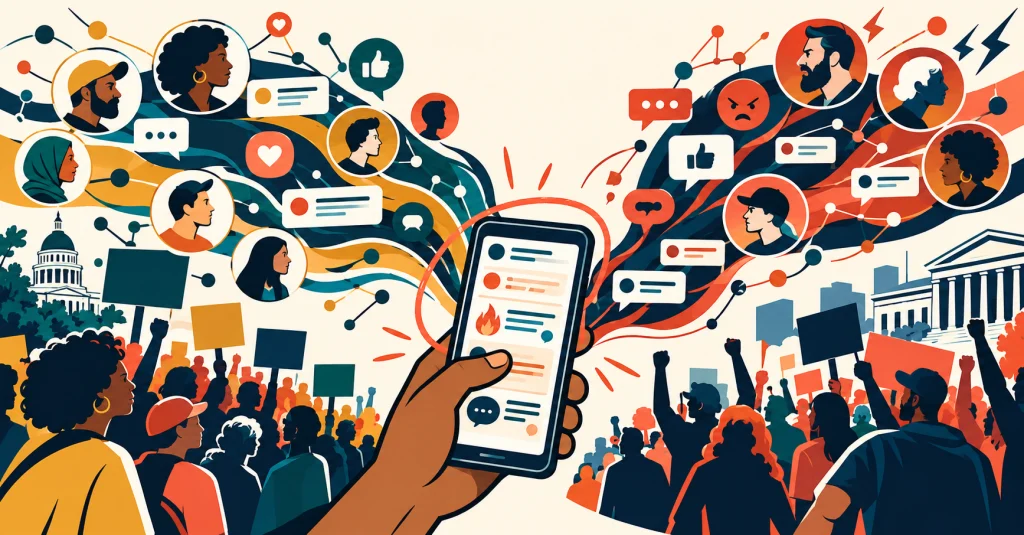
America’s racial tensions are no longer confined to institutions, neighborhoods or political movements. Social platforms, algorithms and automated accounts have built an infrastructure capable of turning resentment into community — and community into mobilization.
The numbers do not describe one uniform surge in American hatred. They describe something more complicated. The Council on American-Islamic Relations received 8,683 complaints in 2025, the highest annual total in its nearly three decades of tracking civil-rights complaints. Nearly half of Asian American and Pacific Islander adults — 49% — reported experiencing a hate act in 2025, according to Stop AAPI Hate. Among Latinos, 34% told Pew Research Center they had personally experienced discrimination or unfair treatment because of their Hispanic background during the previous year, while FBI data showed anti-Hispanic or Latino hate-crime incidents rising approximately 16% in 2025 to the highest level recorded for that category. Black Americans remained the largest racial target in FBI hate-crime statistics, with roughly 2,800 anti-Black incidents in 2025, even after a year-over-year decline. And discrimination against White Americans exists too: FBI data recorded about 880 anti-White incidents in 2025, roughly flat but slightly higher than the year before. These numbers are measuring different things — crimes, complaints, surveys and lived experiences — but together they describe an America where racial identity continues to shape who feels threatened, excluded or targeted.
The Black experience also demonstrates why racial climate cannot be measured by hate crimes alone. A cross burned on someone’s property is easy to categorize; structural disparities rarely arrive with a racial slur attached. In the first quarter of 2026, the Census Bureau reported a 44% Black homeownership rate compared with 75% among non-Hispanic White households, a 31-point divide in one of the country’s primary mechanisms for accumulating generational wealth. The September unemployment rate for Black Americans was about 7%, while long-running federal data continue to show Black unemployment substantially above White unemployment. The Federal Reserve’s newest Survey of Consumer Finances adds another layer: Black household net worth fell approximately 25% between 2022 and 2025 after making substantial gains during the previous period. Racism in America therefore cannot be understood solely through interpersonal hostility. It also exists within accumulated differences in wealth, employment, housing access and the ability to absorb economic shocks.
Nor should anti-White hostility simply be dismissed because its historical context and scale differ from anti-Black racism. The FBI recorded 880 anti-White hate incidents in 2025, compared with 877 in 2024, and Pew found 45% of White adults believed White people experience at least some discrimination in American society. That perception is intensely political: 55% of Republicans compared with 21% of Democrats said White people face at least some discrimination. A healthy discussion of race has to be capable of holding two ideas simultaneously. People can experience genuine hostility because they are White, and the existence of those incidents does not erase the deeper institutional disparities confronting Black Americans or the increased hostility being reported by Latino, Muslim and Asian communities. Treating racial suffering as a competition is precisely how legitimate grievances become fuel for political entrepreneurs who need every group to believe another group is taking something from them.
The new accelerant is the phone in nearly everyone’s hand. Social media did not invent racial resentment, xenophobia or religious prejudice, but it changed the economics of spreading them. In a 2026 investigation of Instagram, the Anti-Defamation League reported that the platform removed only 7% of 253 pieces of extremist or hateful content researchers reported, leaving white-supremacist networks, terrorist propaganda and Nazi merchandise accounts operating on the service. Stop AAPI Hate found that 43% of hate experienced by Asian American and Pacific Islander adults in 2025 occurred online, while its September 2026 analysis found the use of anti-South Asian slurs online rose 109% between 2023 and 2025. NYU’s Center for Business and Human Rights has documented how extremist communities across ideological lines now use multiple platforms to recruit followers, justify violence and keep propaganda networks alive. What once required a meeting hall, printed literature and local organizers can now begin with an account, an algorithm and a recommendation feed.
Then there are the accounts that may not represent people at all. Bots and coordinated inauthentic networks can manufacture the appearance that an idea is more popular than it actually is by posting, reposting, liking and repeating the same narratives at scale. Research published on bot activity and racial discourse found that greater bot activity predicted higher levels of hate speech later in online conversations and that automated accounts could redirect racial hostility toward political identities. California’s Commission on the State of Hate warned in its latest annual report that bots can rapidly distribute hateful messages, target communities and create an illusion of widespread support for extremist positions. That mechanism matters because people take social cues from what appears popular. A racist idea repeated by thousands of automated or coordinated accounts can begin to look like public consensus rather than engineered amplification. The danger of bot culture is therefore not simply that machines can say hateful things; it is that they can distort our perception of how many actual people believe them.
This is where America’s 2026 racial climate feels different from earlier periods of racial conflict. The country has always had organizations built around racial resentment, but today’s infrastructure allows people to move from grievance to validation to organization without leaving the same screen. A person who believes immigrants are replacing them, Muslims threaten their community, Black Americans receive unfair advantages, White Americans are under coordinated attack, or Asian Americans do not belong can find an ecosystem that confirms the belief almost instantly. Algorithms reward engagement, and anger is exceptionally good at producing it. Repetition then turns fringe language into familiar language; familiar language becomes socially permissible language; and socially permissible language makes recruitment easier. The pipeline does not require everyone exposed to extremist content to become an extremist. It only requires enough people to become more comfortable with dehumanization, suspicion and collective blame.
That is why the most useful question in 2026 is not whether America is more racist than it was five, 10 or 50 years ago. The federal numbers themselves resist such a simple conclusion: the FBI says overall reported hate-crime incidents declined 7% in 2025, even as anti-Latino incidents reached a record high, anti-Muslim civil-rights complaints remained at record levels and racial disparities persisted elsewhere. The more urgent question is whether America has built a communications system that makes racial conflict easier to manufacture and harder to contain. The evidence increasingly says yes. We are entering an era when a real injustice can be amplified alongside a fabricated grievance, when an authentic community can be infiltrated by automated accounts, and when a few hundred committed extremists can appear to be a movement of millions. The threat is not simply that Americans disagree about race. It is that we increasingly cannot tell when those disagreements are being deliberately engineered, monetized and mobilized — and by the time they move from the feed into the street, the algorithm has already done its work.