
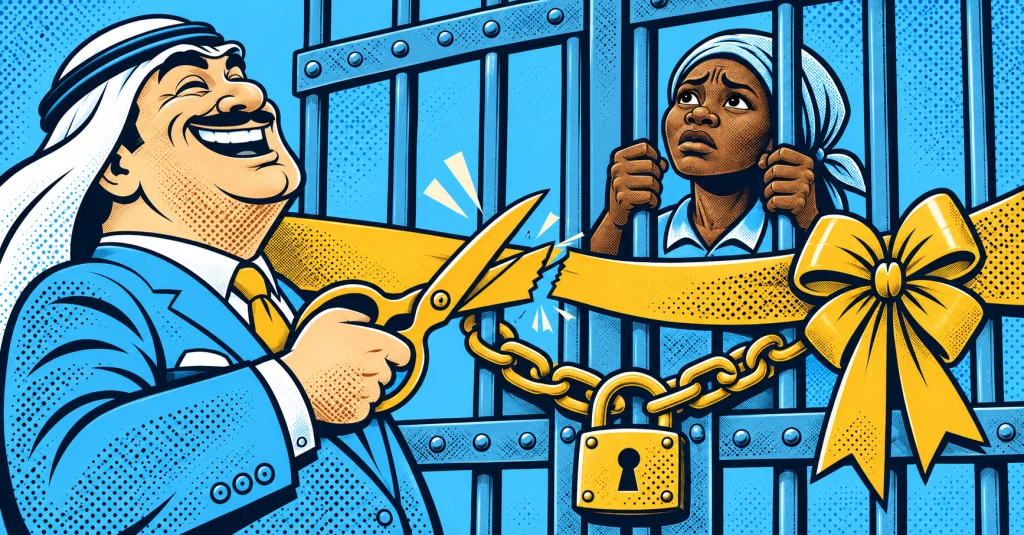
On Monday the ILO closed its case against Saudi Arabia, nine years after it closed Qatar’s the same way. Kenya has just agreed to send 10,000 workers a month.
Social Storytellers Collective Newsroom | Nov. 16, 2026 | 5 min read
On Monday in Geneva, the International Labour Organization dropped its forced-labor case against Saudi Arabia. Instead of opening a commission of inquiry, it accepted a five-year workplan built around six priority areas. Workers’ delegates from 36 countries filed the complaint in 2025 over forced labor and wage theft under kafala, the system that ties a migrant worker’s legal status to a single employer.
We’ve seen this before. In 2017, the ILO closed a similar complaint against Qatar in exchange for a cooperation program that Qatar funded with $25 million. Nine years later, Human Rights Watch says migrant workers there still face widespread abuse under a restrictive kafala system. Josimar’s Sam Kunti called the Saudi deal a repeat of Qatar’s playbook in the buildup to the 2022 World Cup.
Why This Matters
- A commission of inquiry is the ILO’s strongest tool. The threat of one is the only real leverage the process has. Once a case closes, that leverage becomes a workplan the government helps write.
- “Abolished” rarely means gone. Saudi Arabia announced the end of kafala in June 2025. In April, UN experts said wage theft, passport retention and extortionate recruitment fees were still being reported among an estimated 16 million migrant workers.
- Domestic workers get left out. Reforms target what outsiders can count, such as exit permits and job transfers. The women working inside private homes are usually outside those protections.
The Grid
Eight countries have used the system. Here’s what each one promised, and what’s still in place.
| Country | Promised | Still in place |
|---|---|---|
| Saudi Arabia | End of kafala (2025) | Wage theft, seized passports, recruitment fees |
| Qatar | “Abolished” (2016) | Widespread abuse, per Human Rights Watch |
| Bahrain | Claimed abolition | Lawmakers blocked a ban on seizing workers’ IDs (2026) |
| UAE | New labor law (2021) | Documented abuse of domestic workers |
| Kuwait | No major reform | A 2025 exit-approval rule that tightens sponsorship |
| Oman | Smaller reforms | No cap on domestic workers’ hours |
| Lebanon | New worker contract (2020) | Blocked by a court after recruiters sued |
| Jordan | — | Sponsorship system remains in use |
Sources: ILO, UN OHCHR, Human Rights Watch, Migrant-Rights.org, Lawfare.
Look at who stopped the reforms. In Lebanon, the court sided with recruitment agencies, which argued the new contract would hurt their business. In Bahrain, the Chamber of Commerce fought the ID-seizure ban. The businesses that profit from dependency keep getting a veto over the reforms meant to end it.
Kenya Signs Up for More
Two days before Geneva closed the case, Kenya moved in the opposite direction. Labour Cabinet Secretary Alfred Mutua signed a deal in Riyadh on Saturday, The Star reported.
- The target: at least 10,000 Kenyan workers placed in Saudi Arabia every month
- The safeguard: a three-month pilot under an agreed all-inclusive recruitment cost ceiling
- The jobs: drivers, hospitality, teachers, nurses, construction, retail and oil and gas
A fee cap limits what a worker pays to get to Saudi Arabia. It doesn’t change who holds her passport once she lands there.
Kenya knows what happens after landing. One year to the day before the signing, The New York Times’ Abdi Latif Dahir and Justin Scheck reported that Kenyan maids working in Saudi Arabia had their passports confiscated, wages denied and food withheld. Earlier Times reporting counted at least 274 Kenyan workers, mostly women, dead in Saudi Arabia in five years. Saudi Arabia sets wages country by country, and the Times found Kenyan household workers earn about 40% less than Filipinos doing the same job. When sending countries negotiate one at a time, they compete on price.
What Comes Next
Between Saturday and Monday, the pressure on Saudi Arabia’s labor system eased twice. In Geneva, the case turned into a workplan. In Nairobi, worker protections turned into a quota. Southeast Asia is trying the other approach: on Sunday, ASEAN leaders adopted a joint declaration targeting recruitment abuses, negotiated as a bloc.
Expect Kenya’s first pilot report early next year to lead with placements, not complaints. Expect Riyadh to cite Monday’s ILO decision the way Doha cited 2017, while the workplan runs out before the 2034 World Cup. Until East African governments bargain together, the price of their workers will keep being set in Riyadh.