I have been a Spotify subscriber for over ten years. I listen most days from the time I wake up through my workouts at Gold’s Gym and Lifetime Fitness, through work, and into the evening. I look forward to Spotify Wrapped every December the way some people look forward to a performance review — it’s the one moment in the year where the platform shows you the data it has been quietly collecting about your life, and you get to see yourself reflected back in it. I also use their AI DJ feature, which curates a continuous mix based on my listening history without me having to make a single decision. And I have a Peloton. Which means Spotify just built this feature for me — and I never asked for it. That is worth paying attention to.
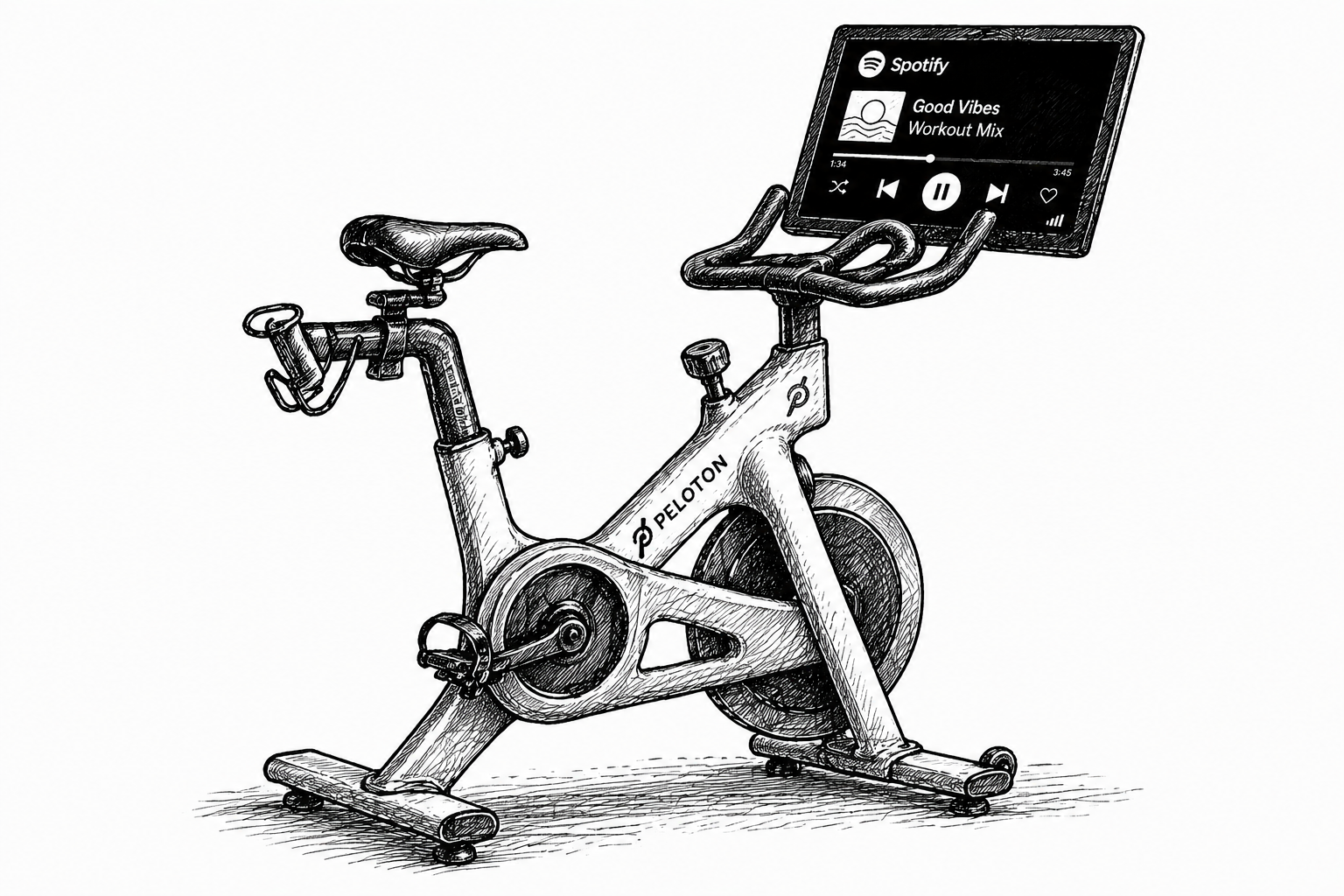
With its new fitness hub — built through a partnership with Peloton — Spotify has introduced guided workouts, instructor-led classes, and curated movement content directly into its ecosystem. Users can now move from a playlist to a Pilates session to recovery audio without switching apps, devices, or contexts. What looks like a feature expansion is more precise than that. It is an attempt to eliminate friction between moments in a user’s day, collapsing previously separate activities into a single continuous experience. The platform is not entering fitness. It is absorbing it.
The logic behind this move is already visible in how people use Spotify. The platform has long functioned as background infrastructure — music for commuting, working, exercising, and unwinding. The addition of fitness formalizes behavior that already exists. Millions of users were already building workouts around playlists or pulling in content from elsewhere. By integrating structured fitness content directly into the app, Spotify is not creating a new habit. It is capturing an existing one and preventing it from migrating elsewhere. The shift is less about entering fitness and more about retaining time.
That distinction matters because platforms are no longer competing solely for attention. They are competing for continuity. Each moment that requires switching apps introduces the possibility of loss — loss of engagement, loss of data, loss of monetization. By keeping users within a single ecosystem from activity to activity, Spotify increases both the duration and the depth of interaction. A run becomes a playlist, becomes a guided session, becomes recovery audio, all within one loop. The experience feels seamless. The outcome is structural: more of the user’s day is routed through a single platform. The AI DJ I use daily is already doing this — making decisions about what I hear next so that I never have to stop and choose, never have to leave the loop. Spotify just extended that same logic into my body in motion.
This is the same logic that has driven Spotify’s expansion into podcasts and audiobooks. Music alone creates entry points but does not fully occupy time. Spoken-word content fills longer, more focused stretches of the day — commuting, chores, extended listening sessions. Fitness extends that logic further into physical activity, an area that was previously adjacent but external. Each addition is not random. It maps to a different segment of daily life, gradually reducing the need to leave the platform at all.
The Peloton partnership is particularly instructive because it accelerates this transition without requiring Spotify to build credibility from scratch. Rather than constructing a fitness ecosystem, Spotify is importing an established one — with existing instructors, formats, and user trust already intact. The content remains the same. The container changes. And the container determines how engagement is captured, how data is collected, and where the value of that interaction is ultimately retained.
What emerges is a different definition of what a platform is. Spotify is no longer positioning itself as a destination for music or even audio. It is positioning itself as a layer that sits across multiple activities, structuring how those activities are experienced. When the platform describes itself as a “daily wellness companion,” it is signaling an ambition to be present across the full arc of a user’s routine from start to finish. I am already living that arc. Most days Spotify is the first thing I open and the last thing I close. The fitness hub is not a new offering for users like me. It is a formalization of something that was already happening — and a signal that the platform intends to deepen it.
This shift carries implications worth naming directly. As platforms expand across domains, they begin to define not just what is available but how it is accessed and experienced. The consolidation of activities into a single ecosystem increases convenience, but it also concentrates control. The same system that reduces friction also determines visibility, prioritization, and discovery within that environment. Wrapped tells me what I listened to. It does not tell me what I was nudged toward, what was surfaced over what, or how my behavior was shaped by decisions made inside the algorithm. That asymmetry is the real product. I am the data. The workout is the new entry point.
Spotify’s move into fitness is not an isolated feature launch. It is part of a larger pattern in which platforms are competing to become the primary interface through which daily life is organized. Music brought users in. Podcasts extended their time. Fitness now captures their movement. I have been a willing participant in that assembly for a decade — and Spotify Wrapped every year is their way of showing me exactly how willing. The platform is not simply expanding categories. It is assembling continuity, one segment of the day at a time. The question worth asking is not whether that continuity is convenient. It is who benefits most from it being seamless.