
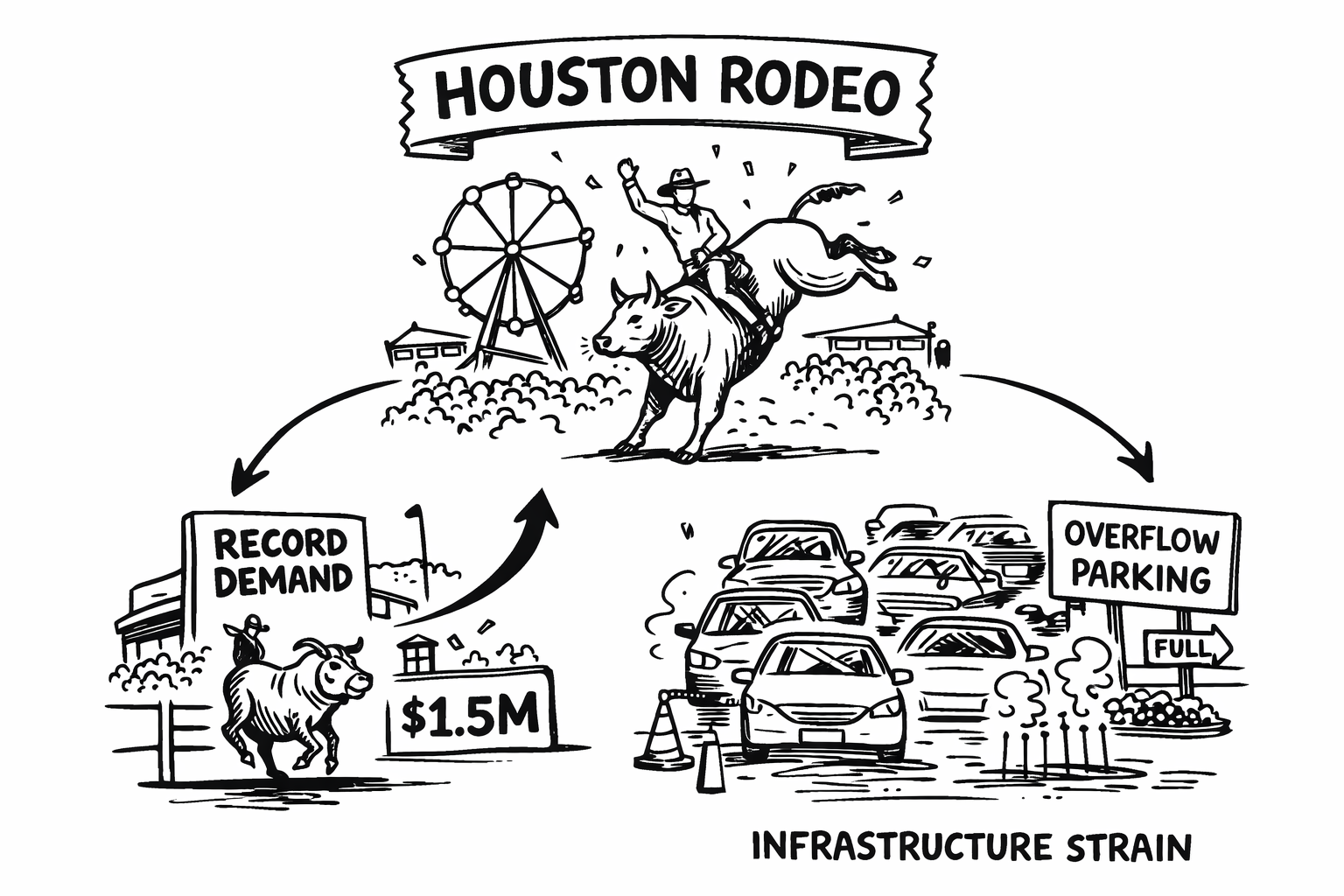
The Houston Livestock Show and Rodeo closed Sunday after a three-week run that once again drew millions of attendees and reinforced its position as one of the largest cultural and economic events in the country. The final night alone set a record, with more than 80,000 people filling NRG Stadium for a closing performance that capped off sustained high attendance across the event. High-value transactions, including a grand champion steer that sold for $1.5 million, underscored the level of spending concentrated within a short window of time. The scale of participation points to something broader than tradition. It reflects continued demand for large, in-person experiences that has not tapered in the way some expected. The energy is held from start to finish.
At the same time, the conditions surrounding that demand became increasingly visible. Traffic congestion intensified across key corridors, parking capacity reached its limits, and movement into and out of event spaces slowed noticeably during peak periods. These are not new dynamics for the rodeo, but their intensity this year reflected a growing mismatch between how quickly participation can scale and how slowly infrastructure can respond. What was once manageable friction began to feel like sustained pressure.
This pattern mirrors what has been unfolding more broadly across the city, particularly during the recent spring break surge, where large inflows of visitors created similar strain across nightlife, transportation, and public space. In both cases, demand was not the issue. The system’s ability to absorb that demand in real time was. The overlap is not incidental—it points to a recurring condition rather than a one-off event.
That condition is defined by speed. Demand can now concentrate quickly, driven by shared attention, social momentum, and tightly scheduled experiences. Infrastructure, by contrast, expands incrementally. Roads, parking systems, staffing, and access points are designed for anticipated flow, not compressed surges. When those timelines fall out of sync, systems do not break immediately. They tighten.
In this environment, two realities can exist at once without contradiction. Participation can remain high, and systems can still feel strained. In fact, the success of an event can amplify pressure rather than relieve it, particularly when activity is concentrated within narrow timeframes and limited geographic space. The more effective the draw, the more it tests what surrounds it.
What the rodeo ultimately reveals is not a failure of the event itself, but a shift in the conditions around it. The event functioned as expected—drawing crowds, generating revenue, and sustaining cultural relevance. The systems supporting it were asked to operate at a scale that is becoming more common, but not yet fully accommodated.