
I live in Houston. I chose it deliberately — the scale, the diversity, the sense that the city is still becoming something rather than having already decided what it is. But living here also means living inside the data. Every morning the city absorbs more people, and every month the cost of that absorption shows up somewhere: in the commute, in the grocery bill, in the conversation about where the affordable neighborhoods still are and how long they’ll stay that way. The numbers below are not abstract to me. They are the conditions of daily life in one of the fastest-growing cities in the country.
Houston ranked second in the nation for total population growth in the twelve-month period ending July 2024, adding 43,217 new residents — the equivalent of a small town arriving every week. At the metro level the scale is larger still: the Houston area added nearly 198,000 residents between July 2023 and July 2024, a pace that translates to roughly 543 new people every day. That rate of growth reframes population change from something gradual into something constant. Instead of expansion happening in phases, it is happening in real time, daily, without pause. The scale matters, but the frequency matters more. When growth becomes continuous, the systems designed to absorb it are forced to operate under sustained pressure rather than periodic adjustment.
That pressure is most visible in housing. Houston has long positioned itself as one of the more affordable major metros in the United States. Housing costs in Houston remain 20.2% below the national urban average — the second lowest among the most populous U.S. metros. But that headline figure obscures what is happening at the household level. The median rent in Houston increased 9% in a single year, according to Rice University’s Kinder Institute for Urban Research — 6% when accounting for inflation. The median home price rose from $325,000 in 2023 to $345,000 in 2024. And the median affordability gap for a Houston home now stands at approximately $130,000 — meaning the median household can afford a home priced around $195,000 in a market where the median sits at $325,000. Even in a city known for building quickly, supply does not always keep pace with demand at the speed of daily arrivals. A single adult in Houston now needs $90,064 annually to live comfortably — nearly $15,000 more than was required the year prior. The affordability advantage is real. It is also narrowing.
Infrastructure is experiencing a similar strain, though it is often less immediately visible. Roads, public transit, utilities, and flood control systems are not designed to expand in real time. Many rapidly growing suburban and exurban areas — especially in northern Harris and Montgomery counties — already grapple with overburdened utility systems, inadequate road networks, and limited transit options that hinder mobility, safety, and access to essential services. Houston’s flood infrastructure adds another layer of complexity that most fast-growing cities do not face at the same scale. After the Texas Supreme Court denied Houston’s motion to appeal a drainage lawsuit in early 2025, Mayor Whitmire settled with plaintiffs on a plan to phase in additional infrastructure funding — increasing the dedicated drainage and street renewal allocation from 57% to 67% in FY 2026 and 77% in FY 2027, with full funding beginning in FY 2028. The city is catching up to its own growth in real time, funding infrastructure that should have scaled alongside the population that required it.
The labor market adds another layer to the story. The median worker in Houston earned $45,984 in 2024, placing the region 17th among the nation’s 20 most populous metros in nominal wages. The cost-of-living adjustment improves that picture — Houston’s purchasing power ranking rises to sixth nationally once local costs are factored in. But that aggregate masks the distributional reality. The living wage for a single adult in Houston is $18.38 per hour. The city’s minimum wage is $15.04. The gap between those two numbers is where the daily financial pressure concentrates — not in the headline employment figures, but in what workers can actually do with what they earn. Houston ranked second in the nation for financial distress, with over 8% of residents carrying accounts in forbearance or deferred payments — a data point that sits uncomfortably alongside the growth numbers but explains, more than any single metric, what sustained pressure actually feels like from the inside.
What makes Houston’s situation distinct is not simply that it is growing, but how it is growing. The city’s model has historically relied on expansion — more land, more development, more outward movement — to accommodate new residents. That model works differently when growth becomes constant. Expansion requires time, coordination, and capital, while population increases happen every single day. The Houston region is projected to add millions of residents by 2050, fueling rapid growth that is often concentrated in unincorporated areas where planning and service delivery struggle to keep pace. The result is a city that must operate in two timelines at once: the immediate reality of incoming residents and the slower pace of structural adaptation.
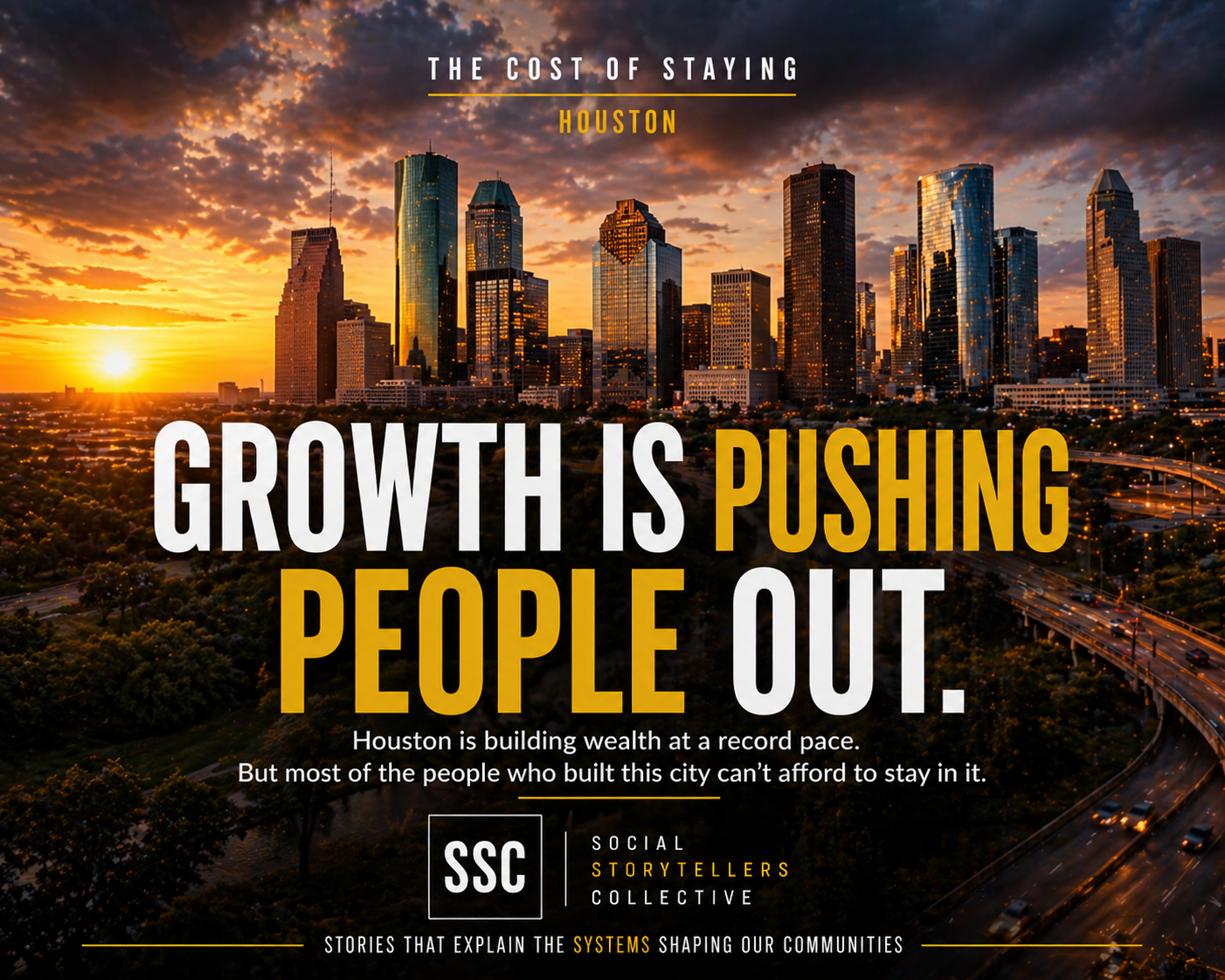
The benefits of growth and the burdens of growth do not distribute evenly. Housing feels it first. Infrastructure absorbs it over time. And affordability reflects it most directly in people’s day-to-day lives — in what gets cut from the budget when rent goes up, in how far workers commute because closer neighborhoods are no longer accessible, in the quiet accumulation of small financial decisions made under sustained pressure. About half of all Harris County neighborhoods lost population between 2023 and 2024, with most of those neighborhoods located within Beltway 8 — the inner city — where higher land prices disproportionately affect neighborhoods where ethnic minorities are the majority. Growth at the metro level and displacement at the neighborhood level are happening simultaneously. That is not a contradiction. It is the pattern.
Houston is approaching 7.8 million residents in its metro area. That scale brings opportunity — real opportunity, distributed across one of the most racially and ethnically diverse regions in the country. But opportunity and pressure are not opposites. They are the same condition experienced differently depending on where you sit inside it. The question is no longer whether the city is growing. It is whether the systems serving its residents — housing, infrastructure, wages, planning — can adapt at the same pace as the people arriving. Growth that does not pause requires systems that can respond continuously. Without that alignment, what looks like expansion on paper begins to feel like pressure in everyday life.
Houston is part of City Signals, SSC’s ongoing series on what cities reveal about who they’re built for. Read the New York City installment now at socialstorytellers.substack.com. The Miami installment publishes May 4. Future cities in the series include Boston, Washington D.C., Los Angeles, Dallas, Austin, and San Francisco.