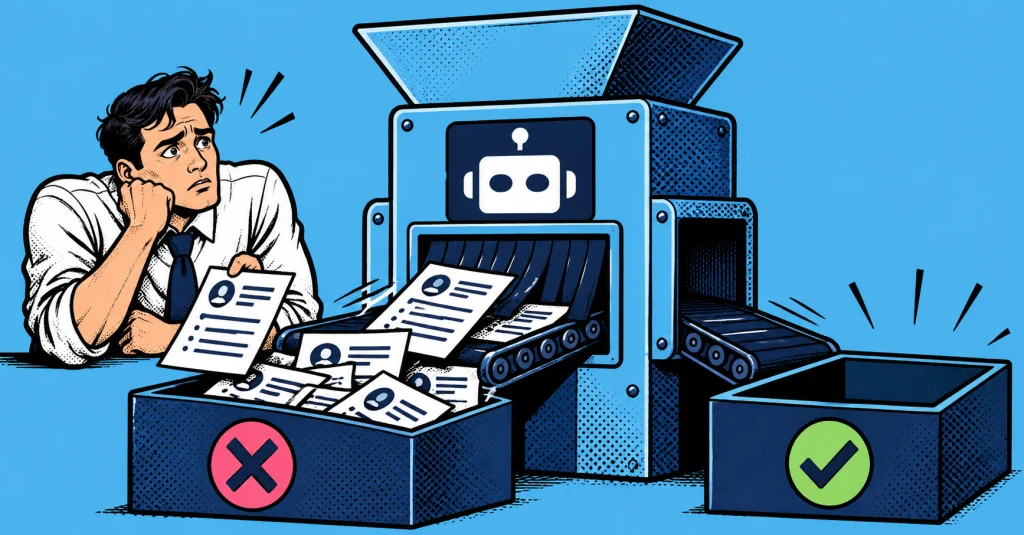
An unverified story about one missing dot is spreading because candidates recognize the pattern, and the problem it points to is that nobody sees what an automated filter rejects.
Max Lockie, an editor at LinkedIn News, reported this week on an anonymous Reddit account shared on LinkedIn. In it, a hiring manager applied under a fake name to a job whose description he had written and was rejected in six minutes. HR had told him the position stayed open because candidates were failing screenings. The alleged cause: his resume said “React” and the filter required “React.js,” two names for the same programming tool. LinkedIn News noted the account has not been independently verified, but it has drawn thousands of reactions across the platform.
A screening filter makes errors that nobody sees. Rejections happen before a human reads the application, and the reports that reach managers show only the people who got through. In the account, the manager found the leak only by posing as a candidate, and until then HR’s explanation was a thin pipeline in a tough market. That explanation describes a labor market, when the cause may have been a setting. The Reddit post cannot prove that, and recruiter Jessica Max said on LinkedIn that none of the four applicant tracking systems she used in the past year works this way. Her doubt is a reasonable limit on the story.
The story spread because candidates have their own versions. Caroline Edwards, a product and service designer, posted that she has been auto-rejected or ghosted 38 times since August 15, after being rejected for only three jobs in her entire previous career. Louis D. wrote that he was rejected for listing “O365” when a posting asked for “Office 365.” These are anecdotes, not data, but they describe the same problem: a candidate cannot tell whether a human read the application.
The people amplifying the warning often sell the replacement. Thomas Chan, CEO of Lantern, posted the story and closed with a pitch for his company’s screening product. J.T. O’Donnell, who runs an AI career coaching business, warned recruiters about what she called the “hiring reject machine.” A failure of one automated tool becomes a sales case for another, so the problem gets framed as bad filters and the fix as better filters. Engineer Gaurav Kesarwani noted that one cheap fix, normalizing synonyms like React and React.js before matching, would have caught this error. Marketer Zain M. argued that people should be read by people.
The scale of automated hiring raises the stakes. More than 80% of U.S. employers use some form of AI in hiring, according to Reuters as cited by Hoodline. In June 2026, a federal judge in San Francisco allowed claims to proceed in Mobley v. Workday, in which plaintiffs allege that Workday’s AI screening disproportionately screens out applicants by race, age and disability. Workday denies the claims, telling reporters its tools do not make hiring decisions and operate with human oversight. The dispute turns on whether an automated screen that decides who a recruiter sees is a tool or a decision-maker.
Whoever configures the filter holds the power, and no one is positioned to check it. Candidates cannot see why they were rejected, hiring managers see only the shortlist, and vendors say humans make the decisions. In the Reddit account, even the person who wrote the job description had no view into it. This hiring process moved power from the people being evaluated, and from the managers who need to evaluate them, to whoever set the rules.
The next fight over screening will be about audit rights: who can see the rejection log. Employers will test their own funnels the way this manager did, candidates will demand explanations through litigation, and vendors will resist disclosure as a trade secret. Whoever wins that argument decides whether an auto-reject is a decision someone must be able to explain or a quiet cost the candidate pays alone.