
The state’s latest reading results expose a stubborn early-literacy gap even as policymakers expand curriculum requirements and tutoring options.
BY SOCIAL STORYTELLERS COLLECTIVE NEWS DESK
OCTOBER 11, 2026
About half of Texas third-graders are not reading at grade level, a stark measure of how many children reach a pivotal point in elementary school without the literacy skills educators expect. Texas Education Commissioner Mike Morath highlighted the problem during the 2026 txEDCON conference in Houston, connecting early reading outcomes to poverty and the challenges students face later in school and work. The concern is supported by the state’s own testing picture: the Texas Education Agency said third-grade reading performance fell by one percentage point in spring 2026, even as several older grades held steady or improved. The Houston Chronicle reported Morath’s remarks, while TEA published its statewide STAAR findings.
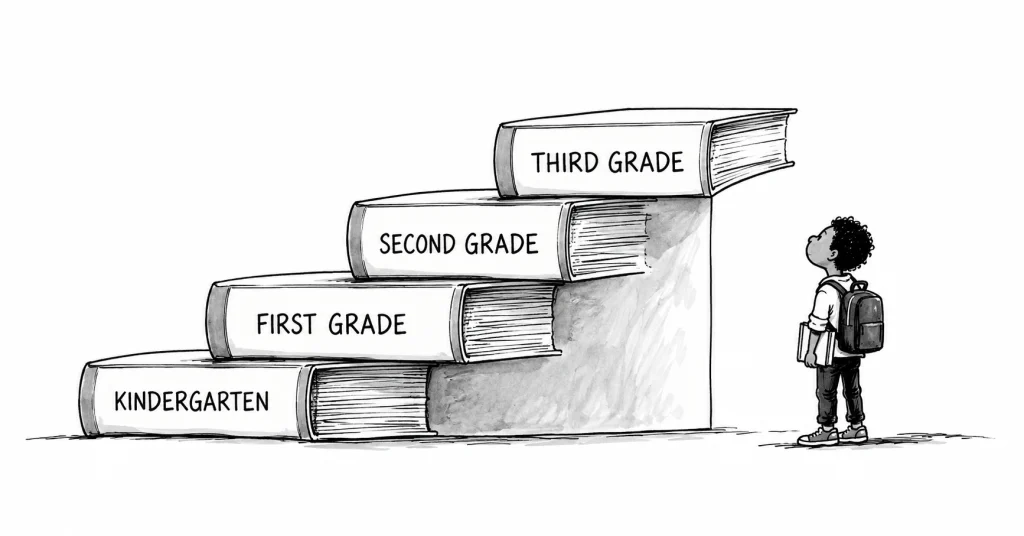
Why Third Grade Is a Turning Point
Early elementary instruction is designed to move students from learning how to read toward using reading to learn other subjects. By third grade, textbooks, written directions and assessments increasingly assume children can decode and understand passages independently. Students who struggle at that transition may have trouble demonstrating what they know in science, social studies and mathematics, even when the underlying concepts are within reach. Reading performance is not a verdict on a child’s potential, but persistent difficulty can compound when schools do not provide timely, targeted instruction.
The state’s results also require careful interpretation. Texas uses several STAAR performance categories, including Approaches Grade Level, Meets Grade Level and Masters Grade Level. Saying a student did not meet grade level is not identical to saying the student cannot read at all. The distinction is important when policymakers translate test scores into headlines or interventions. What the figures establish is that a substantial share of students have not demonstrated the grade-level proficiency expected on the state assessment. That leaves educators with a practical challenge: identifying the specific reading skills students have missed and delivering instruction that addresses them.
Texas Has Changed the Instructional Rules
Texas has responded to literacy concerns with statewide reading academies for teachers, an emphasis on phonics-based early instruction and new state-endorsed curriculum materials. The Bluebonnet Learning curriculum is part of that effort, although its inclusion of biblical material has also generated debate. According to the Houston Chronicle, roughly one-third of Texas school districts adopted the materials for the 2025–26 school year. Adoption is only the beginning of the implementation test: teachers need training, time and support to use materials effectively, and districts need to monitor whether students actually make gains.
The 2026 results show why implementation deserves as much attention as policy announcements. TEA reported that eighth-grade reading improved three percentage points and seventh-grade reading improved two points, while grades four through six maintained their prior-year performance. Third grade moved in the opposite direction. Those differences do not prove that one particular curriculum or intervention succeeded or failed. They do suggest that statewide averages can conceal different challenges at different ages, and that early-grade literacy remains an urgent pressure point even when the overall reading picture appears stable.
The Cost of Falling Behind
Literacy gaps are also connected to access outside the classroom. Children may have different opportunities for early language development, tutoring, books, quiet study space and consistent attendance. Poverty can intensify those differences, and a school system cannot assume that families have the money or time to purchase private support. That makes publicly available interventions particularly consequential. In its June release, TEA described the new Parent Access to Supplemental Supports (PASS) program, which offers eligible families up to $400 for literacy tutoring when a child receives a Did Not Meet Grade Level result on the third-grade reading assessment. TEA outlined the eligibility and tutoring program.
The program may help individual students, but the scale of the problem calls for more than a single benefit. Districts will need to show whether instruction, attendance supports and tutoring are reaching the children most at risk of falling behind. They will also need to measure progress beyond the moment a test score is released. For parents, the immediate priority is understanding a child’s results and what targeted help is available. For state leaders, the more consequential measure will be whether next year’s third-graders enter fourth grade with stronger reading skills than this year’s cohort. Texas has identified the gap; the next test is whether its policies close it.