
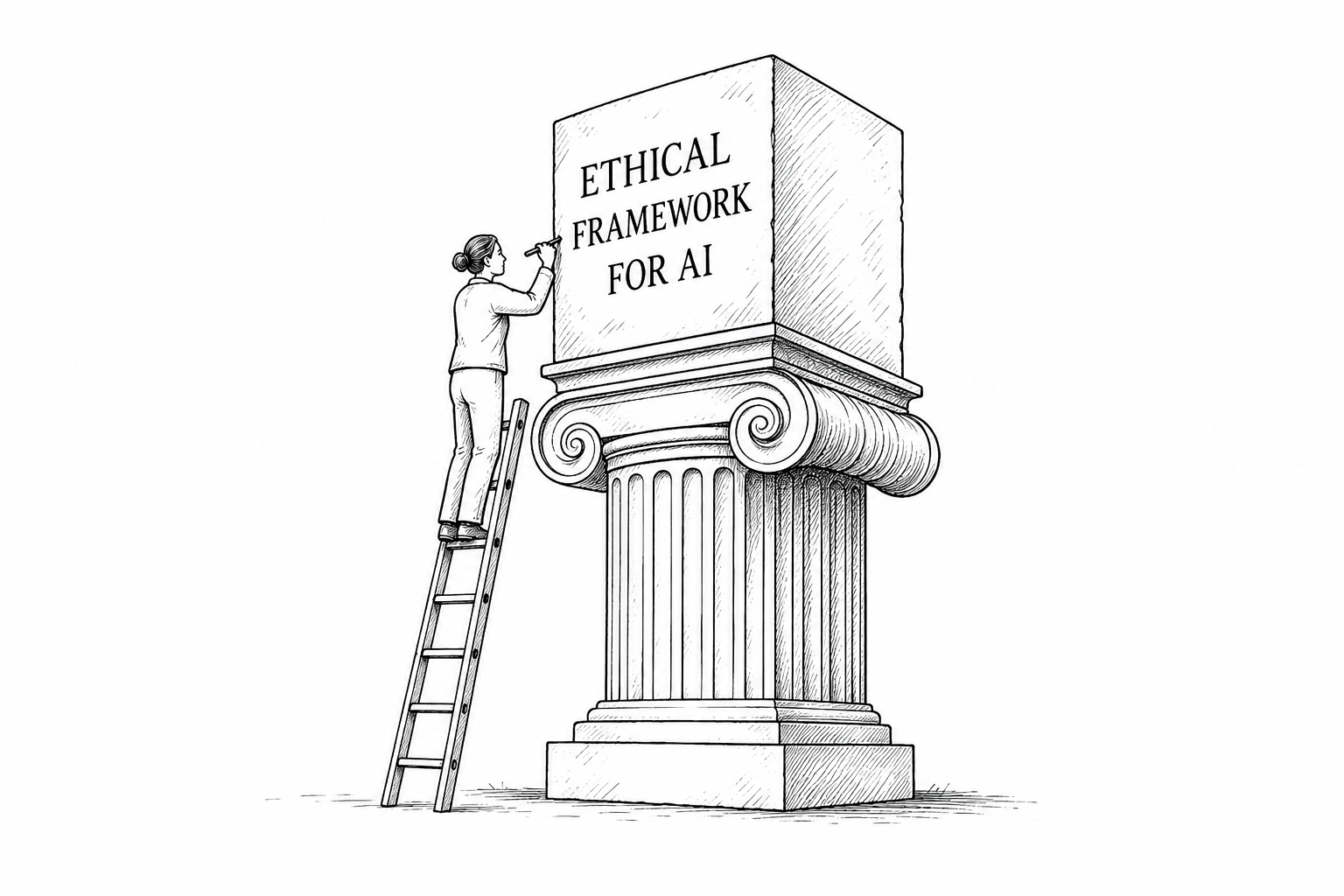
The Atlantic reported this month that philosophy has become one of the technology industry’s most unexpected growth fields, with leading AI companies recruiting scholars to determine how systems reason about ethical conflicts. OpenAICEO Sam Altman said in a September 2025 interview that the company relied on “hundreds of moral philosophers” when developing ChatGPT. Google DeepMind hired Cambridge scholar Henry Shevlin under the formal title of philosopher in April 2026. ZipRecruiter salary data placed AI ethics positions between $66,000 and $177,000 annually as of May 2026.
Every AI response requires a tradeoff. Honesty versus helpfulness. Safety versus openness. Privacy versus transparency. Those decisions cannot be resolved through computation — they require someone to hold authority over which principle wins when two legitimate values conflict. That authority is now being encoded into the training architecture of systems used by hundreds of millions of people daily. The companies hiring philosophers are not adding an advisory function. They are creating a private governance layer for decisions that societies have historically made through legislatures, courts, and democratic deliberation.
At Anthropic, philosopher Amanda Askell leads work that determines how Claude resolves those conflicts. Her 23,000-word Claude Constitution, published in January 2026, establishes an explicit priority hierarchy: safety first, ethical compliance second, company guidelines third, usefulness fourth. At Google DeepMind, political philosopher Iason Gabriel has spent years on value alignment. These scholars are not reviewing products after they are built. They are inside the architecture that determines how models reason before they reach the public — which means the moral framework encoded in their work reaches every user, in every country, in every context the model is deployed.
Universities are following the labor market signal, not a pedagogical one. Higher Ed Dive reported that institutions are investing in philosophy programs focused on AI after years of declining enrollment across the humanities. The market pulled students toward philosophy because technology companies need people capable of translating abstract moral theory into operational rules — and are paying six figures for it. Philosophy did not become valuable because the industry became more thoughtful. It became valuable because AI systems reached a scale at which the value decisions embedded in them could no longer be concealed inside engineering choices.
The philosophical traditions informing these systems are rooted almost entirely in Western analytic frameworks — utilitarianism, deontology, and virtue ethics developed through Oxford, Cambridge, and a small number of American research universities. The models shaped by those assumptions govern hiring decisions in Lagos, healthcare eligibility determinations in Manila, and content moderation outcomes in São Paulo. The communities absorbing the consequences of those frameworks had no representation in producing them. That is not a diversity argument. It is a governance argument: the scope of authority being exercised inside these companies now exceeds the representational mandate of the institutions exercising it.
Business Insider reported in May that critics argue some of these hires function more as evidence of responsibility than as sources of decision-making authority — that the title on the org chart signals seriousness without changing which arguments actually win when ethics conflicts with commercial incentives. The meaningful test is not whether a philosopher appears in the building. It is whether that philosopher can overrule a product decision. No major lab has made that answer public.
The arrangement has a specific consequence for what governance becomes. Legislatures and courts set rules after deliberation, with representation, subject to challenge and revision. Model training documents, internal constitutions, and product policies written inside corporations do the same work without any of those mechanisms. As AI becomes embedded in everyday institutional life, the moral decisions shaping access to jobs, healthcare, credit, and information will increasingly have been made in rooms that were never open to the people those decisions affect. Democratic governance does not disappear in that scenario. It is simply preceded by a layer of private governance that determines the conditions under which public governance operates — and that layer is being written now, by a small number of philosophers, inside a small number of companies, accountable to no one outside them.