
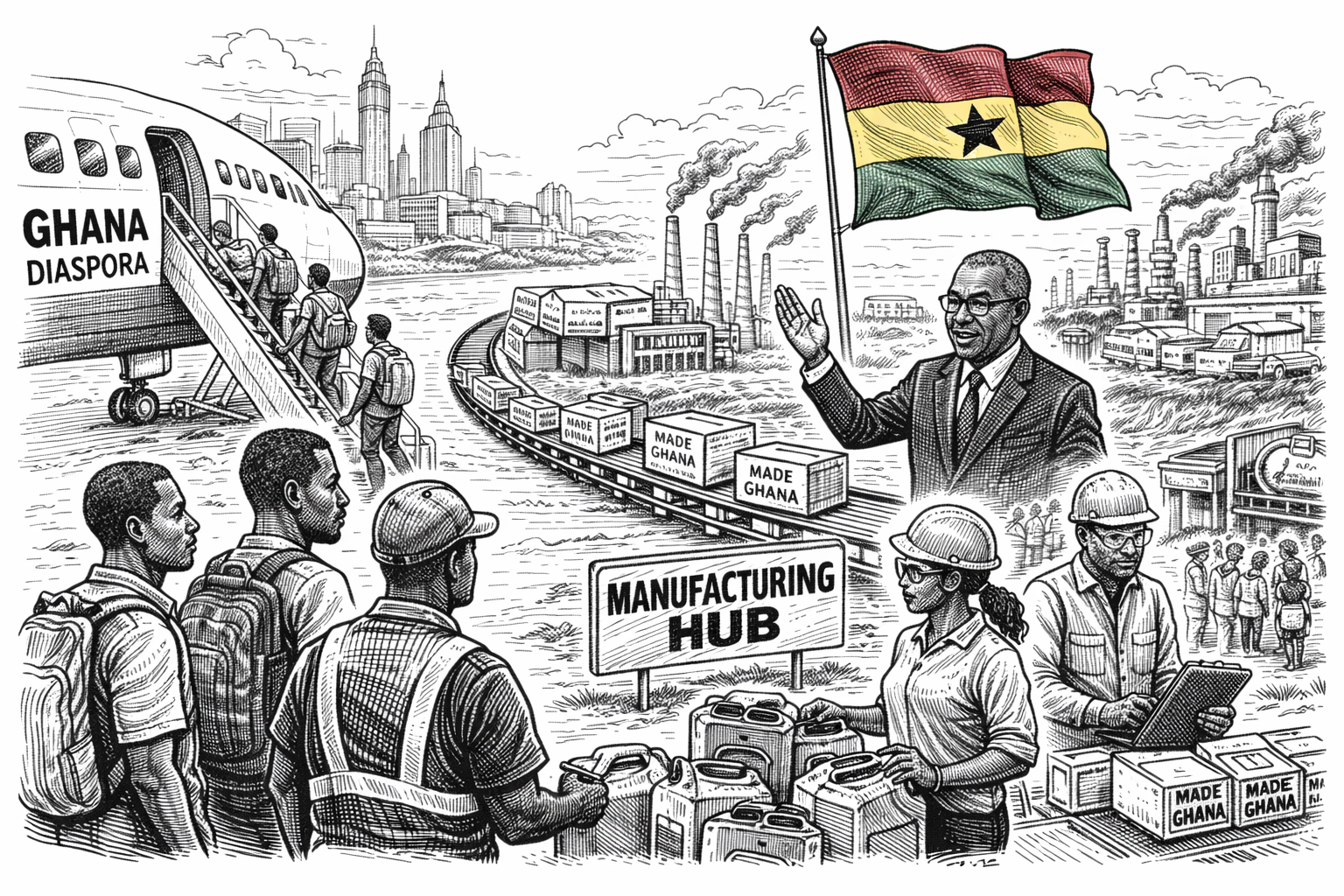
At the Kwahu Business Forum this week, Ghana’s Chief of Staff Julius Debrah delivered a declaration that carried weight beyond the conference hall. Ghana, he said, is positioning itself to become the leading manufacturing hub in West Africa — committed to transitioning from commerce to production, from rhetoric to factories, from a commodity economy to one respected globally for value addition and competitive excellence. Ghana also announced it would extend free visas to all African countries beginning May 25, signaling continental integration as much as tourism.
These are not small statements. They are claims about what Ghana intends to become — and for the West African diaspora in Houston, Atlanta, New York, and London, they land in a specific context. The japa generation — Nigerians, Ghanaians, Senegalese — left not because they stopped believing in their countries, but because the institutional environment made belief insufficient. The question the Kwahu declaration raises is whether that environment is actually changing, or whether the language is evolving while the conditions remain the same.
The economic indicators offer a mixed but notable picture. Ghana recorded 5.5% GDP growth in Q3 2025, driven by agriculture and services, and continues to recover from a debt restructuring that nearly broke its economy two years ago. Nigerian investors pumped $103 million into Ghana’s economy in the first three quarters of 2025, outpacing China in a single quarter — a signal of real confidence in Ghana’s stability and market potential. Meanwhile, Nigeria’s Dangote refinery, if it reaches full capacity, could reduce the region’s dependence on imported refined petroleum and materially lower input costs for West African manufacturing. The macroeconomic conditions for an industrial pivot exist in a way they did not five years ago.
But the structural barriers remain just as real. Ghana’s manufacturing sector has long struggled with power reliability, logistics infrastructure, access to affordable credit, and competition from cheaper imported goods — particularly from China and India. The political will expressed at Kwahu is not new; previous administrations made similar declarations and hosted similar forums. What may be different under Mahama is the convergence of factors: completed debt restructuring, rising diaspora investment interest, and the AfCFTA framework creating a larger continental market for Ghanaian-made goods than any previous industrial moment allowed.
As SSC documented in The Black Immigrant Population Has Doubled, the African-born share of the Black immigrant population in the United States has grown significantly, with Nigerian and Ghanaian communities concentrated in major American cities. These communities are not passive observers of development at home. They are investors, remittance senders, and potential returnees whose decisions are directly tied to whether institutional conditions are actually improving. A manufacturing economy that creates stable employment and middle-class wages changes that calculus in ways no diaspora engagement strategy alone can.
The free visa policy for African countries — effective May 25 — may ultimately be the most underexamined part of this shift. It signals that Ghana is beginning to view the continent not as a source of competition or migration pressure, but as a market, a talent pool, and a shared economic ecosystem. If the manufacturing ambition is real and the continental integration holds, Ghana is positioning itself not just as a West African economy, but as a node in a Black global economic network stretching from Accra to Lagos to Houston to London. That network is the story SSC has been building toward all year.
Why This Matters
The diaspora’s relationship to home is not static. It responds to conditions — to whether the systems that pushed people out are being rebuilt, to whether the economic floor is rising or falling, to whether return or investment makes sense. Ghana’s manufacturing push is a claim about those conditions. The japa generation will not be moved by declarations alone. They will be moved by what the factories actually produce, who owns them, who works in them, and whether the wages are enough to make staying worth it. That answer is not available yet. But the question is now unavoidable — and SSC will be following it closely.