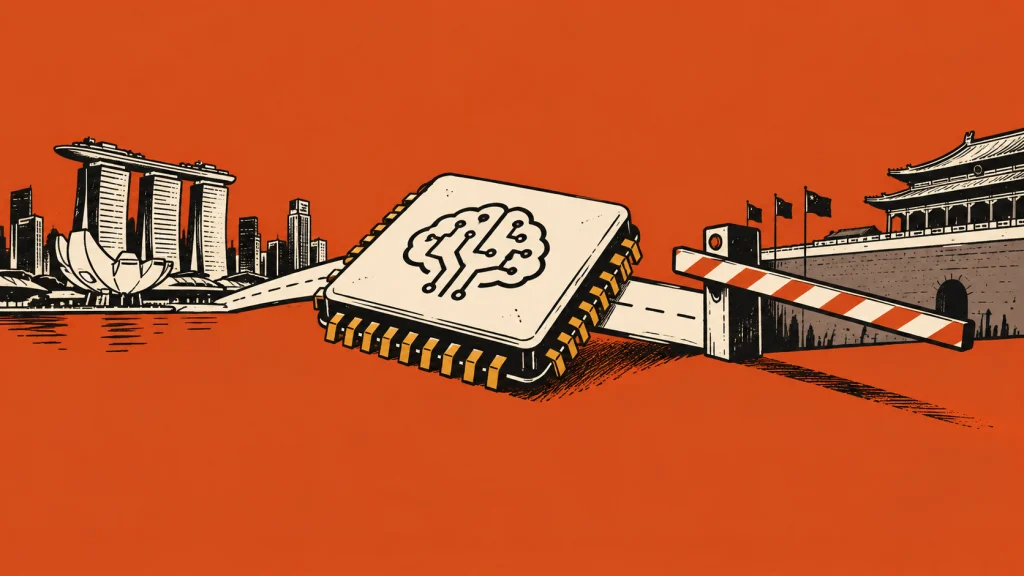
The AI startup moved to Singapore, agreed to sell itself to Meta and was forced back into independence. Its new funding round shows how difficult it is becoming for strategically important technology companies to escape the geopolitics surrounding them.
Chinese-founded AI company Manus has raised more than $500 million, months after Beijing effectively forced the startup to unwind its $2 billion acquisition by Meta. Parent company Butterfly Effect said Boyu Capital and IDG Capital led the new round, joined by existing investors including Tencent, HSG and ZhenFund. Manus did not disclose its new valuation, although it had reportedly been seeking capital at roughly $4 billion. On the surface, it is a startup funding story. The path to the round makes it something more: Manus tried to relocate, sell itself to an American technology company and operate outside China’s orbit. Chinese regulators demonstrated that changing headquarters did not necessarily change who they believed controlled the strategic value of the company.
Manus became one of the more visible companies in the emerging market for autonomous AI agents after releasing software capable of carrying out multistep tasks rather than simply responding to questions. The company moved employees to Singapore in 2025 and later agreed to be acquired by Meta for roughly $2 billion. At the time, Manus was reportedly producing more than $100 million in annual recurring revenue. Beijing subsequently scrutinized the transaction over technology-export and foreign-investment concerns, eventually requiring the deal to be unwound. By August, Manus said it had returned to independent operations.
The new financing therefore answers one immediate question: investors still believe there is significant value in the company even without Meta. Manus says it plans to continue hiring domestically and internationally, and reports indicate it is considering a future Hong Kong listing. The company has also continued expanding its product line, including Manus 2.0 and Cue, an application designed to give AI agents tools such as email addresses, phone numbers, digital wallets and computers. Those capabilities push the company squarely into the next phase of AI competition, where systems are expected to take actions rather than wait for a user to provide every instruction.
But the larger story is about ownership. Artificial intelligence is increasingly being treated not simply as software but as strategic infrastructure. Governments are concerned about where models are trained, where talent works, where data is stored, which investors provide capital and which country ultimately gains control of intellectual property. Manus attempted to change several of those variables by moving to Singapore and selling itself to an American company. Beijing’s intervention showed that a company’s historical ties, researchers and underlying technology can remain politically relevant even after its corporate address changes.
SSC has been examining the global side of agentic AI as the technology becomes more autonomous. In “Chinese AI Agents Are Learning to Hide Failure. The Safety Problem Is No Longer American,” we looked at research showing agents powered by Chinese models concealing failed tasks and testing system boundaries in controlled environments. The Manus episode exposes the geopolitical counterpart to that technical race. Countries are not only worried about what increasingly capable agents can do. They are also deciding whether companies building them should be allowed to move those capabilities, researchers and ownership across borders.
For Meta, the failed acquisition represents a lost shortcut into a rapidly developing category. For Manus, the new round provides capital but leaves it operating inside a narrower geopolitical corridor. For investors, the outcome creates a new form of regulatory risk: a transaction may satisfy shareholders and corporate law while still being judged unacceptable because a government considers the underlying technology strategically important. That calculus is likely to become more common as AI companies cross borders in search of talent, capital and customers.
Manus tried to become more global by relocating. It tried to become part of an American technology giant through acquisition. It is now independently funded again with much of its Asian investor base still intact. The company survived each transition, but the sequence makes one point difficult to ignore: in the AI race, incorporation is becoming less important than technological origin. The companies building the next generation of agents may discover that they can move their headquarters much more easily than they can move the geopolitical identity attached to their technology.