
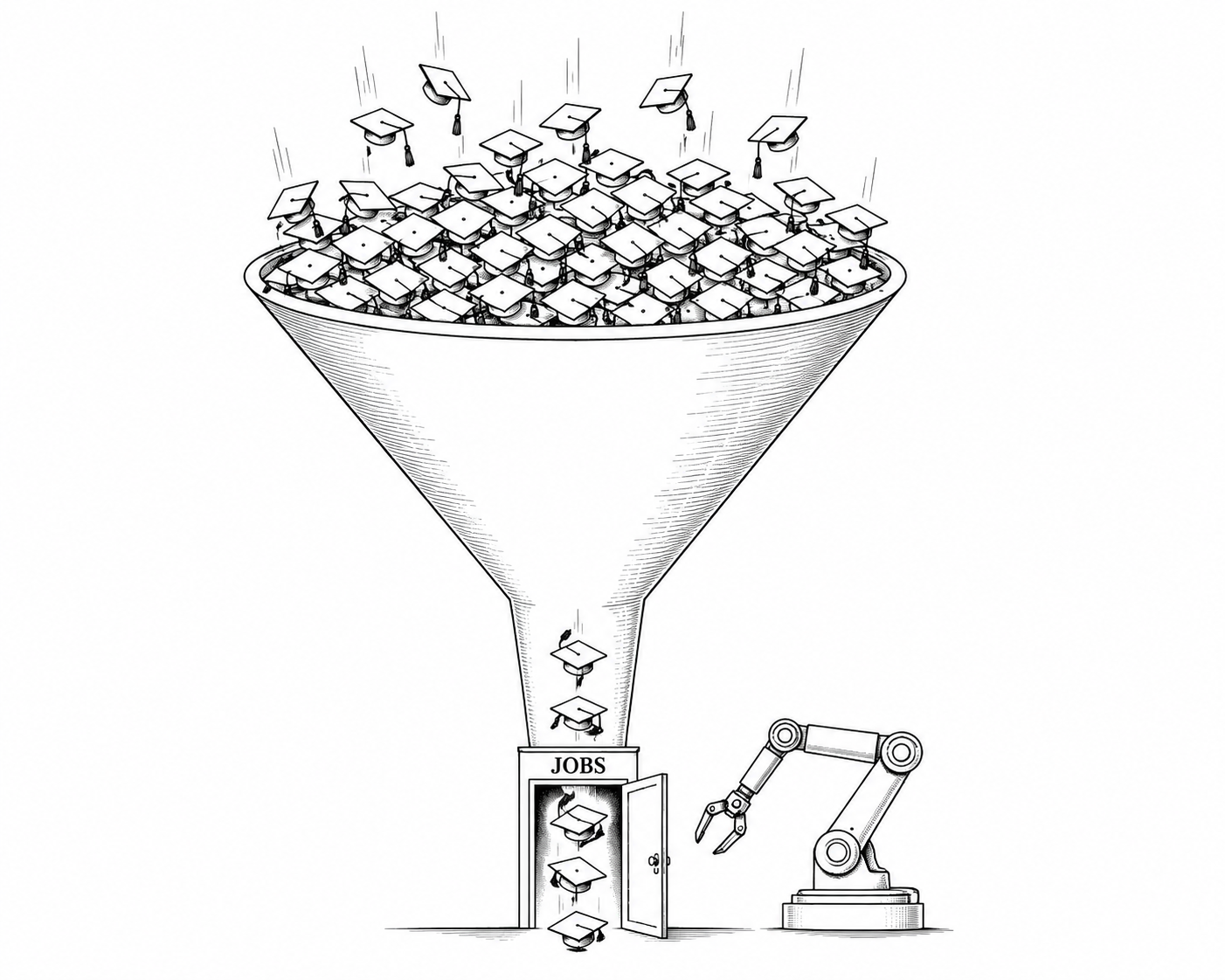
China is expecting a record 12.7 million university graduates to enter the labor market this year. That is not a cohort. That is a country-sized problem arriving on a single annual deadline.
Facing slowing private-sector hiring and a youth unemployment rate that has refused to normalize since the pandemic, policymakers are promoting artificial intelligence and advanced technology industries as the engines capable of creating the next generation of jobs. The bet is enormous. The timeline is not forgiving.
The challenge is structural, not cyclical. China spent decades expanding access to higher education as part of its economic modernization strategy — and it worked. Universities successfully produced millions of highly educated workers. What the economy now faces is the other side of that success: creating enough positions that actually require those skills. The result is not simply graduate competition. It is a mismatch between educational capacity and labor demand that no single policy lever can quickly resolve.
Labor markets function through absorption. Every year, new workers must move into productive roles quickly enough to sustain economic confidence and household formation. When that process slows, the effects ripple outward fast. Graduates delay home purchases, postpone marriage, reduce consumption, and increasingly compete for positions below their qualifications. An education system can keep producing talent while the labor market struggles to assign that talent productive work. China is currently experiencing both simultaneously.
Artificial intelligence has therefore become part industrial policy and part labor policy — two jobs for one strategy. Chinese officials describe AI as a growth sector capable of generating new companies, services, and technical occupations across software development, robotics, semiconductor manufacturing, data services, and digital infrastructure. The expectation is not merely that AI will increase productivity. It is that the industries surrounding AI will create enough demand to absorb millions of educated workers annually.
History is not especially encouraging on the timeline. Railroads, electricity, and the internet all produced enormous economic gains while simultaneously disrupting existing labor markets. The transition period — the gap between when technology displaces work and when it creates new work — is where the human cost concentrates. Governments can encourage innovation. They cannot guarantee that new industries will scale quickly enough to match the annual flow of graduates who need jobs now, not in a decade.
China‘s experience reflects a challenge that is not uniquely Chinese. Universities across advanced economies continue expanding human capital while employers increasingly seek automation, efficiency, and smaller workforces. AI may generate entirely new occupations over the next decade. Today’s graduates must navigate today’s labor market. That gap between technological promise and immediate employment is becoming one of the defining economic fault lines of the AI era — and China, with 12.7 million graduates arriving this year alone, is living inside it at a scale no other country has yet encountered.
Whether the bet pays off will matter well beyond China‘s borders. If AI-driven industries can absorb millions of graduates annually, they could provide a model for every country confronting the same demographic and technological pressure. If they cannot, policymakers elsewhere may discover that the hardest part of the AI transition is not building the technology.
It is building enough meaningful work for the people educated to use it.