
African financial institutions now hold more than $2 trillion in capital, a figure that has grown by roughly 25% in recent years, according to analysis cited by Reuters. Despite that expansion, large-scale infrastructure projects across the continent remain underfunded, with roads, energy systems, and industrial development continuing to lag behind demand. The gap is not driven by a lack of money. It is driven by where that money is going, and more importantly, where it is not.
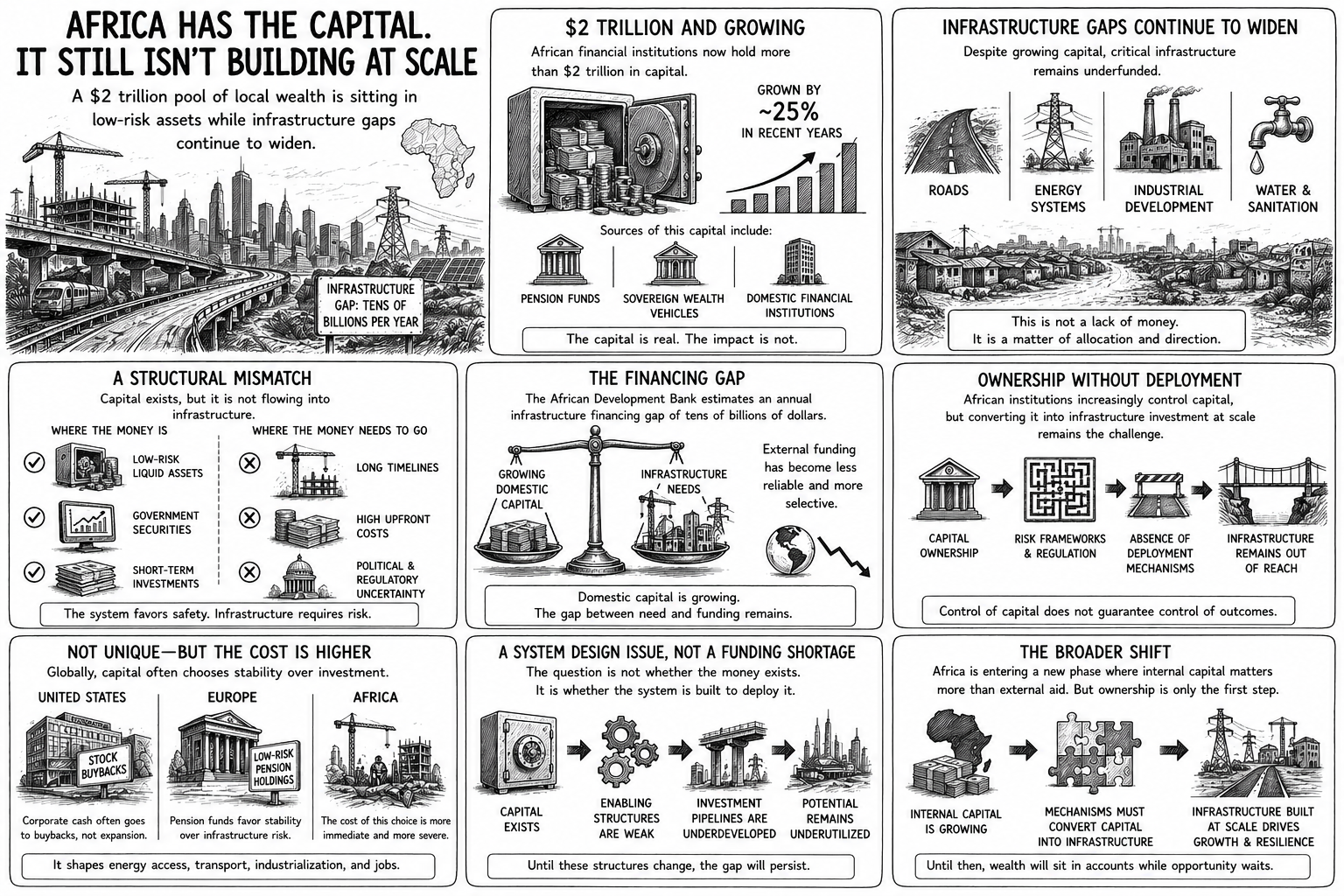
The disconnect reflects a structural mismatch between capital and deployment. Much of this $2 trillion is held by pension funds, sovereign wealth vehicles, and domestic financial institutions that prioritize low-risk, liquid investments over long-term infrastructure projects. Infrastructure, by contrast, requires extended timelines, higher upfront costs, and exposure to political and regulatory uncertainty. The result is a system where capital exists in significant volume but is not configured to move into the sectors that need it most.
This dynamic is not unique to Africa, but its effects are more visible given the scale of unmet infrastructure demand. The African Development Bank has estimated that the continent faces an annual infrastructure financing gap of tens of billions of dollars, even as domestic capital continues to grow. External funding, historically used to bridge that gap, has become less reliable, particularly as global economic conditions tighten and development financing becomes more selective.
What emerges is a contradiction between ownership and access. African institutions increasingly control capital, but that control has not translated into the ability to direct it toward transformative development. The capital is real, but its impact is constrained by risk frameworks, regulatory environments, and the absence of mechanisms that can convert long-term investment into deployable infrastructure funding.
This pattern mirrors broader global trends where capital accumulation does not automatically lead to productive investment. In the United States, corporate cash reserves have often been directed toward stock buybacks rather than expansion. In Europe, pension funds have similarly favored stability over infrastructure risk. The difference in Africa is that the cost of that allocation is more immediate, shaping energy access, transportation networks, and industrial growth.
What is often framed as a funding shortage is more accurately a system design issue. The question is not whether the money exists. It is whether the structures needed to deploy it at scale have been built. Until those structures change, the presence of capital will continue to coexist with the absence of infrastructure, reinforcing a cycle where potential remains underutilized.
The broader shift is toward a new phase of development where internal capital matters more than external aid. But ownership alone is not enough. Without mechanisms that convert capital into infrastructure, the gap between what is available and what is built will persist, defining the next stage of economic growth across the continent.