
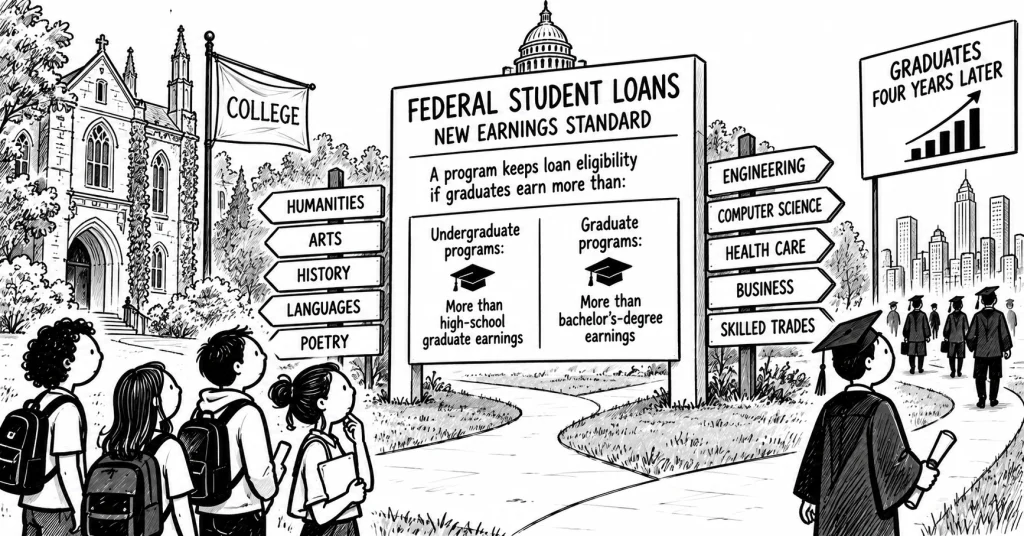
An earnings standard gives Washington more influence over which programs students can finance—and puts colleges under pressure to show an economic payoff.
Just 2.9% of borrowers who took out federal student loans in 2024 and 2025 attended programs that would fail a new earnings standard, according to a PEER Center analysis reported by MarketWatch’s Jillian Berman. Most degree programs clear the threshold. But the policy changes the terms of federal support: access to government-backed borrowing increasingly depends on what graduates earn after leaving school. Berman’s reporting suggests the immediate reach is limited, even as the accountability principle extends across higher education.
The timing requires care. Congress established the earnings requirement in its 2025 legislation, and the Education Department published implementing regulations this July. Certain provisions and early implementation began in 2026, but most of the final rule takes effect July 1, 2027. Colleges are preparing for a financing system in which their graduates’ outcomes can determine whether future students retain federal loan access. The Government Accountability Office’s review confirms that schedule.
From Enrollment to Earnings
Undergraduate programs face a comparison with the earnings of workers who hold only a high-school diploma; graduate programs face a bachelor’s-degree benchmark. The measure uses graduates’ median annual earnings four years after completion, covering people who are working and no longer enrolled. A program that fails in two of three consecutive years loses Direct Loan eligibility, subject to limited provisions for an orderly closure. The sanction operates at the program level, giving federal officials a way to restrict financing without cutting off every course of study at an institution. The final regulations establish those requirements.
That structure changes the relationship between colleges and the government that helps finance their enrollment. Schools receive tuition when students borrow; students carry the repayment obligation afterward. Conditioning future borrowing on graduate earnings gives institutions a financial reason to pay closer attention to the transition from classroom to employment. A struggling program could respond by improving instruction, strengthening employer relationships or reconsidering its offerings. The incentive reaches administrators before any formal loss of eligibility, because the prospect of losing financing can affect budgets and recruitment.
An Earnings Floor Has Limits
The standard also changes how Washington defines an acceptable outcome. The final rule replaces the previous debt-to-earnings metric with an earnings premium measure. That makes the comparison straightforward, but passing does not establish that a program’s price is affordable or its debt manageable. Two programs could produce similar graduate salaries while charging very different amounts. Both might clear the same earnings floor, even though their students face different repayment burdens.
PEER researchers Stephanie Riegg Cellini, Jordan Matsudaira and Clare McCann raised that problem during rulemaking, urging officials to preserve a debt-to-earnings threshold for programs combining modest wages with unaffordable debt. Their comments on the proposed framework also called for safeguards against institutional gaming. An earnings threshold can identify weak outcomes, but it cannot by itself separate the effects of educational quality, local wages, student circumstances and program pricing. Colleges’ responses will determine whether accountability produces better education or stronger incentives to protect the measured result.
Students Face the Consequences
For students who depend on federal borrowing, a program’s eligibility becomes part of the practical decision about where to enroll. Losing loan access could steer applicants toward a stronger alternative. Where comparable options are scarce, it could also make a desired qualification harder to finance. Wealthier households would have more capacity to continue paying, creating a possible divide between who can pursue a program and who needs federal approval to afford it.
If colleges improve weak programs before sanctions arrive, the policy could move some educational risk back toward the institutions collecting tuition. If they mainly discontinue offerings or narrow access, students will carry more of the adjustment. The next stage should be judged by what schools change—and whether graduates receive a better education at a price their earnings can support.