
A House-approved budget framework this week allocated an additional $70 billion over three years toward immigration enforcement — expanding detention infrastructure, staffing, surveillance systems, and operational reach. The political framing stays focused on border control. The scale and structure of the funding signal something more durable. Enforcement is being built out as a standing system, not a temporary response. The vote passed along party lines, reflecting not just disagreement over immigration policy but alignment around the idea that enforcement itself now requires sustained, institutional backing.
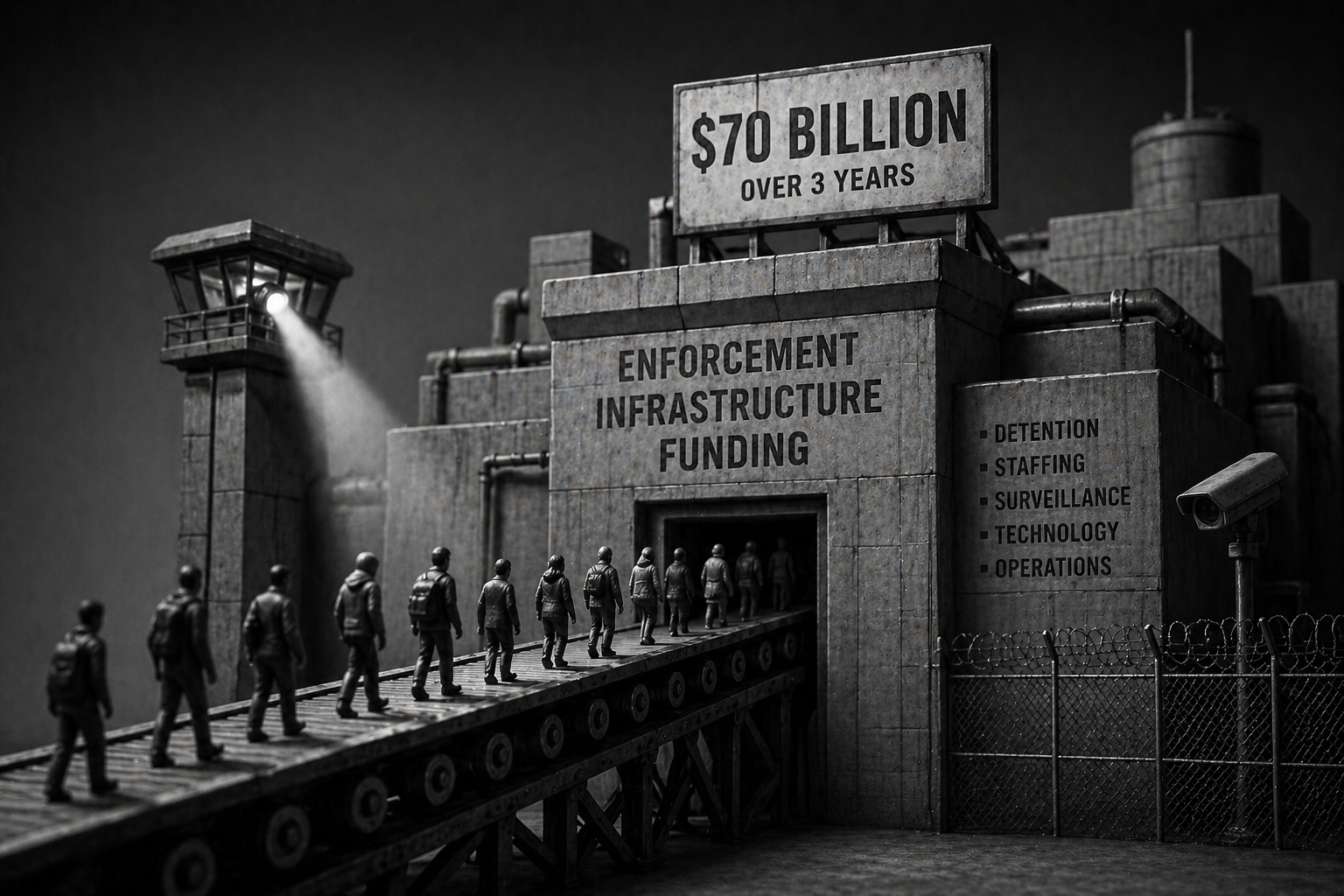
The context makes the shift legible. This proposal follows an earlier $130 billion immigration package, meaning enforcement is no longer episodic or crisis-driven — it is cumulative. Each round of funding builds on the last, expanding capacity regardless of fluctuations in border crossings or migration patterns. That changes how the system behaves. Instead of scaling with need, it begins to operate like infrastructure: once built, it must be used, maintained, and justified. The incentives shift from solving a problem to sustaining a system.
That logic extends beyond the federal level. As enforcement funding grows, local jurisdictions are pulled into its orbit through contracts, cooperation agreements, and funding pressure. What appears as a federal policy decision begins to reshape local governance, law enforcement priorities, and community-level dynamics. The question is no longer just who crosses the border, but how deeply enforcement mechanisms penetrate everyday civic life once the resources exist to support them.
The most consequential changes are happening in the less visible layers — processing timelines, detention capacity, background check requirements, inter-agency coordination. These are the levers that determine who moves through the system, who gets delayed, and who gets removed, often without the public scrutiny that accompanies the high-profile moments that dominate political coverage.
Once enforcement becomes infrastructure, it develops its own momentum — budgeted, staffed, and operationalized in ways that outlast the moment that justified its expansion. The result is not just more enforcement, but a different kind: one that is harder to scale back, easier to normalize, and increasingly central to how the state manages movement, access, and belonging.