
The argument this series has been building across two weeks arrives here at its hardest question. Part V — While PWIs Contract, HBCUs Are Growing documented the enrollment surge — record classes, record applications, institutions growing while the broader credential market contracts. Part VI — The Infrastructure Moment documented the infrastructure investment — AHRI, Howard’s R1 designation, the coalition building the research capacity that makes growth sustainable. The growth is real. The infrastructure investment is real. And the employer side of the equation has not caught up to either.
That gap is where the momentum of the HBCU ascent is most at risk — not from hostile federal policy, not from the credential deflation this series opened with, but from the structural mismatch between what HBCUs are now producing and what the employer market is currently equipped to absorb.
In Q1 2024, 75% of employers reported that they specifically target HBCUs for recruiting. Another 16% said they are school-agnostic. Only 9% said they do not currently recruit at HBCUs. Those numbers suggest broad employer engagement. They do not tell you what that engagement produces in terms of hiring outcomes, starting salaries, or the depth of recruiting relationships — the on-campus presence, the internship pipelines, the return-offer rates, and the alumni network density that converts recruiter interest into actual career trajectories.
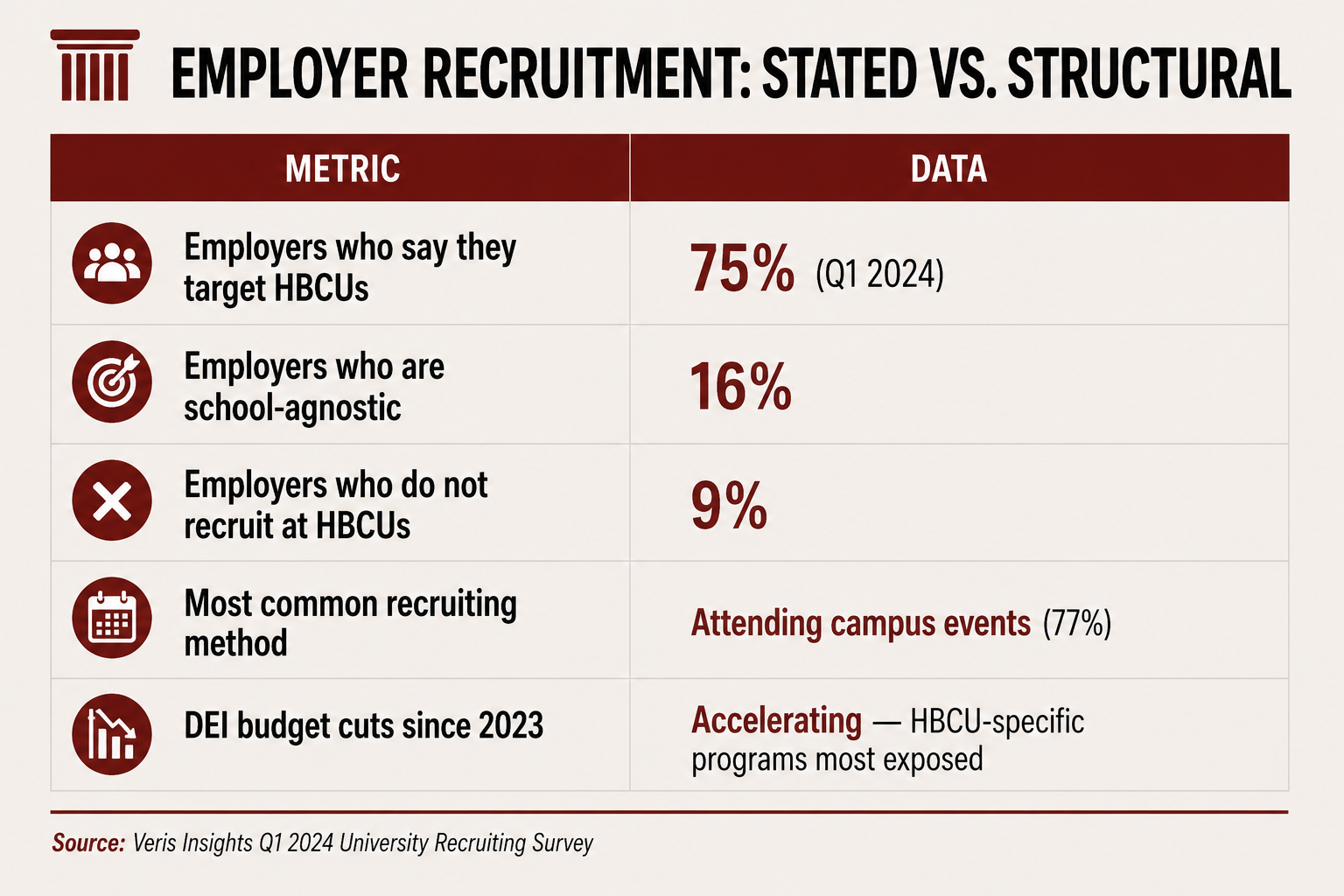
The distinction between targeting and hiring is where the employer gap actually lives. SSC documented the structural version of this pattern in The NFL Says It Wants HBCU Talent. The Draft Will Tell the Truth. — where the NFL held a showcase for HBCU prospects and grouped them with international developmental athletes, communicating through the structure of the event that it considers HBCU players and athletes new to American football to occupy the same category. The parallel to corporate recruiting is direct. Attending an HBCU career fair is low-cost and provides optics. Maintaining dedicated HBCU recruiting pipelines, funding summer internships, and building the multi-year relationships that produce genuine career outcomes is the investment that gets cut first when DEI budgets contract. The showcase is not the pipeline. The stated commitment is not the infrastructure.
That infrastructure is now being actively dismantled. As SSC covered in The Federal Government Just Redefined DEI as Discrimination, the administration’s executive orders have extended the anti-DEI campaign from federal agencies into the private sector — and legal experts are already questioning whether recruiting at an HBCU career fair constitutes a violation under the order’s broad language. The HBCU-specific recruiting programs that companies built between 2020 and 2022 are the programs most exposed to DEI budget cuts. The legal ambiguity the executive orders have introduced gives companies a pretext for scaling back commitments that were never as deep as the press releases suggested.
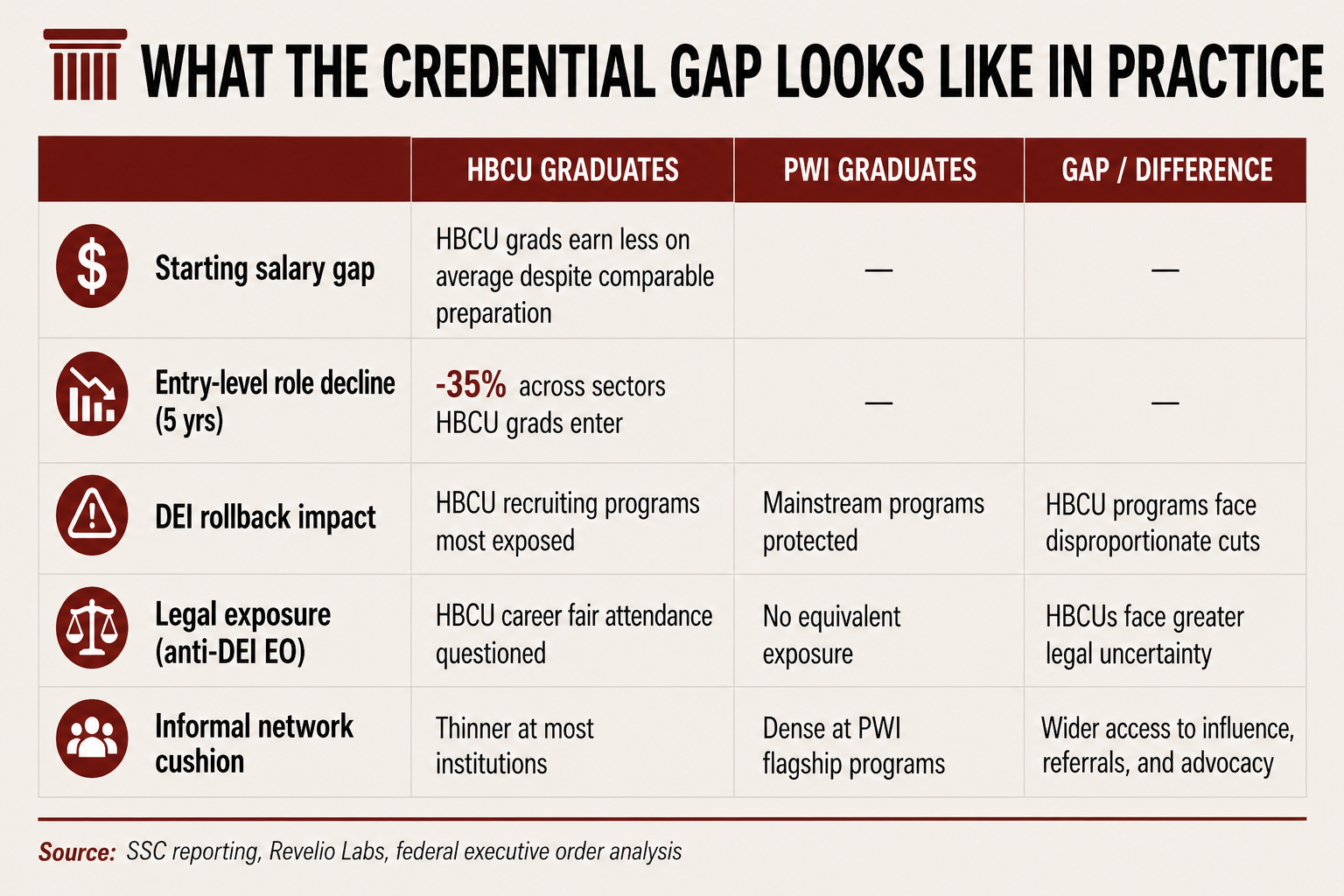
The salary gap compounds the recruiting gap. HBCU graduates enter a labor market that, as Part II — AI Ate the ROI documented, is being reshaped by AI elimination of entry-level roles in exactly the fields — consulting, finance, operations, strategy — where the credential pipeline was supposed to deliver them. And HBCU graduates enter that market with a starting salary disadvantage relative to PWI graduates that reflects not their skills or their preparation but the informal network effects, brand recognition, and recruiting infrastructure gaps that have never been closed.
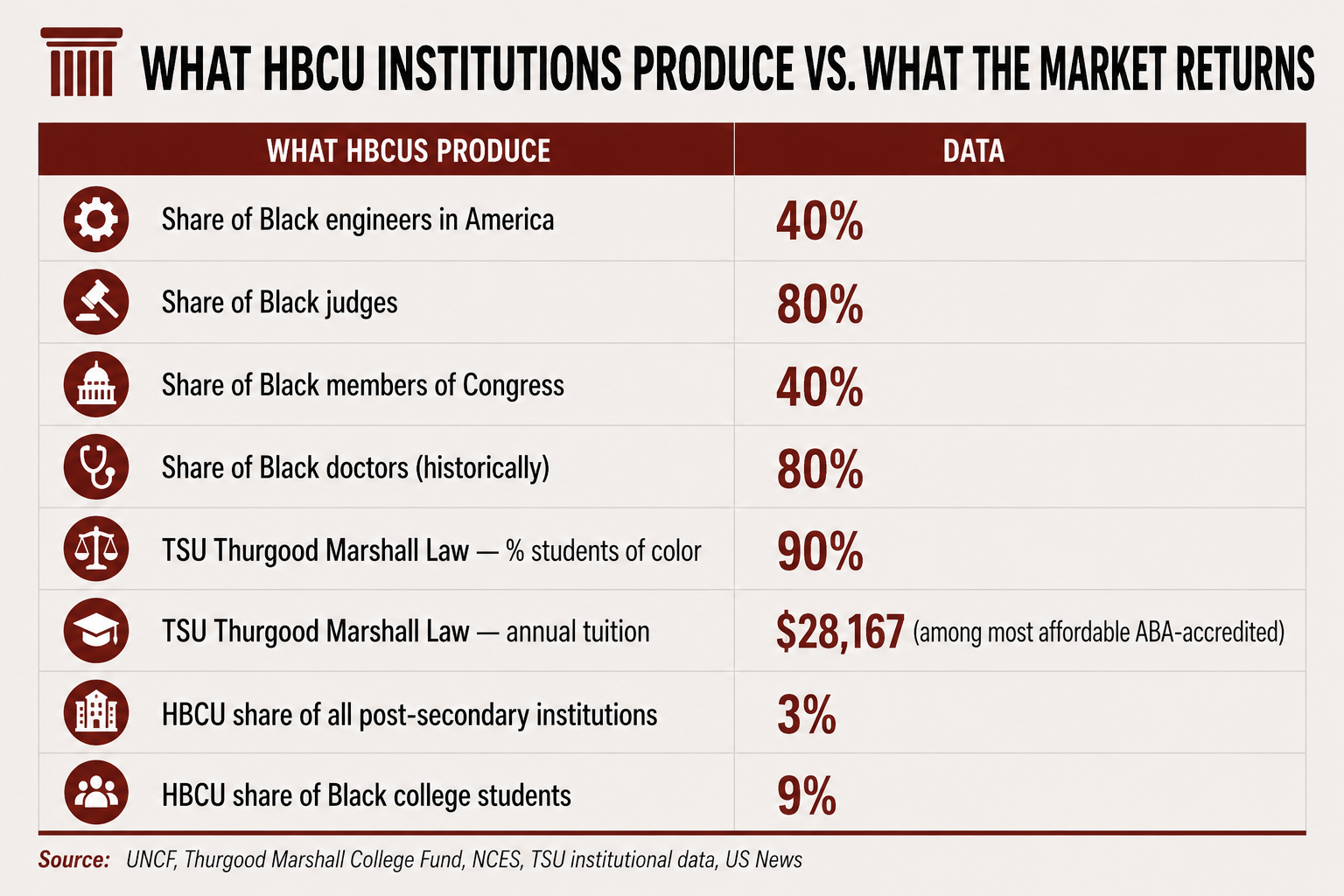
The employer gap shows up most clearly in professional schools. At Texas Southern University’s Thurgood Marshall School of Law — tuition of $28,167, 90% students of color, ABA-accredited — the institution is producing the diverse legal pipeline that firms, government agencies, and corporate legal departments say they cannot find. The 2024 Texas bar passage rate was 75.91%. The recruiting infrastructure that would absorb those graduates proportionally to their preparation does not exist at the same scale it does for graduates of higher-ranked, predominantly white institutions. The school bears the name of the man who transformed American law from an HBCU law library. The gap it is still navigating makes the same structural argument he spent his career making before the Supreme Court.
The research infrastructure that AHRI is building addresses part of this. R1 designation changes how federal agencies, private foundations, and corporate research partners engage with an institution — it opens doors to research-track career pipelines that have historically been largely closed to HBCU graduates. The STEM-focused institutions in the AHRI coalition are building toward the moment when their research output gives corporate and government partners a specific, high-value reason to recruit from them rather than a DEI-motivated reason to attend a campus event. Those are different kinds of relationships. They are more durable when political environments shift.
But the employer gap extends beyond research tracks. The majority of HBCU graduates are not entering research careers. They are entering the same labor market that this series has documented contracting from both ends. As SSC documented in The Job Market Isn’t Crashing. It’s Closing. and The AI Resume Screen, the structural compression hitting the entry-level labor market lands hardest on the workers with the least informal network cushion and the least institutional brand recognition in hiring rooms. HBCU graduates, despite their institutions’ growth and their own preparation, are navigating that compression without the employer infrastructure that would make the difference between momentum and permanence.
The HBCU ascent is real. The enrollment numbers are current, documented, and growing. The research infrastructure launched on April 29, 2026. The window is open. Whether the market meets the moment is the question that will define what the HBCU ascent actually produces — and for whom.
Why This Matters
The Degree Economy series opened with a fire sale — a credentialing market in distress, discounting a promise it could no longer fully keep. It closes with a different story: institutions that were built to do the impossible under impossible conditions, growing anyway, building research infrastructure anyway, producing talent anyway — in a moment when the systems surrounding them are simultaneously hostile and dependent on what they produce. The employer gap is the last structural barrier between HBCU momentum and HBCU permanence. Closing it requires employers who treat HBCU recruiting not as a DEI line item to be cut when the political environment shifts, but as a talent strategy built on the recognition that the students coming out of these institutions are exactly what a restructuring economy needs.
Part VII of The Degree Economy. Part I — The Credential Is Deflating | Part II — AI Ate the ROI | Part III — Who Gets Left Out of the Sale | Part IV — The HBCU Squeeze