Black Men Were Taught to Survive. We Have to Learn How to Live.
Emotional suppression was handed down as protection. The research now shows what it costs, and a generation of Black men is renegotiating the terms.
Culture in Motion
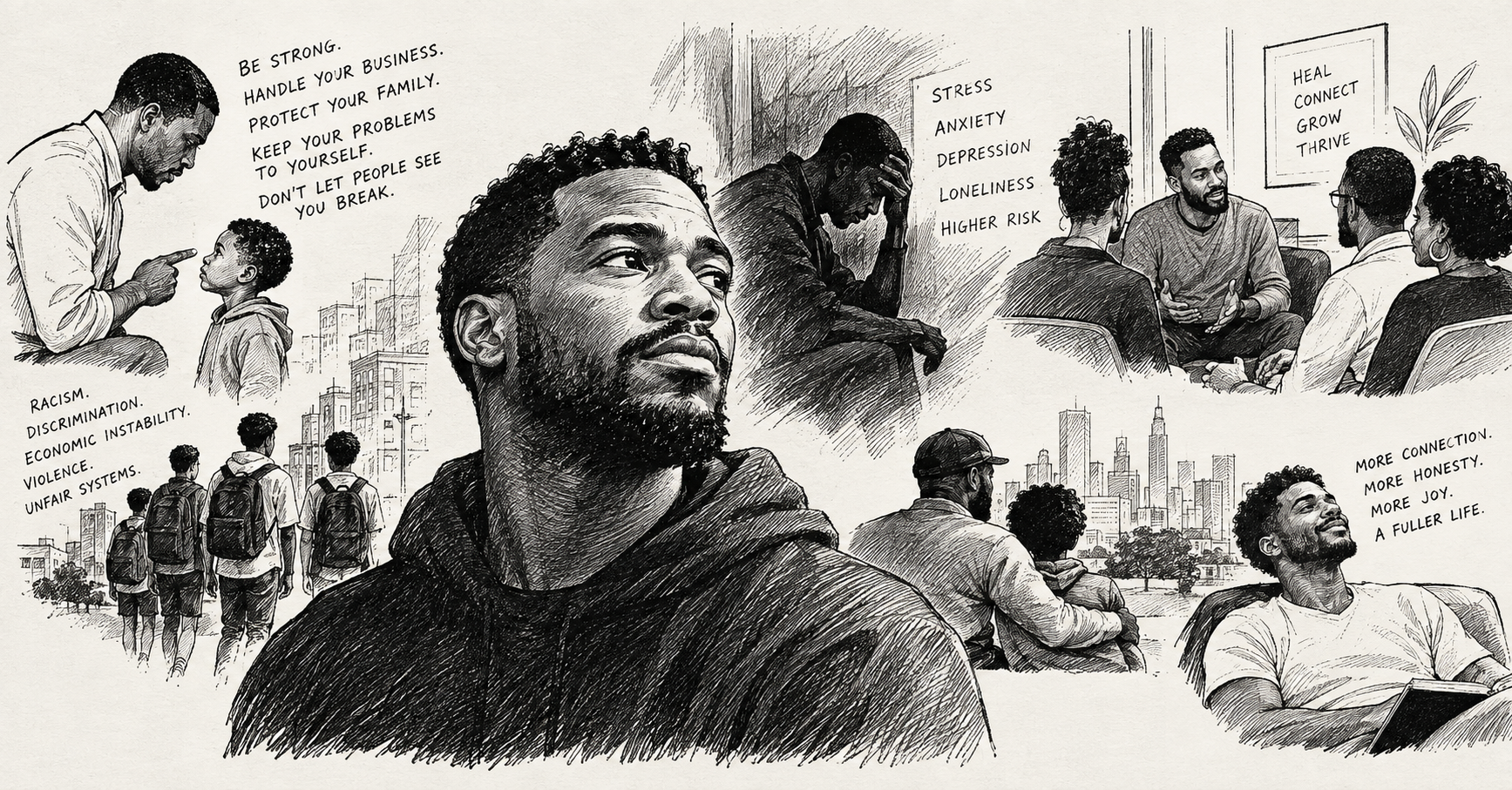
For generations, Black men have been handed a particular definition of strength. Be strong. Handle your business. Protect your family. Keep your problems to yourself. Don’t let people see you break.
Those lessons did not come from nowhere. For many Black families, teaching boys to be tough was a form of preparation. Black men have had to navigate racism, discrimination, economic instability, violence and institutions that have not always treated them fairly. Emotional control, independence and the ability to keep moving were forms of protection, and they worked well enough to be passed down. Researchers call the process gender socialization: the way children absorb the expectations and behaviors a society attaches to being a boy. For Black boys, those expectations arrived carrying the weight of survival.
The problem is what happens when a survival strategy becomes a permanent way of living. A man can become so accustomed to carrying everything that he no longer knows what it feels like to put anything down.
That distinction matters. Resilience is the ability to endure difficulty and continue forward. Emotional suppression is the belief that difficulty should never be acknowledged in the first place. One makes a person stronger. The other leaves him isolated.
Strength Was Never Supposed to Mean Silence
Black men are praised for being resilient. But resilience becomes complicated when a society celebrates the ability to endure without asking what the endurance costs.
The cost is measurable. The American Psychological Association has linked extreme self-reliance and emotional restraint in men to lower rates of help-seeking, higher rates of death by suicide and higher rates of homicide victimization. Broader research on masculinity norms finds the same pattern in less acute form: men who hold traditional beliefs about what masculinity requires report higher levels of stress, anxiety, depression and loneliness, and are less likely to pursue treatment for any of it. Suicide rates among Black men have risen in recent years, a trend that has drawn increasing attention in public health literature.
The pressure appears early. A 2022 study of adolescents found that young Black males reported greater pressure than their white peers to be physically and emotionally strong, to play sports, and to exercise dominance or control over others. The expectation is not something men grow into. It is assigned in childhood and then defended for the rest of a life.
A man who never asks for help may look independent. He may also be exhausted. A man who rarely discusses his emotions may appear composed, and may also have no language for what is happening inside him. A man who insists on solving every problem himself may appear responsible, and may also have learned that depending on anyone else is dangerous.
Healthy masculinity requires separating those ideas. Being emotionally honest does not mean abandoning strength. Asking for help does not eliminate responsibility. Admitting fear does not make a man incapable of protecting the people he loves. In some cases it is the opposite: a man who understands what he is feeling is better positioned to decide what to do about it.
The Cost of Always Being the Strong One
The expectation to remain strong is particularly complicated for Black men because strength is bound to identity. It means being the provider, the protector, the dependable friend, the father who never complains, the son who absorbs his family’s problems, the partner expected to have an answer.
There is dignity in that responsibility. But responsibility without emotional support becomes isolation, and the result is a paradox. A man can be surrounded by people and still have no one he feels safe enough to tell the truth. He can have friends but no confidants. He can have a partner and never explain what he is carrying. He can be successful professionally while privately managing anxiety, loneliness, grief or exhaustion.
Emotions do not disappear because they go unspoken. They surface elsewhere — in sleep that does not come, in irritability and anger, in elevated blood pressure, in drinking, in withdrawal from the people who would help if asked. The body keeps a record the mouth refuses to make.
Because he has spent years being the person everyone else relies on, asking someone to take care of him feels unfamiliar. Sometimes it feels threatening. The issue is not that Black men are incapable of vulnerability. It is that many have been taught to associate vulnerability with risk.
Vulnerability Is Not the Opposite of Masculinity
The conversation about Black male vulnerability often goes wrong because it arrives sounding like another demand. Be more vulnerable. Talk about your feelings. Go to therapy. Open up. Those are reasonable suggestions, and they still land as instructions handed to men who already feel that everyone has an opinion about what they should be.
A better question is what would make vulnerability feel safe enough to become a choice.
It also helps to be precise about what the word means. Vulnerability is not breaking down in public or disclosing your private business to whoever asks. It is being honest with people you trust. It looks like telling a friend the week has been hard, saying you are overwhelmed instead of saying you are fine, apologizing when you were wrong, asking a partner for support, talking to someone after a loss.
That means relationships in which Black men do not have to perform strength every minute. Friendships where checking in means more than “You good?” Fathers who can tell their sons that fear is something humans experience rather than evidence of weakness. Brothers who can say they do not know how to deal with something without feeling they have surrendered their authority. Romantic relationships where emotional honesty is not weaponized later. Professional and community spaces where a Black man can talk without first proving he is successful, responsible and in control.
The Shift Is Already Underway
This is not a hypothetical argument. The behavior is changing.
More Black men are entering therapy, and the framing around it has moved. What was once understood as a last resort for crisis is increasingly treated as maintenance — the emotional equivalent of a physical. Men’s support groups, faith communities, mentorship and coaching are absorbing the same demand from men who want the conversation without the clinical setting. Organizations built specifically for this work now exist at national scale: Therapy for Black Men, Black Men Heal, the Strong Roots Collective, Express Yourself Black Man. Their existence is itself evidence of demand that went unmet for a long time.
Fatherhood is shifting alongside it. Many Black fathers are raising children differently than they were raised, asking their kids how they feel, listening without rushing to fix, apologizing when they are wrong, saying “I love you” without an occasion. Children learn what strength looks like by watching, which means a generation is receiving a different definition than the one handed down.
Sometimes the Strongest Thing Is Admitting You Need Someone
There is no single formula. Therapy works for some men, a group for others, a friend or a pastor or a coach for others still. The shift that matters is recognizing that support is not a failure of self-sufficiency.
Human beings were never built to carry everything alone. Black men in particular have been expected to carry not only their own burdens but the expectations attached to being a Black man in America. That is too much weight for anyone to hold indefinitely.
There is another cost to constant self-reliance, and it is the one least discussed. It makes receiving love difficult. If your identity is built on what you provide, you may struggle to believe you are valuable when you are not providing. If you are always the person solving the problem, you may not know how to sit still while someone solves one for you. If everyone knows you as the strong one, you may begin to wonder who you are allowed to be when you are tired.
Those questions deserve attention.
Redefining Strength
The goal is not to replace one rigid definition of Black masculinity with another. Black men do not need to become softer versions of themselves to be emotionally healthy.
Strength can include discipline and ambition. It can include protecting your family, building wealth, leading a household, serving your community and keeping your word. It can also include knowing when you are overwhelmed. It can mean apologizing, grieving, going to therapy, telling a friend you are not okay, setting a boundary instead of swallowing resentment, saying “I love you” without waiting for a funeral to make the words necessary.
None of that erases masculinity. It expands it.
Not to Stop Surviving, but to Stop Living Only to Survive
There is a difference between knowing how to survive and believing survival is the only thing life requires.
Survival asks how to get through this. A fuller life asks what you want, what you feel, who you trust, what kind of father or partner or friend or brother you intend to be, and what parts of yourself you have never allowed anyone to see.
And it asks the hardest question for a generation of men taught to endure almost anything: what would it look like to build a life that does not require you to be strong every second of the day?
That is not a retreat from strength. It may be a more complete definition of it.
Black men deserve the freedom to survive when survival is necessary. They also deserve the chance to live when it isn’t.