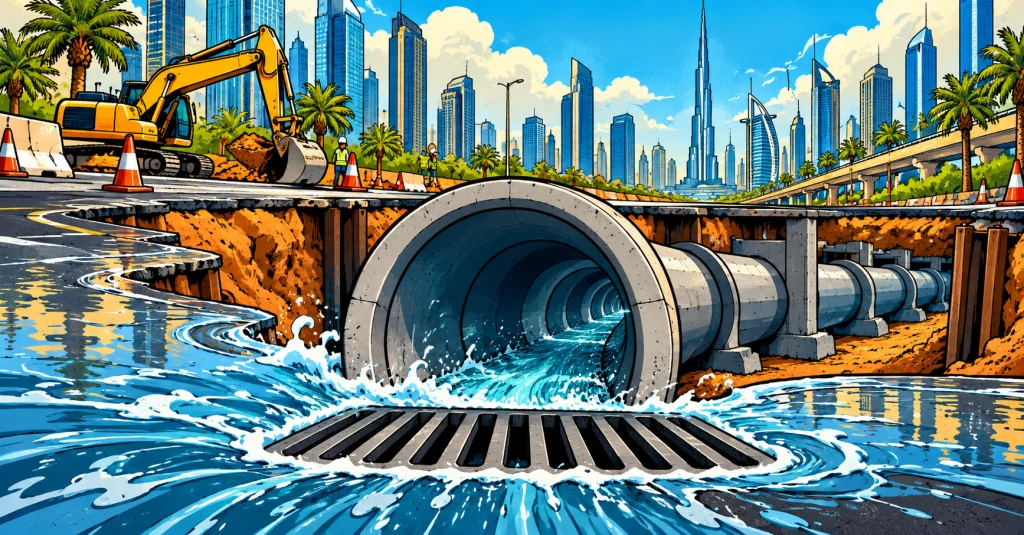
Two years after record rainfall brought parts of Dubai to a standstill, the city is expanding its drainage system. The investment is substantial, but it also shows what can happen when a city grows faster than the infrastructure supporting it.
In April 2024, Dubai experienced the heaviest rainfall recorded in the United Arab Emirates in 75 years. Roads disappeared beneath floodwater, flights were disrupted, businesses closed and residents struggled to get around. For a city known for its modern highways, skyscrapers and rapid development, the flooding exposed a basic problem: Dubai’s drainage system could not handle that much rain. Two years later, the city is spending billions to make sure it is better prepared next time.
On October 25, Dubai Municipality announced $817 million (3 billion UAE dirhams) in new construction contracts to expand the city’s stormwater drainage network. According to The National, the projects will add approximately 100 kilometers (62 miles) of drainage pipes across residential, commercial and industrial areas. The work is part of a larger $8.2 billion (30 billion dirhams) program called Tasreef, which aims to increase Dubai’s drainage capacity by 700% by 2033.
The expansion will reach neighborhoods including Jumeirah, Umm Suqeim, Al Barsha and Al Quoz, along with major roads and business districts. Some of the new underground pipes will be wide enough for a person to stand inside. The goal is straightforward: move large amounts of rainwater away from streets, homes and businesses before flooding becomes widespread. City officials say the completed system will be able to handle more than 20 million cubic meters of water a day, although that capacity has yet to be tested.
Dubai’s rapid growth helps explain why this investment is necessary. As cities build more roads, shopping centers, parking lots and high-rise developments, they cover land that once allowed rainwater to soak into the ground. During heavy rainfall, water instead collects on paved surfaces and must be carried away through drains and underground pipes. When those systems cannot keep up, streets flood. The problem becomes more serious when unusually heavy storms overwhelm infrastructure designed for less extreme conditions.
The financial consequences extend well beyond repairing damaged roads. Flooding can prevent employees from reaching work, delay deliveries, damage vehicles and property, and force businesses to close temporarily. Dubai depends heavily on tourism, international trade and reliable transportation, making major disruptions especially costly. Spending billions on drainage may appear expensive, but repeated flooding can also impose substantial costs on residents, businesses and government.
The timing raises an important issue for other fast-growing cities. Dubai has invested heavily in visible development for decades, but the 2024 floods demonstrated that the infrastructure beneath those developments is just as important. Drainage systems are rarely celebrated the way new buildings or transportation projects are, even though they help determine whether a city can function during an emergency. Waiting until a disaster exposes their limitations can make the eventual improvements more expensive and disruptive.
Dubai expects to complete Tasreef by 2033, meaning the city still faces several years of construction before the full network is operational. The investment will not prevent heavy rainfall, and no drainage system can guarantee that flooding will never occur. What it can do is reduce the damage and disruption when major storms arrive.
For cities expanding as quickly as Dubai, the lesson extends beyond flooding. New homes, hotels, offices and highways create demands on water systems, electricity, transportation and public services. Those systems must grow alongside the developments they support. Dubai is now committing billions to strengthen one of them, after a storm showed what happens when the infrastructure is not ready.