
Dubai did not accidentally become a global destination for aesthetic medicine, wellness optimization, and cosmetic procedures. It built toward it — deliberately, expensively, and with a clear understanding that there was a global market of consumers whose demand for these services was real and whose access to them in their home countries was structurally constrained. The city has invested heavily in medical tourism infrastructure, positioning itself as a destination where procedures that are expensive, waitlisted, or heavily gatekept in the United States and Europe can be accessed at lower cost, with shorter timelines, and inside a luxury environment that frames the entire experience as an upgrade rather than a workaround. That framing is effective because it is partially true. And it obscures something important about why so many people are making the trip in the first place.
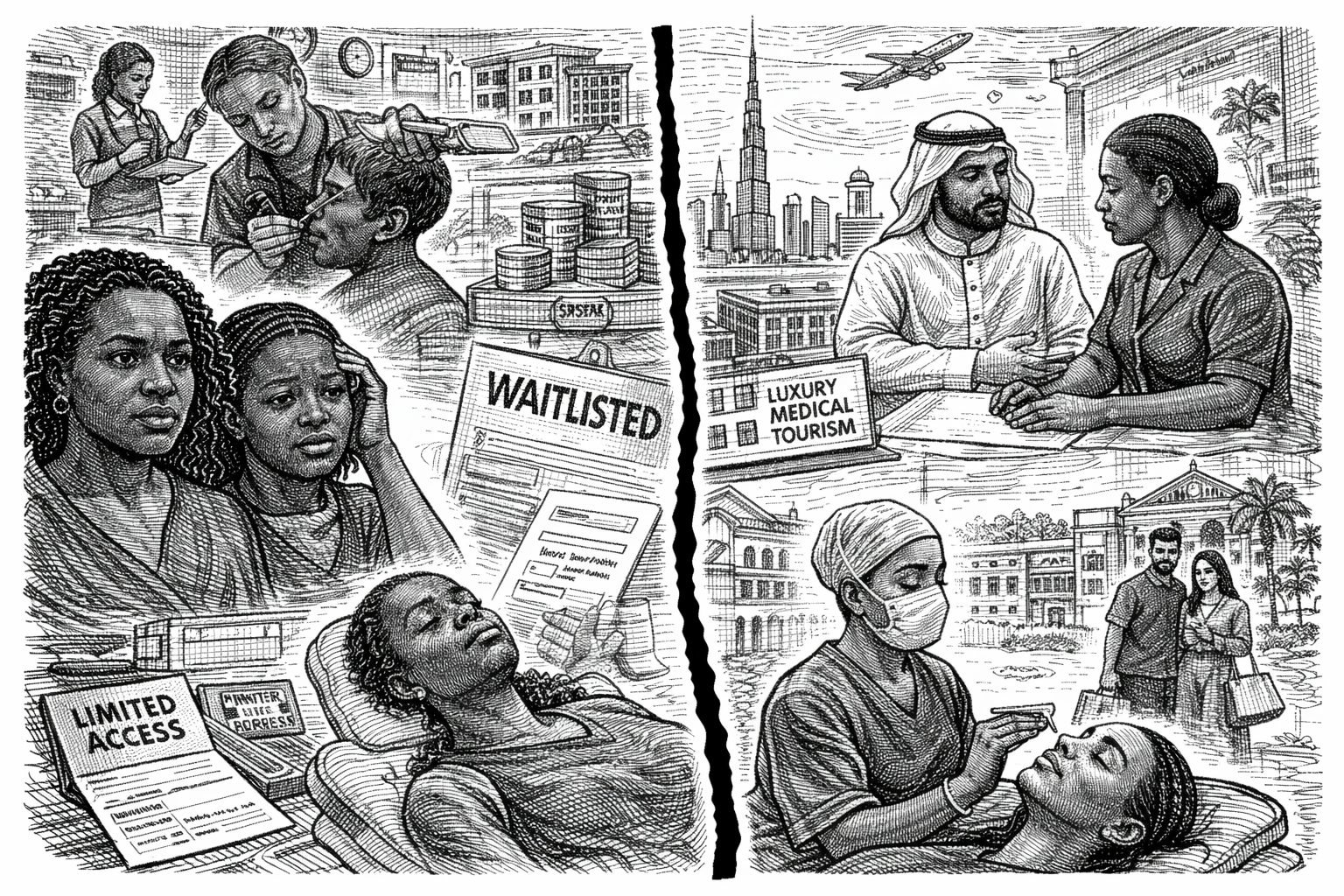
The consumer who travels to Dubai for a cosmetic procedure, a hormone optimization protocol, or an aesthetic treatment is not primarily making a statement about Dubai. They are making a statement about the system they are navigating at home. For Black and Brown consumers in the United States specifically, the domestic healthcare landscape has consistently underdelivered on aesthetic and wellness care in ways that go beyond cost. Dermatological training in American medical schools has historically underrepresented darker skin tones, producing practitioners whose clinical competence with melanin-rich skin is uneven at best. Aesthetic medicine has been built around a standard of beauty that centered whiteness, meaning that the treatments, the products, and the expertise were developed for a patient profile that excluded much of the population now seeking access. When Black women report that they cannot find practitioners who understand how procedures interact with their skin, or that the aesthetic outcomes being marketed to them were not designed with them in mind, they are describing a structural failure of the domestic system — one that Dubai, with its genuinely multicultural patient base and its practitioners trained across a broader range of skin types and aesthetic preferences, has been able to partially fill.
The cost dimension compounds the access dimension in ways that make Dubai’s appeal rational rather than simply aspirational. In the United States, cosmetic and aesthetic procedures are almost entirely outside insurance coverage, meaning they are priced at whatever the market will bear in a system with no cost controls and significant overhead. A procedure that costs several thousand dollars in an American medispa or dermatology practice may be available in Dubai for a fraction of that price, with equivalent or superior clinical outcomes, in a facility that has been optimized for the international patient experience. For middle-income consumers — including a growing segment of Black and Brown professionals who have achieved income mobility without the wealth accumulation that would make domestic luxury healthcare comfortable — Dubai represents an arbitrage opportunity. The same body, the same desired outcome, a meaningfully different price point and a meaningfully different experience of being seen and treated as a valued patient rather than a demographic afterthought.
What Dubai has understood, and what the American healthcare and wellness industry has been slow to reckon with, is that appearance is functioning increasingly as a form of capital — not in the superficial sense that looking good helps you get ahead, but in the structural sense that physical presentation intersects with professional opportunity, social legibility, and the perception of competence and authority in ways that are measurable and consequential. This is not a new observation. Research on appearance discrimination, on the professional penalties associated with natural Black hair, on the way that weight, skin tone, and aesthetic presentation shape hiring and advancement decisions, has been accumulating for decades. What is new is the degree to which consumers are internalizing that research and making economic decisions based on it — treating aesthetic investment not as vanity but as strategy, and seeking the most efficient pathway to that investment regardless of geography.
What the glossy medical tourism narrative consistently underweights is who absorbs the cost when something goes wrong. Regulatory environments differ across countries, and Dubai’s aesthetic medicine sector, while sophisticated and well-resourced at the high end, operates within a framework that does not carry the same consumer protections as the American system. Complications from procedures performed abroad are difficult to address through domestic healthcare channels — practitioners who did not perform a procedure are often unwilling to manage its aftermath, and the liability structures that govern medical practice in the United States do not extend across borders. For consumers who cannot afford domestic care and are making decisions under real financial and social pressure, the risk calculation is different than it is for a consumer who is choosing Dubai for convenience or cost savings from a position of domestic access. The people for whom Dubai represents the only viable pathway to care are also the people with the least recourse when something goes wrong. That asymmetry — between who absorbs the risk and who designs the system — is the structural argument underneath the lifestyle branding, and it is the one worth naming clearly.