
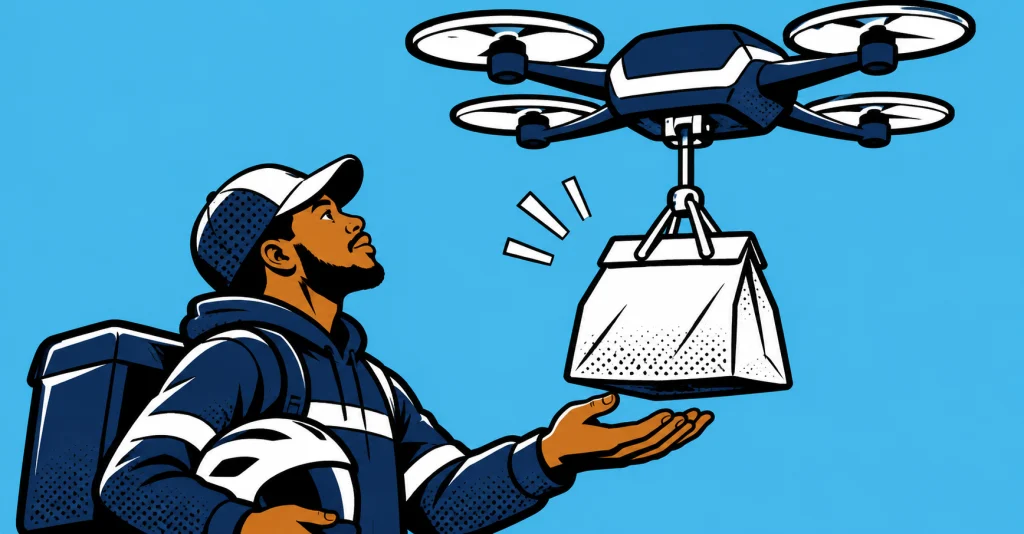
Keeta Drone’s new office route at Dubai Silicon Oasis shows how delivery automation is actually spreading: the drone takes the easy middle of the trip and leaves the worst parts to people.
By SSC News Desk | November 9, 2026 | Technology | 3 min read
More than 1,000 people working at the Dubai Silicon Oasis headquarters complex can now get lunch by air. Keeta Drone, the drone arm of Chinese delivery giant Meituan, launched a route serving the complex, Gulf Business reported. Employees order from brands including Starbucks, Costa Coffee and Raju Omlet and pick up at a landing point inside the compound, daily from 9 a.m. to 9 p.m., with approval from the Dubai Civil Aviation Authority. The route adds to a network that already serves the Rochester Institute of Technology campus and the Emirates Airline residential towers nearby.
Drones get the easy part of the route
Drones fly fixed paths between fixed points. Keeta’s Dubai drones leave a hub at Silicon Central Mall and land at lockers and collection points, and in some neighborhoods a rider covers the last stretch to the door, Arabian Post reported when the service restarted in September. An office tower with a single landing pad full of hungry employees is close to the ideal customer for a drone. It offers repeat orders, short distances and no doorsteps.
That design splits the job in two. The aircraft takes the predictable middle leg, through open air with no traffic. The rider keeps the unpredictable parts: stairs, gated communities, apartment doors and the summer heat. Keeta charged 9.5 dirhams ($2.59) per drone order in Dubai Silicon Oasis, which a company spokesperson told Gulf News was no more than conventional delivery there. Customers pay the same price. The difference is in what each delivery costs the platform to provide.
The costs are falling fast
The numbers from Meituan’s home market show where this is heading. Mao Yinian, the Meituan vice president who runs its drone business, told Yicai’s Lu Hanzhi in May that a single drone site has gone from handling about 10 orders a day to as many as 400. If the price to the customer stays the same while the cost of each delivery drops, the platform keeps the savings. Riders don’t share in them, and customers don’t see lower prices.
Dubai is building out the human side of delivery at the same time. The number of delivery companies operating in the emirate grew about 18% in a year to 2,948, the Roads and Transport Authority said in June, and its safety programs reach more than 70,000 riders. During this summer’s midday heat ban, riders were limited to three orders in peak hours. Rules like that cap how much a rider can deliver, and drones aren’t subject to them. A platform facing rider protections at one end and falling drone costs at the other has a clear reason to keep automating.
The power shift here is quiet. The platform that owns the aircraft, the routes and the aviation license controls the fastest and cheapest part of each trip. The rider becomes the final handoff, paid for a shorter piece of work. That’s the same pattern SSC found in its look at India’s effort to count its gig workers: the job gets broken into smaller pieces before anyone decides what those pieces are worth.
What comes next
Expect the next Keeta routes to follow this one: office parks, campuses and mall-to-locker corridors where demand is concentrated and the landing spot is fixed. Riders won’t disappear from Dubai’s streets, but their share of each trip will shrink as drones take over the middle. Whether riders’ pay shrinks along with it will depend on the platforms, and so far no one has agreed to report how much each leg of the trip earns.