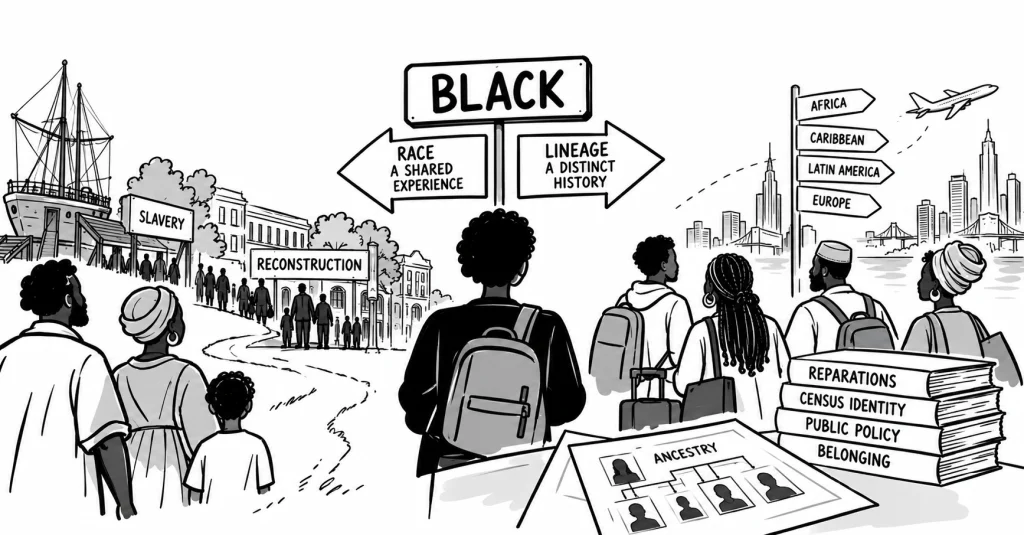
The push to identify descendants of people enslaved in the United States as a distinct Black American lineage is moving from social media into debates over reparations, Census identity and who public policy is intended to repair.
A growing number of Black Americans are making an argument that would have sounded unfamiliar in mainstream racial politics a generation ago: being Black describes race, but it does not necessarily describe lineage. Under labels including Foundational Black American, American Descendants of Slavery and Freedmen, advocates are pressing for clearer recognition of Black Americans whose families descend from people enslaved in the United States. The language varies and the organizations are not interchangeable, but the principle connecting much of what has become known as the delineation movement is relatively straightforward. Black Americans with multigenerational U.S. roots represent a specific ethnic and historical population whose claims, advocates argue, should not automatically be merged with those of every Black person living in the country.
The Black Population Has Become More Diverse
Demography helps explain why the conversation has become more visible. Black immigration has substantially changed the composition of Black America. Pew Research Center reported in March that immigrants now make up roughly one in 10 Black people in the United States. Earlier Pew research found that Black immigrants and their U.S.-born children together accounted for about 21% of the Black population, reflecting decades of migration from Africa and the Caribbean. Census data also shows how much diversity sits inside the broad racial category: among people who identified as Black in the 2020 Census, respondents reported identities including Black American, Jamaican, Haitian, Nigerian and Ethiopian.
SSC Premium · Free with signup
Keep reading. It’s free.
This is a Premium story from Social Storytellers Collective. Enter your email to unlock the rest right now, and get the End of Day Closing Note six nights a week. Already a subscriber? Use the same email and you’ll go straight back to the story.
Free. Unsubscribe anytime. Premium readers also hear first when The Deep View membership opens.