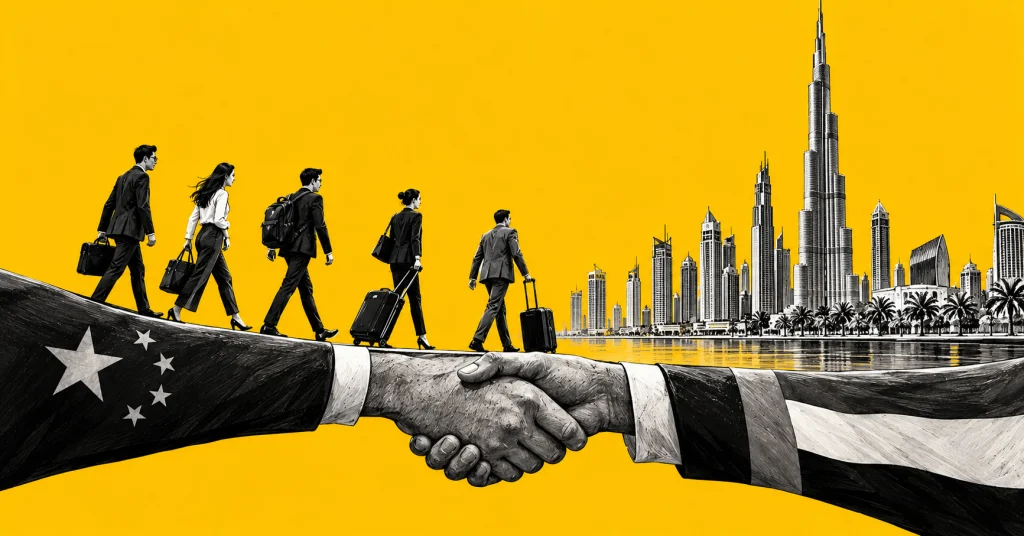
The emirate is recruiting Chinese technology companies, connecting foreign startups with capital and customers, and positioning itself between markets that are becoming harder to connect directly.
Dubai helped 485 digital startups during the first half of 2026, and more than half of them came from outside the emirate. Hind Aldah of Khaleej Times reported Thursday that 51% were international companies, while AI businesses represented 23% of the startups supported by the Dubai Chamber of Digital Economy. The total number of companies receiving support increased 57.5% from a year earlier.
The chamber is using that growth to pursue a particular role in the technology economy. Speaking at the Dubai Business Forum in Shenzhen, China, chamber vice president Saeed Al Gergawi encouraged Chinese companies in AI, robotics, smart hardware, cloud services, industrial automation, e-commerce and financial technology to establish operations in Dubai and use the emirate as a base for expansion into other markets.
The pitch is built around a problem technology companies encounter once they leave their home market. A good product does not provide local customers, regulatory knowledge, financing, distribution or political access. Those requirements have become more demanding as governments impose different rules on data, artificial intelligence, cloud infrastructure and advanced technology.
Dubai is trying to become the place where companies buy those connections.
The chamber’s Business in Dubai platform links companies with services and potential partners, while its broader startup programs connect businesses with customers, investors and strategic relationships. Al Gergawi told the Shenzhen forum that those networks can be as important to growth as the technology itself.
That model fits Dubai’s existing economy. The city has spent decades making itself useful to businesses and travelers whose final destination lies somewhere else. Its airport connects long-haul routes. Its ports move goods between manufacturers and consumers. Its free zones simplify regional operations for foreign companies. Financial and professional services help businesses navigate multiple jurisdictions.
Technology companies face a similar need for an intermediary as the global market becomes less uniform.
Chinese firms are a particularly important part of that opportunity. China has built powerful companies in AI, robotics, manufacturing, electric vehicles and consumer technology, but those businesses now face greater political scrutiny in parts of Europe and North America. At the same time, markets across the Gulf, Africa and South Asia are still looking for capital, digital infrastructure and new technology.
Dubai sits between those pressures. It can offer Chinese firms a commercially friendly base near several fast-growing regions while maintaining economic relationships with Western countries. The more difficult direct expansion becomes between major powers, the more valuable a jurisdiction can become by reducing some of the friction.
This form of technology power looks different from the American and Chinese models. The United States dominates major software platforms, venture capital and advanced computing. China combines manufacturing scale, hardware capacity and a huge domestic market. Dubai can gain influence without matching either country if it controls a useful part of the route between companies and customers.
Market access is where the power moves. A company may own the product and intellectual property, but the jurisdiction that can connect it with investors, regulators, customers and regional partners can shape how quickly that company expands and where it establishes its next operation.
Foreign-company growth also creates a risk for Dubai. High registration numbers do not automatically produce local technical expertise, durable jobs or homegrown companies. International firms can use a city as a convenient regional headquarters without transferring much knowledge or ownership to the people who live there.
The long-term test will be whether Dubai converts its intermediary role into local capability. Foreign companies would need to hire and train workers, establish meaningful operations, create supplier relationships and generate businesses that eventually grow from Dubai rather than merely through it.
Geopolitical fragmentation may give the emirate time to make that transition. Technology trade is becoming harder as countries build separate rules around data, chips, AI and security. Companies that once treated international expansion as a commercial decision increasingly have to navigate political boundaries as well.
If those boundaries continue multiplying, Dubai will have something valuable to sell even when it did not invent the technology itself. The emirate can become the place companies use to reach markets they can no longer enter as easily on their own.